

If you've ever watched a Korean drama, listened to K-pop, or chatted with Korean friends, you've probably heard someone exclaim "jinjja" (진짜) with dramatic flair. This seemingly simple word carries surprising depth and versatility in Korean communication.
Whether you're a K-pop fan wanting to understand your favorite idols better, a Korean language learner looking to sound more natural, or simply curious about Korean culture, mastering "jinjja" will instantly upgrade your Korean expression game.
In this comprehensive guide, we'll explore everything about "jinjja" — from its literal meaning to its cultural nuances, common variations, and practical usage tips that will help you use it like a native speaker.
What Is the Meaning of "Jinjja"?
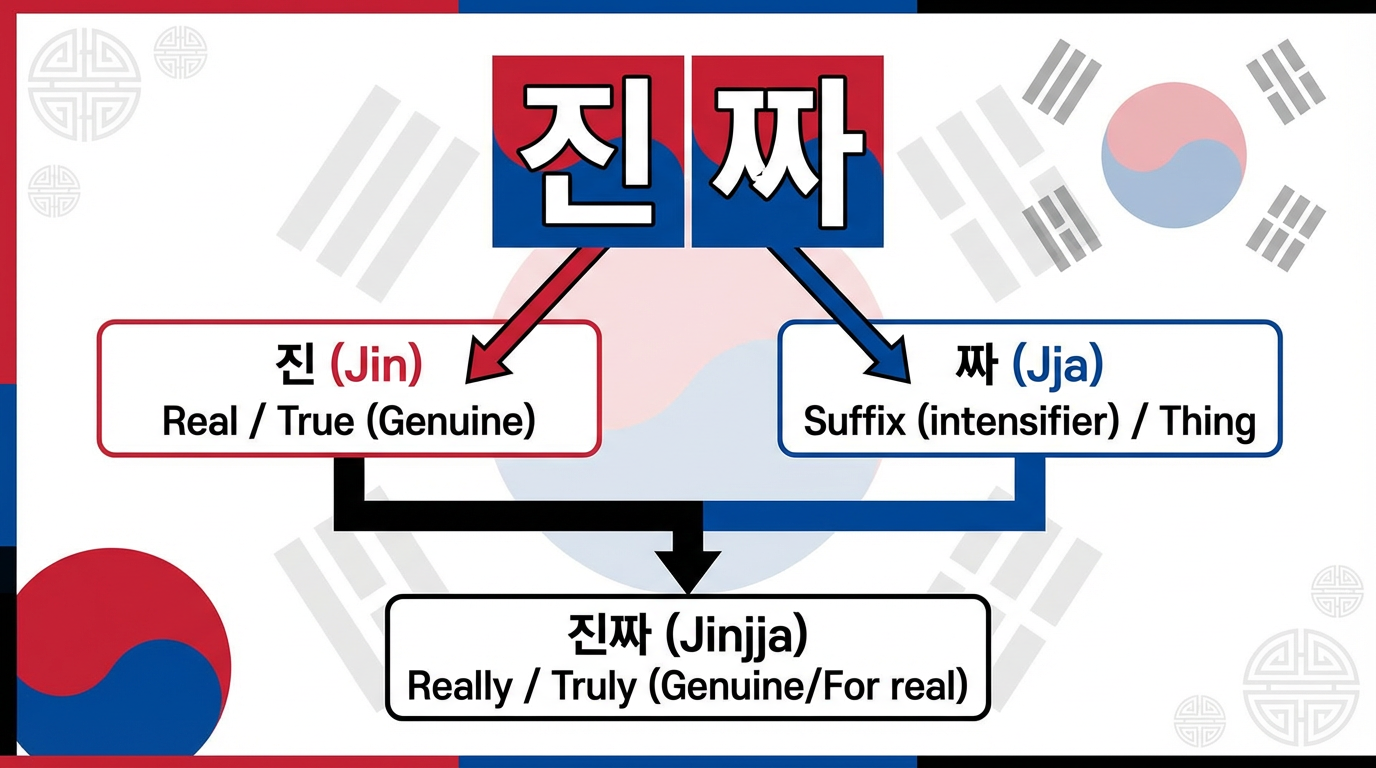
"Jinjja" (진짜) literally translates to "really" or "truly" in English. However, this translation barely scratches the surface of how Koreans actually use this word in daily conversation.
The Breakdown
Together, 진짜 essentially means "the real thing" or "genuinely." But in practice, it functions as a multi-purpose exclamation that expresses everything from surprise to disbelief to strong agreement.
6 Ways Koreans Use "Jinjja" in Daily Conversation
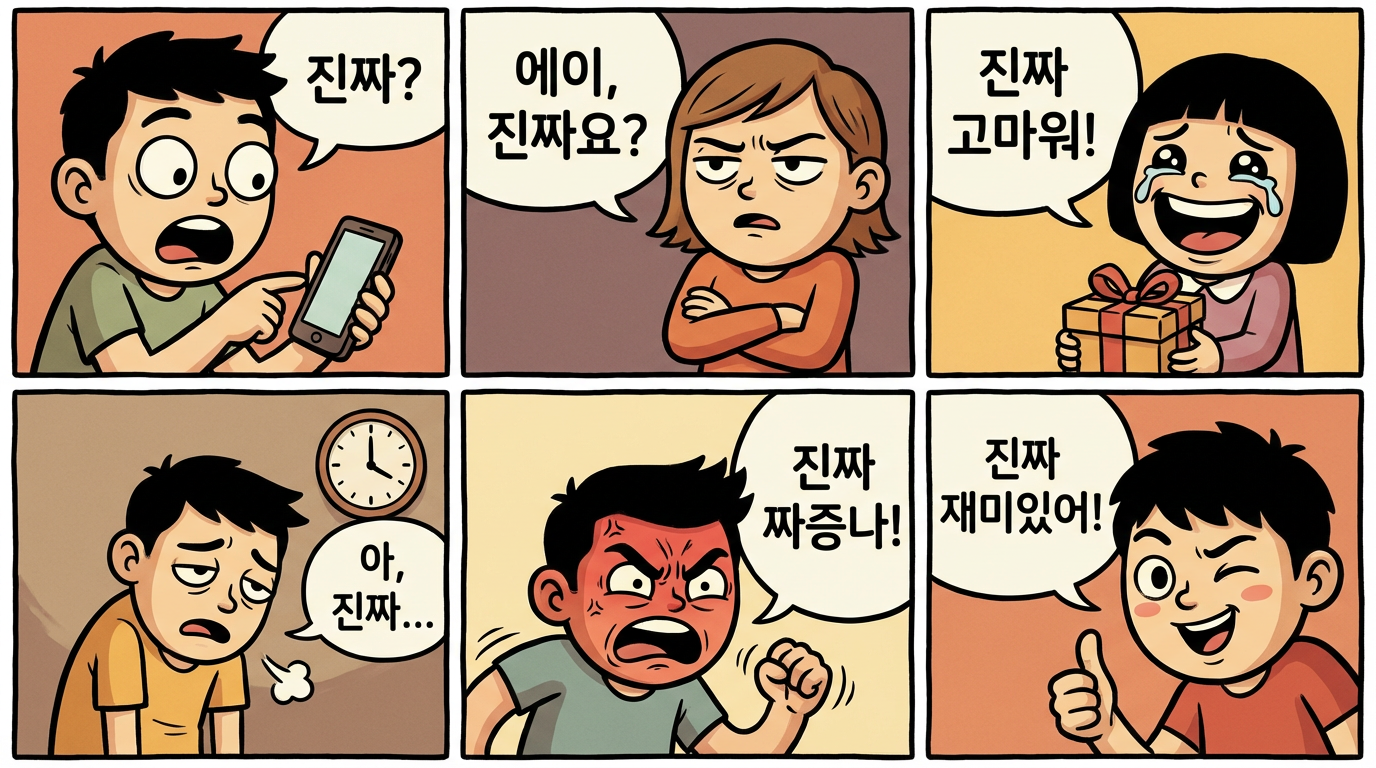
Understanding the context is key to using "jinjja" naturally. Here are the six most common ways Koreans employ this versatile word:
1. Expressing Surprise or Shock
When something unexpected happens, "jinjja" functions like "Really?" or "No way!" in English.
Example scenario:
Friend: "I just won tickets to the BTS concert!"
You: "Jinjja?!" (진짜?!) — Really?!
Korean dialogue example:
A: "어제 태형을 봤어!" (I saw Taehyung yesterday!)
B: "진짜?! 어디서?!" (Jinjja?! Where?!)
2. Emphasizing Truth or Authenticity
Use "jinjja" to stress that something is genuine or true — similar to saying "for real" or "seriously."
Example:
"이거 진짜 맛있어!" (This is really delicious!)
3. Expressing Disbelief or Skepticism
When delivered with a questioning tone or facial expression, "jinjja" can convey doubt — like "Are you serious?" or "You can't be serious."
Example:
Friend: "I can eat 10 bowls of ramen."
You: "Jinjja..." (with raised eyebrow) — Seriously...
4. Strong Agreement
"Jinjja" can also function as enthusiastic agreement, similar to "Absolutely!" or "That's so true!"
Example:
Friend: "This song is amazing!"
You: "Jinjja! 너무 좋아!" (Jinjja! It's so good!)
5. Asking for Confirmation
When you want to verify information, "jinjja" works like "Is that true?" or "For real?"
Example:
"진짜야?" (Jinjjaya?) — Is it true? / Are you serious?
6. Expressing Frustration
With the right intonation, "jinjja" can express exasperation — similar to "Oh, come on!" or "Are you kidding me?"
Example:
When someone cuts in line: "아 진짜..." (Ah jinjja...) — Oh, seriously...
Jinjja vs. Jinjja-ya: Understanding the Forms
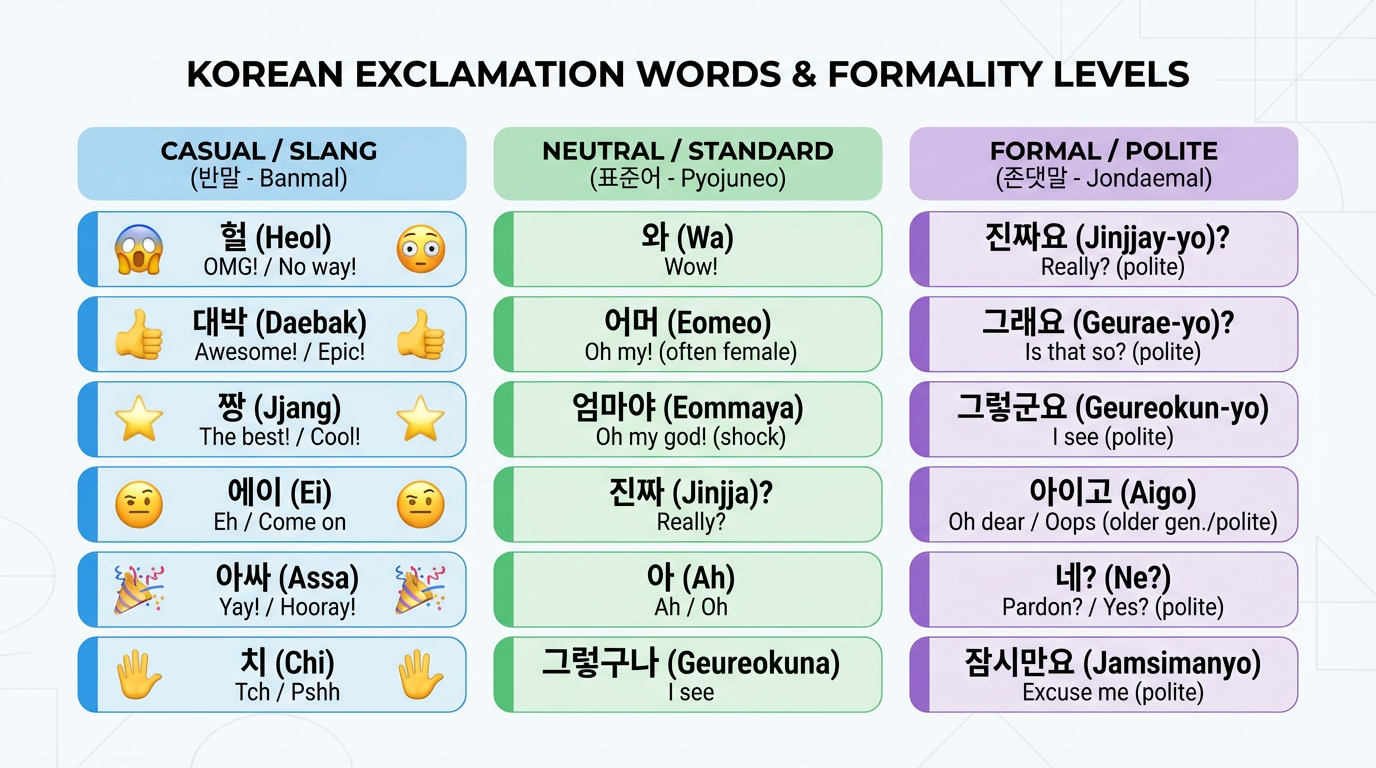
Korean is a language where grammar forms change based on formality and context. Here's how "jinjja" adapts:
Pro tip: When in doubt, stick with 진짜 (jinjja) — it's the most versatile and widely understood form.
Related Korean Exclamations You Should Know
"Jinjja" doesn't exist in isolation. Koreans often pair it with other expressions or use similar words depending on the situation:
Jinjja Variations
Similar Expressions
Dialogue example combining expressions:
A: "이 영화 진짜 재밌어!" (This movie is really fun!)
B: "정말? 나도 보고 싶다!" (Really? I want to watch it too!)
Jinjja in K-Pop and Korean Media
If you're a K-pop fan, you've definitely heard "jinjja" countless times. Here's why it's so prevalent in Korean entertainment:
Why K-Pop Idols Love "Jinjja"
Emotional expressiveness — It conveys genuine reactions during variety shows
Relatability — Using casual slang makes idols seem more approachable
Versatility — One word works for surprise, agreement, or disbelief
Famous "Jinjja" Moments in K-Pop
BTS: Frequently use "jinjja" in Run BTS episodes when surprised by game results
BLACKPINK: Often exclaim "jinjja" during fan meetings when moved by fan support
Korean variety shows: The word appears in almost every episode as cast members react to unexpected situations
Learning Korean Through K-Pop
Using K-pop content to learn "jinjja" and other slang is incredibly effective because:
You hear natural pronunciation and intonation
You see contextual usage in real conversations
Emotional moments create stronger memory retention
Try this: Watch your favorite K-pop variety show with Korean subtitles, and count how many times you hear "jinjja" — you'll be surprised!
Common Mistakes When Using "Jinjja"
Even though "jinjja" is relatively simple, learners often make these mistakes:
❌ Mistake 1: Overusing It
Problem: Using "jinjja" in every sentence sounds unnatural.
Solution: Reserve it for genuine emotional reactions or emphasis. Don't force it into every statement.
❌ Mistake 2: Wrong Intonation
Problem: Flat intonation makes "jinjja" sound robotic.
Solution: Practice the rising intonation for questions (진짜?) and falling intonation for statements (진짜).
❌ Mistake 3: Using It in Formal Settings
Problem: "Jinjja" is casual slang — inappropriate for business meetings or formal presentations.
Solution: Use 정말입니다 (jeongmal-imnida) or 사실입니다 (sasil-imnida) in formal contexts.
❌ Mistake 4: Confusing with Similar Words
Problem: Mixing up "jinjja" with "jeongmal" or other expressions.
Solution: Remember that "jinjja" is more casual and exclamatory, while "jeongmal" is slightly more neutral.
Practical Exercises to Master "Jinjja"
Exercise 1: Shadowing Practice
Listen to Korean dramas or variety shows and repeat "jinjja" exactly as you hear it, matching the intonation and emotion.
Exercise 2: Context Matching
Practice using "jinjja" in these scenarios:
Your friend tells you they met a celebrity
You taste incredibly delicious food
Someone shares unbelievable news
You want to strongly agree with a statement
Exercise 3: Create Your Own Dialogue
Write a short conversation between two friends using "jinjja" at least three times in different contexts.
Example:
A: "야, 내일 시험 없대!" (Hey, no exam tomorrow!)
B: "진짜? 다행이다!" (Jinjja? What a relief!)
A: "진짜로! 교수님이 말씀하셨어." (Jinjjaro! The professor said so.)
B: "와, 진짜 좋은 소식이네!" (Wow, jinjja good news!)
Expanding Your Korean Exclamation Vocabulary
Once you've mastered "jinjja," here are other essential Korean exclamations to add to your repertoire:
Pro tip: Combine expressions for extra emphasis! "진짜 대박" (jinjja daebak) means "really amazing" and is commonly used when something truly impressive happens.
How to Practice "Jinjja" with TalkMe
Want to practice using "jinjja" in real conversations? Here's how TalkMe can help:
AI Conversation Practice
Practice using "jinjja" in various contexts with TalkMe's AI conversation partners:
React to surprising news
Express strong agreement
Ask for confirmation naturally
Pronunciation Feedback
Get instant feedback on your "jinjja" pronunciation to ensure you're saying it with natural Korean intonation.
Contextual Learning
Learn when to use "jinjja" versus "jeongmal" or other alternatives through guided conversations that teach appropriate usage for different situations.
Ready to practice? Visit talkme.ai and start speaking Korean with confidence today!
FAQ About "Jinjja"
Is "jinjja" rude to use?
No, "jinjja" is not rude — it's casual and friendly. However, use more formal alternatives like "jeongmal" or "sasil" in professional or formal settings with elders or superiors.
Can I use "jinjja" in written Korean?
While "jinjja" appears in casual texting and social media, formal writing typically uses 정말 (jeongmal) or 실제로 (siljero).
What's the difference between "jinjja" and "jeongmal"?
Both mean "really," but jinjja is more casual and exclamatory, while jeongmal is slightly more neutral and versatile across formality levels.
How do I pronounce "jinjja" correctly?
Break it down: jin-jja (진-짜). The "jj" sound is a tense consonant — pronounce it with more tension in your tongue than the regular "j" sound.
Is "jinjja" used in North Korea too?
While North Koreans understand "jinjja," they more commonly use 정말 (jeongmal) or 참 (cham) in daily speech.
Can "jinjja" mean "authentic" or "genuine"?
Yes! In contexts like "진짜 가방" (jinjja gabang), it means "authentic bag" as opposed to a fake or replica.
Summary: Your "Jinjja" Cheat Sheet
Conclusion
"Jinjja" is more than just a Korean word for "really" — it's a versatile tool for expressing emotion, building rapport, and sounding more natural in Korean conversations. Whether you're reacting to K-pop news, chatting with Korean friends, or practicing your language skills, mastering "jinjja" will help you connect more authentically with Korean culture.
Remember: language learning is about communication, not perfection. Don't be afraid to use "jinjja" in your conversations — Koreans will appreciate your effort to engage with their language authentically!
Want to practice using "jinjja" and other Korean expressions with native-like feedback? Start your conversation practice at talkme.ai and take your Korean skills to the next level!
For more Korean language tips, K-pop vocabulary guides, and cultural insights, explore more articles on blog.talkme.ai.



Comments
No comments yet.
Leave a Comment