
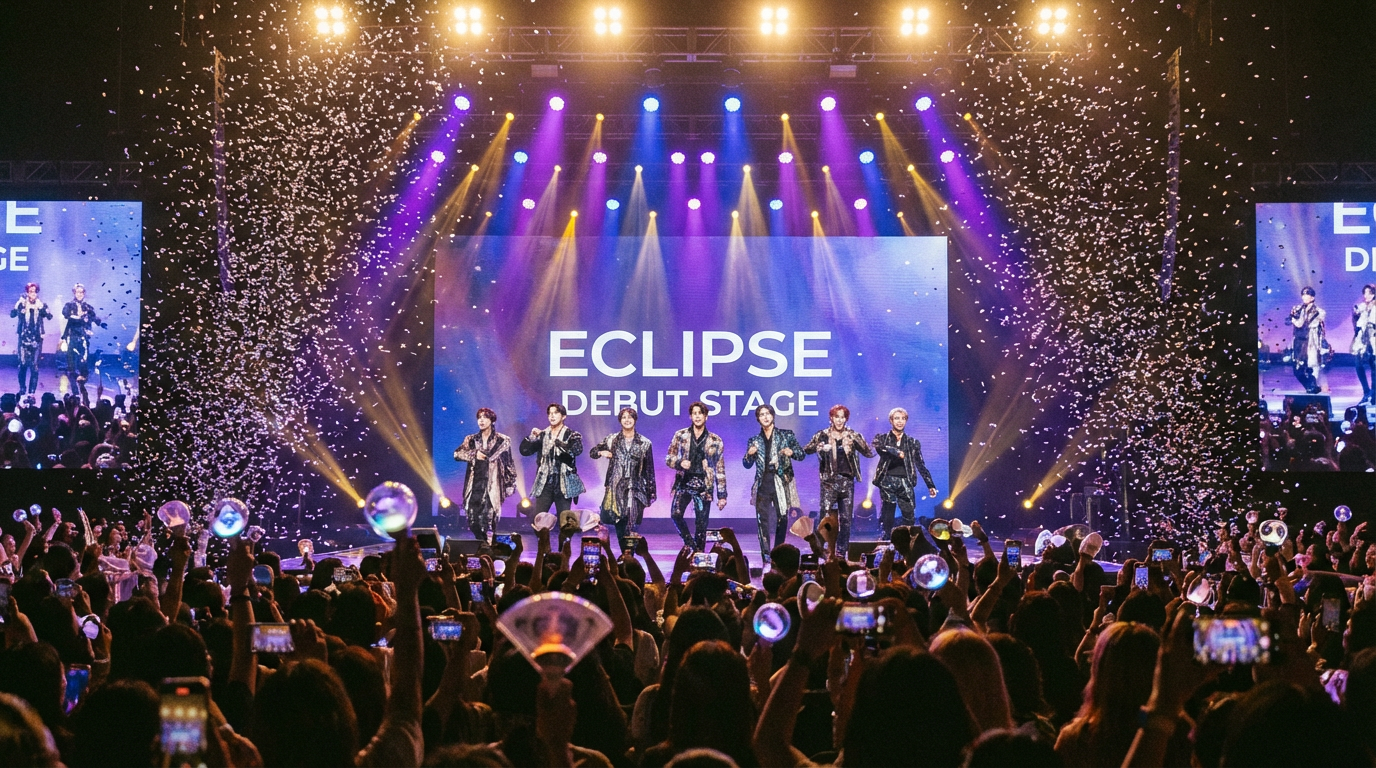
If you've spent any time in the K-pop fandom, you've definitely come across the word debut — and you've probably noticed it's used very differently from how we use it in everyday English. A simple word that usually means "a first public appearance" takes on an entire universe of meaning in K-pop culture.
Whether you're a new fan trying to decode fan conversations, or someone learning Korean through K-pop (a genuinely great strategy, by the way), this guide breaks down everything you need to know about what "debut" means in K-pop — and why it's so much more than just stepping onto a stage for the first time.
The Basic Definition: What Does Debut Mean in K-pop?
In standard English, "debut" refers to a person's first public performance or appearance in a professional context. In K-pop, the meaning is similar but carries far greater emotional and cultural weight.
A K-pop debut refers to the official first public release and performance of a new idol group or solo artist under a talent agency (also called an entertainment company or label). This marks the moment when trainees — who may have trained for years — are finally introduced to the public as a group or artist.
Think of it less like "showing up for the first time" and more like the culmination of years of work officially going public.
The Korean word: 데뷔 (debut, romanized as debyu)
Part of speech: Noun and verb
Used in a sentence: 그들은 올해 데뷔했어요. (They debuted this year.)
The K-pop Trainee System: Why Debut Is Such a Big Deal
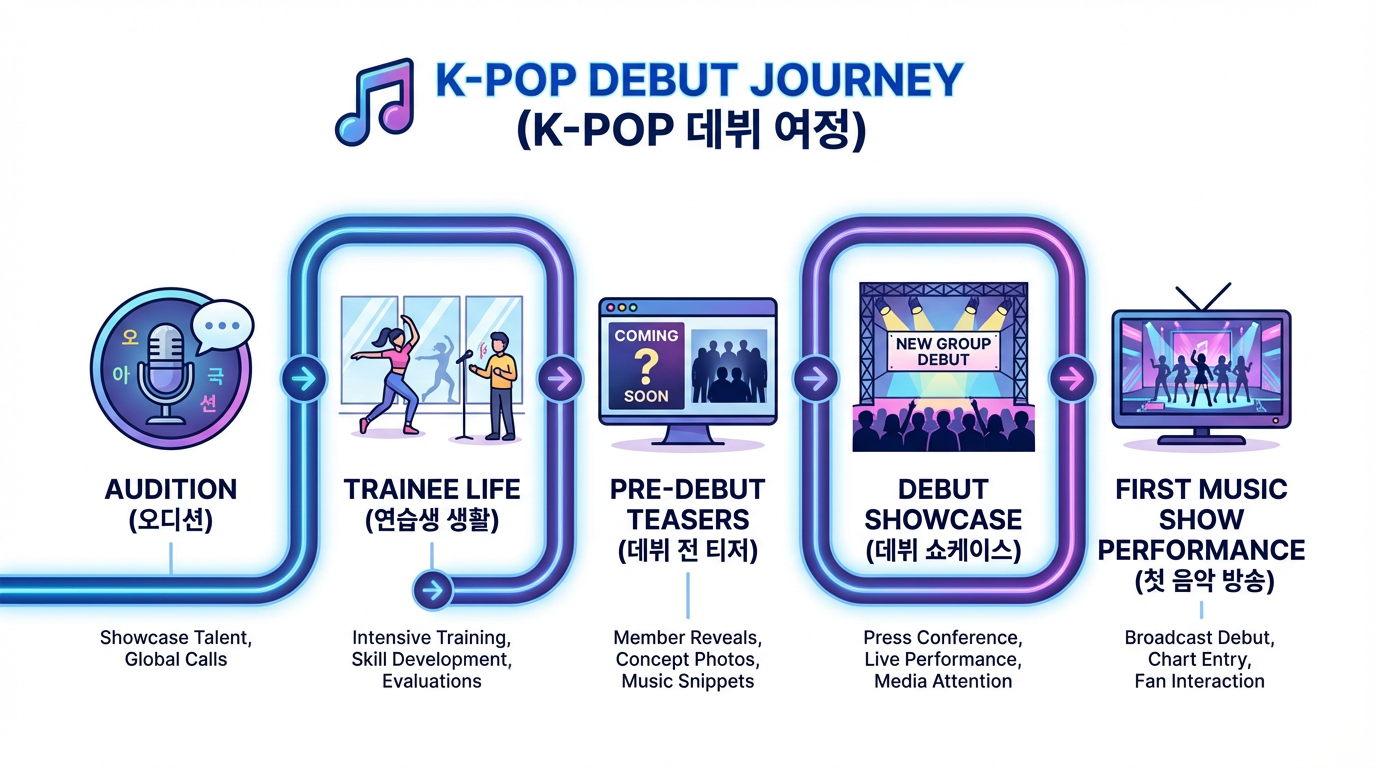
To truly understand why debut is such a loaded word in K-pop, you need to understand the trainee system that makes it possible.
Unlike Western pop music, where artists typically develop organically, K-pop is built on a highly structured system:
Audition — Young hopefuls (often as young as 12–16) audition to be accepted by entertainment companies like HYBE, SM Entertainment, YG Entertainment, or JYP Entertainment.
Trainee Life — Accepted trainees undergo intensive training in singing, dancing, rapping, foreign languages, stage presence, and sometimes acting. This can last anywhere from one to seven years — or more.
Evaluation Cuts — Trainees are regularly evaluated. Those who don't meet the standard may be cut at any point. Only the most talented and hardworking make it through.
Pre-Debut Activities — Some trainees participate in reality survival shows (like Produce 101 or Idol: The Coup) or release pre-debut content. This builds a fanbase before the official debut.
Debut — The official introduction to the world. This usually includes a debut album or single, a debut showcase, and performances on music shows.
This grueling path is why fans care so deeply about debuts. When a group debuts, it represents the survival of years of sacrifice — for both the artists and the dedicated fans who supported them through the trainee years.
Types of K-pop Debuts
Not all debuts are the same. Here are the main types you'll encounter as a K-pop fan:
1. Group Debut (그룹 데뷔)
The most common type. An entirely new idol group makes their official first appearance. Recent examples include NewJeans (2022), aespa (2020), and TOMORROW X TOGETHER (2019).
2. Solo Debut (솔로 데뷔)
A member of a group releases their first solo material. This is distinct from the group's debut. For example, BTS member Jin had his solo debut even though BTS had debuted years earlier.
3. Sub-unit Debut (유닛 데뷔)
Some members of a group form a smaller unit and debut as that sub-unit. Examples include EXO-CBX (a unit of EXO) and SEVENTEEN's multiple sub-units (Hip-Hop Unit, Vocal Unit, Performance Unit).
4. Acting/Variety Debut
While not strictly a music debut, K-pop idols often have separate "debuts" in acting or variety entertainment — their first drama, film, or regular variety show appearance.
5. Re-debut (재데뷔)
When a group disbands and members form a new group, or when an artist starts fresh under a new name or concept, this can be called a re-debut. This is different from a comeback (which we'll touch on below).
Debut vs. Comeback: What's the Difference?
This is one of the most commonly confused K-pop terms, especially for new fans. Here's the clear breakdown:
In Western music, "comeback" implies an artist was gone for a long time. In K-pop, every new release is a comeback — the word simply means returning to the public eye with new music, even if the group was only away for a few months.
So: A group can only debut once. But they can have many comebacks.
K-pop Debut Day: What Actually Happens?
Debut day in K-pop is a carefully orchestrated event. Here's what typically goes down:
Teaser Period (티저 기간)
Weeks or even months before the actual debut, the company releases teasers — member introduction photos, teaser videos, concept trailers. This builds anticipation and helps fans "get to know" the members before hearing the music.
Debut Showcase (데뷔 쇼케이스)
A debut showcase is a dedicated event where the group performs their debut songs for press and fans. They introduce themselves, share their journey, and often answer questions.
Music Show Performances (음악 방송 출연)
Korean music shows like Inkigayo (인기가요), Music Bank (뮤직뱅크), and M Countdown (엠카운트다운) are critical platforms. A debut performance on these shows is a major milestone — and fans work hard to ensure their new favorites get a successful first stage.
Fan Support (팬 서포트)
Dedicated fans organize mass streaming events, bulk album purchases, and even send food trucks (푸드트럭) to the company or recording studio to show support during the debut period.

"Debut" in Korean: Key Vocabulary for K-pop Fans Learning Korean
One of the best things about being a K-pop fan is how naturally it leads you into Korean language learning. The word "debut" is a perfect gateway to related vocabulary:
Core Debut Vocabulary
Sample Korean Sentences About Debut
이 그룹은 작년에 데뷔했어요.
(I geurubeun jangnyeon-e debyuhaesseoyo.)
"This group debuted last year."연습생 생활이 정말 힘들었어요.
(Yeonseubsaeng saenghwal-i jeongmal himdeureoeoyo.)
"The trainee life was really tough."데뷔 무대가 너무 멋있었어요!
(Debyu mudaega neomu meositeoeoyo!)
"The debut stage was so cool!"그 아이돌은 세 살 때부터 연습했대요.
(Geu aidol-eun se sal ttaebuteo yeonseuphaetdaeyo.)
"I heard that idol has been training since they were three years old."
Famous K-pop Debuts That Shook the Industry
Some debuts have become legendary in K-pop history, setting new standards for what a debut can look like:
BTS (방탄소년단) — 2013
Debuted under then-small agency Big Hit Entertainment with "No More Dream." Their debut was modest, but their trajectory changed K-pop history forever. Their story of fighting against industry giants with authentic storytelling became an inspiration for millions.
BLACKPINK (블랙핑크) — 2016
YG Entertainment's girl group broke records immediately after debut with "Whistle" and "Boombayah," becoming one of the fastest groups to achieve global recognition.
aespa (에스파) — 2020
SM Entertainment's metaverse concept group debuted with "Black Mamba" and introduced a groundbreaking digital avatar concept — each member has a virtual counterpart called an "æ."
NewJeans (뉴진스) — 2022
The HYBE sub-label ADOR's group set a new precedent for "quiet luxury" K-pop aesthetics, debuting with multiple singles and a refreshingly different visual approach.
Why Do K-pop Fans Care So Deeply About Debuts?
The emotional investment fans have in debuts is profound — and it makes sense once you understand the context:
1. They've watched the journey. Many fans follow trainees through survival shows or pre-debut social media for years. By debut day, they genuinely feel like they've grown alongside these artists.
2. The stakes are real. Not every trainee makes it to debut. The success of a debut can determine whether a group continues or disbands early.
3. First impressions matter in the K-pop ecosystem. A strong debut performance on music shows, high first-week album sales, and chart performance all feed into how the industry and media treat the group going forward.
4. Fans are co-creators of success. The K-pop fan culture (fandom, 팬덤) actively participates in debut success through streaming, voting, and fan projects. There's a sense of shared achievement.
Using K-pop Culture to Actually Learn Korean
If the vocabulary above got you interested in Korean, that's no accident — K-pop is genuinely one of the most effective and enjoyable ways to start learning Korean. Here's why:
Emotional connection boosts memory. You're far more likely to remember 데뷔 (debyu) after reading an emotional debut story than after drilling a vocabulary flashcard.
Cultural context gives language meaning. Words like 연습생 (yeonseubsaeng, trainee) aren't just vocabulary — they represent an entire cultural phenomenon you already care about.
K-pop content provides endless listening input. Music shows, behind-the-scenes content, fan meetings, and variety appearances are all authentic Korean audio/visual input.
If you want to take your K-pop Korean to the next level, platforms like TalkMe let you practice Korean conversations with an AI tutor that actually understands pop culture context. You can work on the pronunciation of words like 연습생 or 데뷔 무대 and get real-time feedback — much more effective than passive listening alone.
Check out the TalkMe blog for more guides on using K-pop, K-dramas, and Korean culture as a learning shortcut.

The Emotional Language of Debut Day
Debut day isn't just an industry event — it's deeply emotional. Here are some expressions you'll often see Korean fans use around debut:
These expressions are perfect examples of how emotional Korean is — and why learning it through K-pop context helps the words stick.
Debut Facts That Might Surprise You
The longest known K-pop trainee period before debut is estimated to be around 10 years for some members of certain groups.
Some global stars debuted very young: several current major idols started training as young as 11 or 12.
The word 데뷔 is a loanword from French (début) via English, reflecting how K-pop blends global influences into Korean culture.
Some groups hold "debut anniversaries" (데뷔 기념일) every year — celebrated by fans with special projects, trending hashtags, and fan letters.
Frequently Asked Questions (FAQ)
Q: Can an artist debut more than once?
A: In a sense, yes. An artist can debut as a group member and later have a solo debut — these are counted as separate debuts. If a group disbands and members form an entirely new group, that new group has its own debut. However, the original group's debut only happens once.
Q: What's the difference between a debut stage and a debut showcase?
A: A debut showcase (데뷔 쇼케이스) is a dedicated event, usually for press and invited fans, where the group introduces themselves and performs. A debut stage (데뷔 무대) usually refers specifically to their first performance on a live music show (like Inkigayo or Music Bank), which reaches a broadcast audience.
Q: Why do some groups wait years before debuting even after they're announced?
A: Companies carefully time debuts based on market conditions, group readiness, concept development, and scheduling. A well-timed debut in a competitive market can make all the difference. Some groups also face delays due to member changes (if a trainee is cut or leaves before debut).
Q: What happens if a K-pop group fails after debut?
A: Unfortunately, many groups don't achieve commercial success. Companies may reduce promotions, and some groups disband within one to two years of debut. This makes the fandom's early support crucial — and it's why streaming parties and "first week" album sales campaigns are so common.
Q: Is 데뷔 pronounced "debyu" or "debut" in Korean?
A: In Korean, it's pronounced closer to "debyu" (데뷔) — not "deh-byoo" or "deh-boo." The 뷔 syllable sounds like a soft "byoo" or "bwi." Native Korean pronunciation tends to adapt foreign loanwords to Korean phonology, which is one of the fun parts of learning Korean through K-pop!
Q: How do I say "I've been waiting for your debut" in Korean?
A: You can say: 데뷔를 기다리고 있었어요! (Debyureul gidarigo isseosseoyo!) — a sentence K-pop fans actually use on debut day social posts.
Conclusion
In K-pop, "debut" is more than a first appearance — it's the finish line of a grueling race, the beginning of a new dream, and the moment an artist's relationship with the world begins. For fans, it's a shared milestone as emotionally charged as a graduation or a wedding.
Understanding this word — and the culture behind it — opens a door into Korean language and K-pop culture simultaneously. The vocabulary around debut (데뷔, 연습생, 소속사, 데뷔 무대) is practical Korean you'll encounter constantly in fandom spaces, music show broadcasts, and idol interviews.
Whether you're just starting to fall into the K-pop rabbit hole or you're a seasoned stan trying to refine your Korean, keep learning. The language gets richer the deeper you go.
다음 데뷔를 함께 기다려요! 🎤
(Let's wait together for the next debut!)
Want to practice the Korean words from this article out loud? Head to talkme.ai and start a conversation — K-pop vocab included. For more K-pop language guides, visit blog.talkme.ai.




Comments
No comments yet.
Leave a Comment