

Introduction: Why Speaking Remains the Hardest Skill
You've memorized thousands of vocabulary words. You can read English news articles without breaking a sweat. Your grammar exercises come back with near-perfect scores. But the moment someone asks you a simple question in English—"How was your weekend?"—your mind goes completely blank.
If this sounds familiar, take a deep breath. You are not broken. You are not "bad at languages." You are experiencing one of the most common—and most solvable—challenges in language learning: the gap between passive knowledge and active speaking ability.
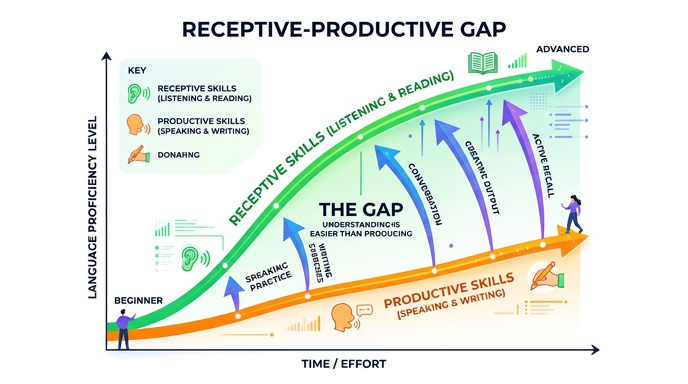
Linguists call this the "receptive-productive gap." It's the distance between what you can understand and what you can produce in real time. For most learners, the receptive side (reading and listening) develops much faster than the productive side (speaking and writing). The gap is natural. The frustration is real. But the solution is within reach.
In this guide, we're going to explore why speaking English feels so difficult, what science tells us about building oral fluency, and—most importantly—what you can start doing today to finally break through the speaking barrier. We'll cover traditional methods that have stood the test of time, cutting-edge tools that are reshaping language learning in 2026, and the often-overlooked psychological side of speaking a foreign language.
Let's begin.
Part 1: Understanding Why Speaking Is Different
The Biology of Speaking
Speaking a language is fundamentally different from reading or listening to it. When you read, you have time. You can pause, re-read, look up words. Your brain processes written language through established visual pathways that you've been strengthening since childhood—even in your native language.
Speaking is different. Speaking requires your brain to execute an astonishingly complex sequence of operations in milliseconds: conceptualize an idea → select appropriate words → arrange them grammatically → coordinate your tongue, lips, jaw, and vocal cords → monitor your own output → adjust based on the listener's reaction. All of this happens while you're simultaneously listening and planning your next sentence.
No wonder it feels hard. It is hard. Your brain is running a linguistic marathon at sprint speed.
The Affective Filter Hypothesis
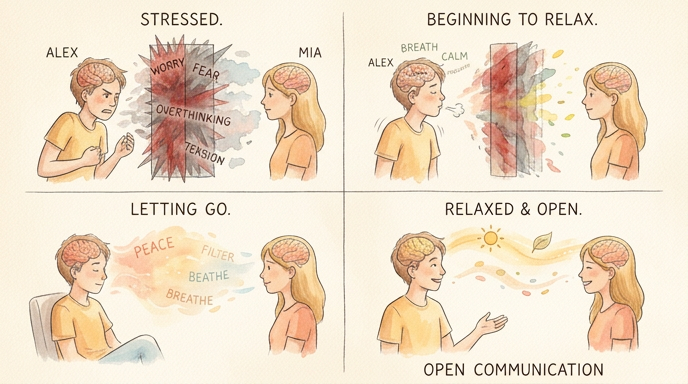
In the 1980s, linguist Stephen Krashen proposed the "Affective Filter Hypothesis," which remains one of the most influential ideas in language acquisition theory. The concept is simple but profound: negative emotions—anxiety, self-consciousness, fear of embarrassment—act as a filter that blocks language input from reaching the parts of your brain responsible for acquisition.
When your affective filter is high, even excellent input can't get through. When it's low, acquisition happens naturally.
This explains why you might speak fluently with a close friend but freeze up in a classroom or professional setting. It's not that your English suddenly disappeared—it's that your affective filter shot up and blocked access to the knowledge you already have.
Understanding this is the first step toward fixing it.
The Input Hypothesis and the Output Gap
Krashen also argued that we acquire language through "comprehensible input"—hearing and reading language that is slightly above our current level. This remains largely true, and it's why immersion works so well. But there's a nuance that many learners miss: input alone is not enough for speaking.
Think about it. You've likely consumed hundreds or thousands of hours of English content—movies, podcasts, YouTube videos, music. Your listening comprehension is probably quite strong. But how much of that time have you spent actually producing spoken English?
For most learners, the input-to-output ratio is heavily skewed. They might spend 95% of their English time consuming and only 5% producing. Reversing this ratio—or at least bringing it closer to balance—is one of the most powerful changes you can make.
Part 2: The Building Blocks of Speaking Fluency
Pronunciation: The Foundation You Can't Skip
Many learners skip pronunciation work because it feels tedious or embarrassing. This is a mistake. Poor pronunciation isn't just a cosmetic issue—it actively undermines your confidence and can lead to communication breakdowns that reinforce speaking anxiety.
The good news is that pronunciation is a physical skill. Like learning a sport or a musical instrument, it improves with targeted, deliberate practice. Here's where to start:
Master the sounds that don't exist in your native language. Every language has a unique set of phonemes. English has sounds like the "th" in "think" and "this," the "r" sound that varies dramatically across accents, and vowel distinctions that many languages don't make. Identify the 3-5 English sounds that are hardest for speakers of your native language and drill them specifically.
Learn the rhythm of English. English is a stress-timed language, which means stressed syllables occur at roughly regular intervals, and unstressed syllables get compressed between them. This is very different from syllable-timed languages like Spanish or Japanese. Getting the rhythm right often matters more for intelligibility than getting individual sounds perfect.
Record yourself and listen back. Yes, it's uncomfortable. Yes, it works. Hearing your own voice reveals pronunciation patterns that you simply can't hear while you're speaking.
Tools like TalkMe (available at talkme.ai) have transformed pronunciation practice in recent years. Rather than generic pronunciation exercises, AI-powered platforms can now listen to your speech, identify specific pronunciation issues, and give you targeted feedback in real time. This kind of immediate, personalized correction was once only available through expensive one-on-one tutoring. Now it's accessible on your phone, whenever you have a few spare minutes. For more detailed guidance and pronunciation strategies, check out the resources at blog.talkme.ai.
Vocabulary Activation: From Recognition to Production
You likely already know thousands of English words. The problem is that most of them live in your "passive" vocabulary—you recognize them when you see or hear them, but they don't come to mind when you're speaking.
Turning passive vocabulary into active vocabulary is one of the highest-ROI activities for improving speaking fluency. Here's how:
The "Word of the Day" speaking method. Pick one word or phrase each day that you already understand but rarely use. Your mission: use it at least five times in conversation that day. It doesn't have to be natural at first. Force it a little. The repetition builds the neural pathway from recognition to production.
Topic-based vocabulary activation. Instead of learning random word lists, organize vocabulary around topics you actually discuss. If you're a software engineer, build active vocabulary around technical discussions, meetings, and casual office talk. If you're a traveler, focus on directions, food ordering, and small talk. Speak about these topics deliberately, forcing yourself to use topic-relevant vocabulary.
Paraphrasing practice. Take a short English text—a news paragraph, a blog post, anything—read it, then close it and explain the content aloud in your own words. This forces your brain to retrieve vocabulary and construct sentences in real time, exactly what you need for spontaneous conversation.
Grammar in Speech: Accuracy vs. Fluency
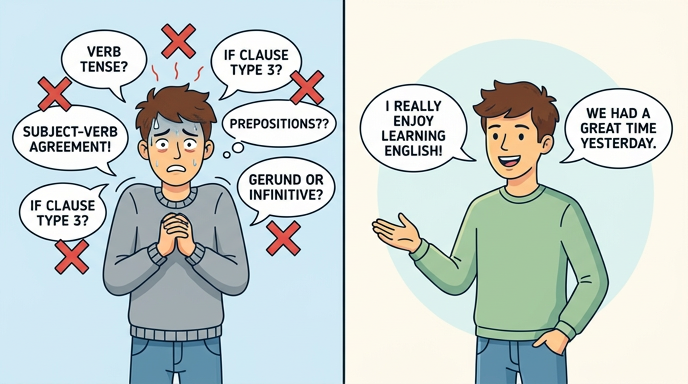
One of the biggest traps in speaking practice is the pursuit of perfect grammar. Learners who try to produce grammatically flawless sentences in real time inevitably speak slowly, hesitantly, and—ironically—less naturally.
Native speakers make grammatical "errors" constantly. They start sentences and change direction mid-way. They use fragments. They say "who" when prescriptive grammar demands "whom." And yet nobody doubts their fluency.
The goal in speaking should be communicative competence, not grammatical perfection. This doesn't mean grammar doesn't matter—it does. But the priority is getting your meaning across clearly and naturally. Grammar accuracy improves over time through exposure and practice, not through self-monitoring during conversation.
A practical approach: accept that you'll make grammar mistakes while speaking. Note recurring errors that actually interfere with communication. Work on those specifically. Let the rest go.
Part 3: Proven Methods That Actually Work
Shadowing: The Underrated Power Tool
Shadowing is a technique borrowed from interpreter training, and it's one of the most efficient ways to improve both pronunciation and fluency simultaneously. Here's how to do it properly:
Find audio of a native English speaker—a podcast, a TED talk, a YouTube video. Choose content at or slightly above your level.
Listen to a short segment (10-20 seconds) to understand the content.
Play it again, but this time speak along with the audio, matching the speaker's pace, intonation, and rhythm as closely as possible. Try to become their "shadow."
Gradually increase the segment length as you improve.
The key to effective shadowing is not to pause the audio. Keep speaking even if you stumble. The goal is to train your mouth and brain to process English at natural speed. Start with just 5-10 minutes daily—consistency matters far more than session length.
Shadowing works because it engages multiple learning systems simultaneously: you're listening, processing meaning, coordinating speech muscles, and internalizing the natural rhythm of English. It's a full-brain workout for speaking.
The 4-3-2 Fluency Drill
Developed by applied linguist Paul Nation, the 4-3-2 drill is deceptively simple and remarkably effective:
Choose a topic you can talk about for a few minutes—your job, a hobby, a recent experience.
Speak about it for 4 minutes. Record yourself if possible.
Then, speak about the same topic for 3 minutes. Cover the same content but more efficiently.
Finally, speak about it for 2 minutes. Deliver the essential points clearly and concisely.
What happens is fascinating: as the time pressure increases, your brain stops translating from your native language and starts thinking directly in English. Your speech becomes more automatic and fluent. The repetition also strengthens the neural pathways for the vocabulary and structures you're using.
Do this drill 2-3 times per week with different topics. You'll notice the improvement within a month.
Self-Talk: Your Always-Available Practice Partner
Self-talk gets a bad reputation. People worry it looks strange or feels artificial. But here's the truth: self-talk is one of the most practical, accessible speaking practice methods available, and it's used by language learners at every level—including professional interpreters preparing for assignments.
The key is to make it structured and intentional:
Narrative self-talk: Describe what you're doing as you do it. "I'm making coffee. First, I need to grind the beans. I prefer a medium grind for my French press. Now I'm heating the water to about 200 degrees Fahrenheit..."
Reflective self-talk: At the end of the day, spend 5 minutes summarizing your day aloud in English. What happened? How did you feel about it? What are you planning for tomorrow?
Opinion self-talk: Pick a topic from the news and express your opinion aloud for 3 minutes. Argue both sides if you can. This builds the kind of discursive speaking skills needed for professional and academic contexts.
Problem-solving self-talk: Talk through a problem you're facing. This dual-tasks your brain—solving the problem while practicing English—which actually mirrors real-world speaking situations where you're thinking and speaking simultaneously.
Part 4: Technology and Tools for Speaking Practice in 2026
The AI Revolution in Language Learning
If you haven't explored the latest generation of AI-powered language tools, you're missing out on one of the biggest advances in self-directed language learning. AI speaking practice has moved far beyond simple speech recognition and canned responses. Modern platforms offer genuinely conversational experiences with contextual feedback.
TalkMe (talkme.ai) exemplifies what's now possible. Instead of rehearsing scripted dialogues, you can have open-ended conversations with an AI tutor that responds naturally to what you say, corrects your pronunciation in real time, and adapts to your level. The experience is remarkably close to speaking with a human tutor—but available 24/7, infinitely patient, and significantly more affordable.
What makes AI speaking practice particularly valuable is the removal of social anxiety. Many learners report that they feel more comfortable making mistakes with an AI than with a human conversation partner. This lowers the affective filter we discussed earlier, allowing for more practice volume and faster improvement. Once confidence is built with AI practice, transitioning to human conversations becomes much easier.
For structured learning paths, speaking tips, and in-depth guides on maximizing your practice sessions, visit the TalkMe blog at blog.talkme.ai. The blog covers everything from pronunciation drills to confidence-building strategies, all designed to complement hands-on speaking practice.
Language Exchange Platforms: The Human Element
AI tools are powerful, but they don't fully replace human interaction. Language exchange platforms connect you with native English speakers who want to learn your language, creating a mutually beneficial practice arrangement.
HelloTalk and Tandem remain popular options in 2026, offering text, voice, and video exchange features. Speaky and Conversation Exchange provide similar services with different community vibes. Each platform has its strengths, and many learners use multiple platforms to maximize practice opportunities.
The key to successful language exchange is structure. Don't just say "let's chat." Set a topic in advance. Prepare some questions. Consider using a shared article or video as a conversation starter. The more structure you bring, the more productive the session will be.
Speech Recognition and Feedback Tools
Beyond full conversation AI, there are specialized tools worth knowing about:
ELSA Speak focuses specifically on pronunciation, using speech recognition to identify exactly which sounds you're struggling with and providing targeted exercises. It's particularly strong for addressing accent-related pronunciation challenges.
Google's Read Along (originally Bolo) was designed for children but works well for adult learners too. It listens as you read aloud and provides real-time feedback, gamifying the pronunciation practice experience.
Speechling combines speech recognition with human coach feedback. You record yourself speaking, and a real human coach provides personalized pronunciation corrections within 24 hours. The blend of technology and human input makes it uniquely effective.
Each of these tools addresses a different aspect of speaking. Using them in combination—AI conversation practice for fluency, pronunciation tools for accuracy, and language exchange for real human interaction—creates a comprehensive speaking development system.
Immersive Media as a Speaking Tool
We often think of movies, TV shows, and podcasts as listening practice, but they can be powerful speaking tools with the right approach:
The "pause and respond" technique: Watch a TV show or movie with natural dialogue (sitcoms work particularly well). When one character finishes speaking, pause the video and respond as if you were the other character. This mimics the turn-taking rhythm of real conversation.
The "retell the scene" technique: After watching a scene, pause and retell what just happened aloud, in your own words. This combines comprehension with speaking production.
Podcast shadowing: With conversational podcasts featuring multiple speakers, try shadowing one particular speaker throughout the episode. This exposes you to that person's unique speech patterns, vocabulary, and rhythm.

Part 5: The Psychology of Confident Speaking
Reframing Mistakes
The fear of making mistakes is probably the single biggest barrier to speaking progress. Let's reframe how we think about errors.
Mistakes are not failures. They are data. Every mistake tells you something specific about what your brain hasn't fully internalized yet. A pronunciation error? Your mouth needs more practice forming that sound. A grammar slip? You probably know the rule consciously but haven't automated it yet. A vocabulary gap? You've just identified a word worth learning actively.
When you shift from "I made a mistake, I'm bad at English" to "I made a mistake, that's useful information about what to practice next," everything changes. The emotional sting disappears. Practice becomes exploration rather than performance.
The 80% Rule
Perfectionism is the enemy of fluency. If you wait until you can produce a perfect sentence before speaking, you'll never speak. Instead, adopt what I call the "80% rule": if you're about 80% confident that you can express your idea (even imperfectly), go ahead and speak. The remaining 20% will sort itself out through context, gestures, rephrasing, or simply learning from what comes out of your mouth.
Native speakers do this constantly. They start sentences without knowing exactly how they'll end. They rephrase mid-stream. They use filler words while their brain catches up. None of this is a sign of poor language skills—it's how real spoken communication works in any language.
Building a Speaking Habit
Motivation is unreliable. Habits are not. The learners who make the fastest progress aren't necessarily the most talented or the most motivated—they're the ones who build speaking practice into their daily routine so it happens automatically, regardless of how they feel.
Here's a minimal viable speaking habit:
5 minutes of shadowing while your coffee brews in the morning
2 minutes of self-talk during your commute (narrate what you see, plan your day)
10 minutes of AI conversation practice with TalkMe before bed, when your affective filter is naturally lower
That's 17 minutes a day. It's not a huge time commitment, but done consistently, it adds up to over 100 hours of speaking practice per year—more than most learners get in a lifetime of traditional study.
Managing Speaking Anxiety in High-Stakes Situations
Job interviews, presentations, important meetings—these situations trigger speaking anxiety even in native speakers. For English learners, the pressure is amplified. Here are strategies that help:
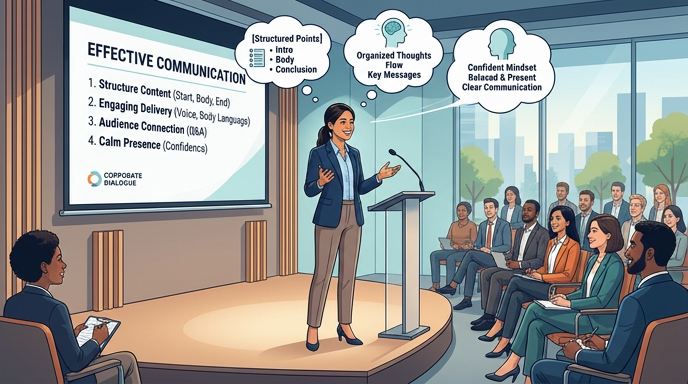
Prepare, don't script. Memorizing a script is risky because if you forget one line, the whole structure collapses. Instead, prepare talking points—key ideas you want to convey, with relevant vocabulary and phrases noted. This gives you structure without locking you into exact wording.
Warm up your English brain. Spend 10-15 minutes speaking English before the high-stakes event. Call a friend, do a quick TalkMe session, or even just talk to yourself. This activates your English neural networks and reduces the "cold start" problem where your first few minutes of English for the day are particularly rough.
Use the physiological sigh. When anxiety spikes, your body enters fight-or-flight mode. The physiological sigh—two quick inhales through the nose followed by a long exhale through the mouth—activates your parasympathetic nervous system and calms you down within 30-60 seconds. It's a free, invisible tool you can use anywhere.
Focus on the message, not the medium. Your listener almost certainly cares more about what you're saying than how perfectly you're saying it. Shift your attention from "Am I speaking correctly?" to "Am I communicating my point clearly?" This external focus reduces self-monitoring and actually improves fluency.
Part 6: Common Mistakes and How to Avoid Them
Mistake #1: Translating in Your Head
Translation is a crutch that feels helpful but ultimately limits your fluency ceiling. The processing delay between hearing English → translating to your native language → formulating a response → translating back to English is simply too slow for natural conversation.
The solution isn't to "stop translating" (you can't just will it away). It's to build direct English-to-meaning connections through massive comprehensible input and output practice. The translation habit fades naturally as your brain builds stronger direct pathways.
A practical step: when you learn new vocabulary, avoid translation pairs. Instead, learn words through context, images, and definitions in English. Your brain will form direct concept-word connections rather than word-translation-word chains.
Mistake #2: Practicing Only When You "Feel Ready"
If you wait until you feel confident to start speaking, you'll wait forever. Confidence doesn't precede competence—it follows it. You build confidence by speaking, not the other way around.
Start messy. Start with simple sentences. Start with mistakes. The volume of practice matters far more than the quality of any individual sentence. Every minute of speaking, however imperfect, is strengthening neural pathways and building the automaticity that underlies fluency.
Mistake #3: Neglecting Listening
Speaking and listening are two sides of the same coin. Strong listening skills provide the input your brain needs to internalize natural speech patterns, vocabulary in context, and conversational rhythms. Learners who focus exclusively on speaking while neglecting listening often develop awkward, unnatural-sounding speech.
The fix is simple: maintain a balanced diet of English input. Podcasts during commutes. YouTube videos during meals. Audiobooks before bed. The more natural English you absorb, the more natural your output becomes.
Mistake #4: Comparing Your Speaking to Your Native Language Self
You are not the same person in English that you are in your native language—and that's okay. In your native language, you have a lifetime of practice, a vocabulary of tens of thousands of words, and intuitive mastery of cultural nuance. Expecting your English self to match that is unrealistic and demoralizing.
Judge your English speaking against your past English speaking, not against your native-language abilities. Celebrate that you can now express an opinion in 30 seconds that used to take you 2 minutes. Notice that you're using more connectors and transitions naturally. Appreciate that you made a joke and someone laughed. These are the metrics that matter.
Mistake #5: Inconsistency
The most common pattern in language learning: intense study for two weeks, then nothing for two months, then another burst of motivation. This approach is nearly useless for building speaking fluency. Speaking is a skill that improves through consistent, moderate practice—like physical fitness. You can't "cram" for fluency.
A 15-minute daily practice habit will produce dramatically better results than 3-hour weekend marathons followed by week-long gaps. Consistency trumps intensity every time.
Part 7: Creating Your Personal Speaking Improvement Plan
Let's turn everything we've covered into a concrete, personalized action plan. The best plan is the one you'll actually follow, so be honest with yourself about your schedule, energy levels, and preferences.
Step 1: Assess Your Starting Point
Record yourself speaking for 3 minutes on a familiar topic. Save this recording. It's your baseline. You'll compare against it in 30, 60, and 90 days. Don't judge the recording—it's data, not a performance evaluation.
Step 2: Set Process Goals, Not Outcome Goals
Bad goal: "I want to speak English fluently." (Too vague, no clear path.)
Good goal: "I will do 15 minutes of speaking practice every day for the next 30 days." (Specific, measurable, within your control.)
Process goals focus on actions you can take, not outcomes you can't directly control. Fluency is the natural byproduct of consistent process.
Step 3: Design Your Daily Speaking Routine
Here's a template. Customize it based on your schedule and preferences:
Morning (5 min): Shadow a short podcast or YouTube clip
Commute/break (10 min): Self-talk—narrate your surroundings, plan your day, or reflect on a topic
Evening (15 min): AI conversation practice with TalkMe (talkme.ai) on a rotating topic
Weekly (30 min): Language exchange session with a native speaker, or an extended guided practice session using resources from blog.talkme.ai
Total: roughly 30 minutes daily, with one longer session per week.
Step 4: Track and Adjust
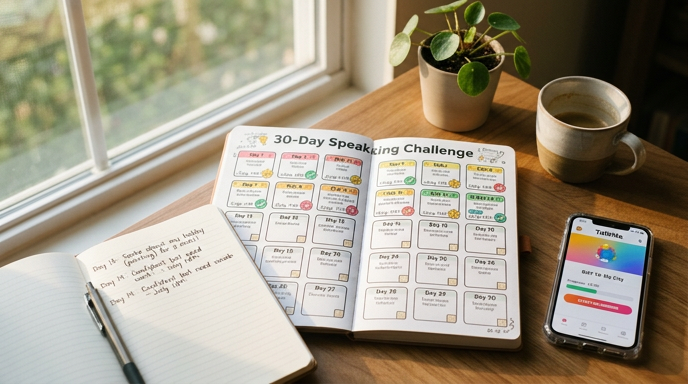
Keep a simple log. Each day, note what speaking practice you did and one thing you noticed—a word you used successfully, a pronunciation that improved, a moment of unexpected fluency. This builds awareness and motivation.
Every two weeks, review your log and adjust. If shadowing feels tedious, try the 4-3-2 drill instead. If evening practice consistently doesn't happen, move it to lunchtime. The plan should evolve with you.
Step 5: Celebrate Progress
Language learning is a long game. Without milestones and celebrations along the way, motivation erodes. Did you speak English for 10 minutes straight without freezing? Celebrate that. Did someone understand your joke? Celebrate that. Did you successfully use a word you learned last week? Celebrate that.
These small wins compound. They're the fuel that keeps you going through the inevitable plateaus and frustrations.
Conclusion: Your Speaking Journey Starts Now
Improving your English speaking skills is not a mystery. It's not a talent reserved for the genetically gifted. It's a systematic process of consistent practice, strategic use of effective tools, and gradual expansion of your comfort zone.
The tools available in 2026—from AI conversation partners like TalkMe to global language exchange communities—have made speaking practice more accessible than ever before. The barrier is no longer access. The barrier is action.
Start today. Five minutes of shadowing. A quick self-talk session while you make dinner. An evening conversation with an AI tutor who will never judge you, never get tired, and always meet you exactly where you are. Visit talkme.ai to explore how AI-powered speaking practice can accelerate your progress, and check out blog.talkme.ai for deeper dives into specific techniques and strategies.
Your future fluent self is not a different person. It's you—with more practice, more confidence, and more miles on the speaking odometer. Every word you speak today is a deposit into that future.
Now close this guide and speak something—anything—in English. The journey from hesitant learner to confident speaker is made one sentence at a time. Your next sentence starts now.
This guide was created by the TalkMe content team. For more language learning resources, speaking tips, and in-depth guides, visit blog.talkme.ai. Ready to practice? Start your free speaking session at talkme.ai.



Comments
No comments yet.
Leave a Comment