
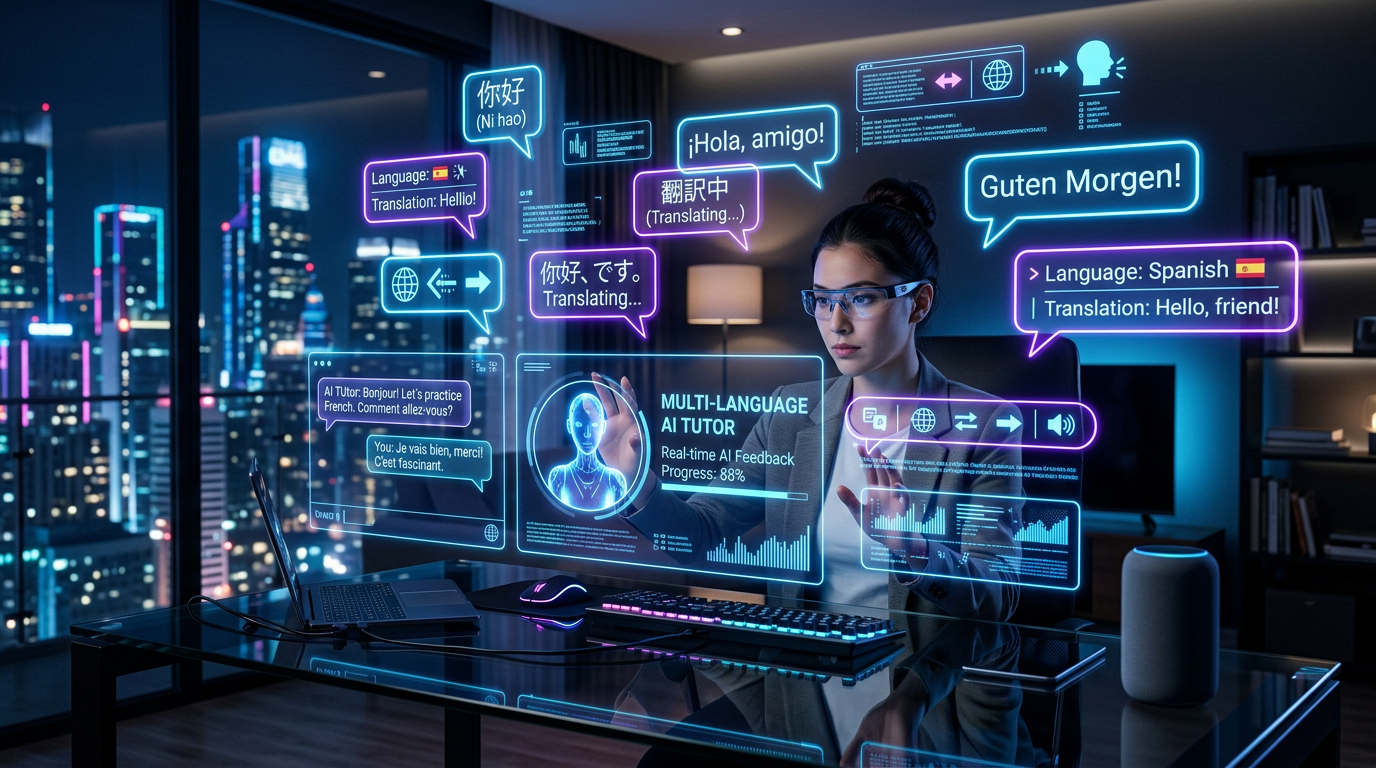
Language learning has been completely transformed by artificial intelligence. What once required expensive tutors, rigid classroom schedules, and heavy textbooks can now be accomplished with a smartphone, a good internet connection, and the right tools. In 2026, AI-powered resources are not just helpful extras — they are the backbone of effective language acquisition.
If you are reading this, you already know that traditional methods alone are no longer enough. You need real interaction, instant feedback, and content that adapts to your level. That is exactly what modern AI tools deliver. This guide covers the most effective AI language learning resources available in 2026, from conversational partners to adaptive flashcards, listening libraries, and writing assistants.
Why AI Has Changed Language Learning Forever
Before we dive into specific resources, let's quickly examine why AI has become such a game-changer. Traditional language learning had three major pain points:
Limited speaking practice — In a classroom of 30 students, you might speak for only a few minutes per session.
Delayed feedback — You write an essay or record a speech, then wait days for corrections.
One-size-fits-all content — Every student follows the same textbook, regardless of strengths and weaknesses.
AI solves all three. Modern tools give you unlimited speaking practice with instant pronunciation and grammar correction. They adapt content to your specific level and learning style. They are available 24/7, at a fraction of the cost of human tutors.
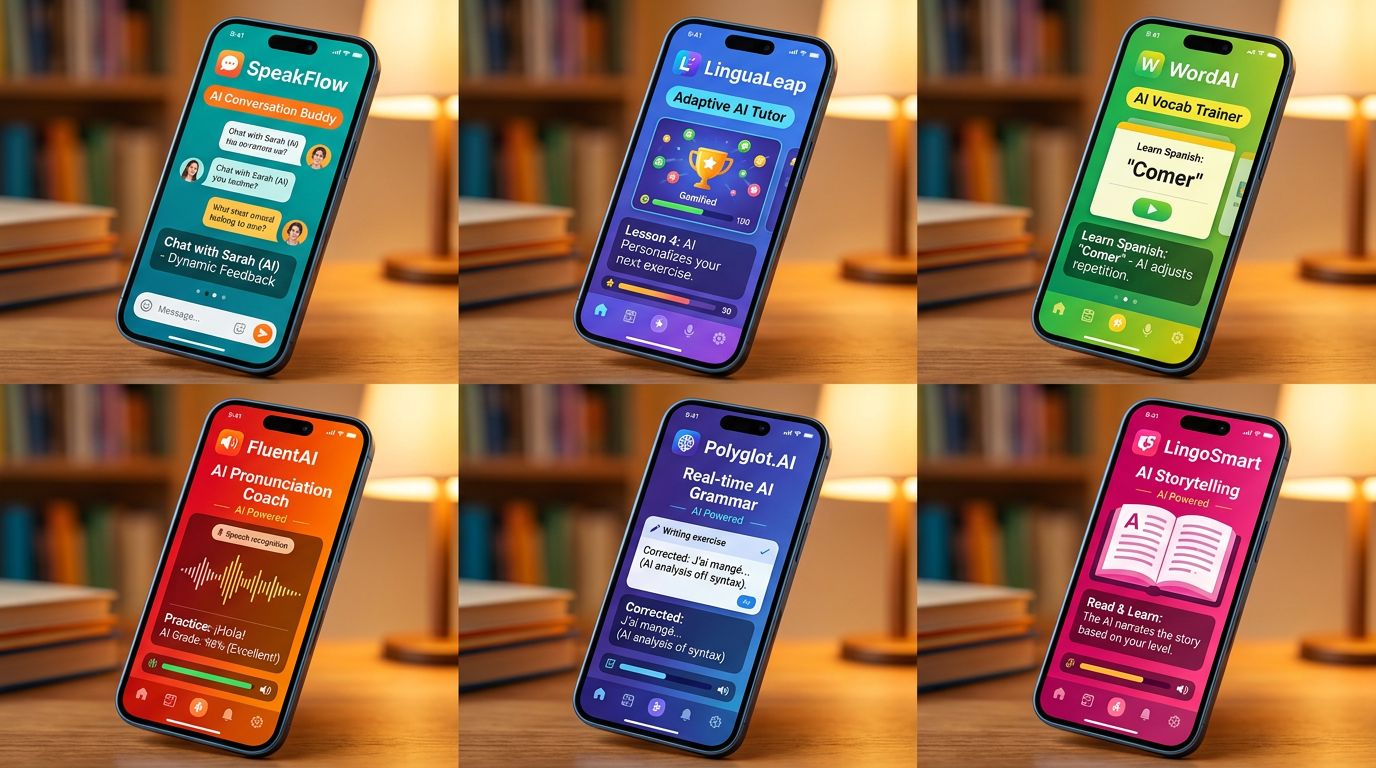
In 2026, the market is flooded with options — which makes choosing the right ones even more important. Below are the categories of AI language learning resources you should know about, with specific recommendations for each.
1. Conversational AI Tutors (The Biggest Leap Forward)
The single most important development in language learning technology is the rise of conversational AI tutors. These are not simple chatbots that give pre-written responses — they use large language models to understand context, detect grammar mistakes, and hold natural, flowing conversations.
TalkMe — Best for Real-World Speaking Practice
TalkMe stands out as one of the most advanced conversational AI tutors available in 2026. What makes it different is its focus on natural, unscripted conversation. Instead of following rigid lesson plans, TalkMe adapts to what you actually want to talk about. Whether you want to practice ordering food, discussing current events, or negotiating a business deal, TalkMe generates realistic scenarios on the fly.
Key features that make TalkMe exceptional:
Real-time pronunciation correction — Speak into your microphone and get instant feedback on individual sounds, word stress, and sentence intonation.
Grammar suggestions in context — Rather than handing you a rule sheet, TalkMe gently rephrases your mistakes during conversation so you learn naturally.
Multiple accent support — Practice understanding British English, American English, Australian English, and more.
Progress tracking — The system tracks your most common mistakes and adjusts future conversations to focus on your weak points.
For more in-depth articles about talkative AI learning methods, visit the TalkMe blog where we regularly publish guides on pronunciation, grammar, and cultural expressions.
Other Notable Conversational AI Tutors
While TalkMe leads the pack for conversational fluency, other tools in this category serve different niches. Some focus strictly on business language, while others emphasize exam preparation. The key is finding a tool whose conversation style matches your learning goals. Most platforms now offer free trials, so you can test their conversational flow before committing.

2. AI-Powered Flashcards and Spaced Repetition Systems
Flashcards have been a staple of language learning for decades, but AI has supercharged them beyond recognition. Modern spaced repetition systems (SRS) powered by machine learning can predict exactly when you are about to forget a word and schedule a review at the perfect moment.
What Makes AI Flashcards Different
Traditional SRS tools like Anki are effective, but they require you to manually create decks and set parameters. AI-powered alternatives automate this entire process:
Automatic vocabulary extraction — Upload any text (a news article, a YouTube transcript, a PDF), and the system identifies key vocabulary at your level.
Difficulty prediction — AI analyzes each word's frequency, complexity, and similarity to words you already know to predict how hard it will be for you.
Contextual example generation — Instead of a single example sentence, AI generates multiple contexts showing how the word is used in different situations.
Multimodal learning — Modern flashcard apps combine text with AI-generated images, audio clips, and even short video snippets to reinforce memory through multiple channels.
Best Practices for AI Flashcards
To get the most out of AI-powered flashcards:
Connect them to conversations — Words you encounter during TalkMe sessions should automatically feed into your flashcard reviews.
Generate personalized examples — Use AI to create example sentences about topics you actually care about. If you love cooking, your flashcard app should show you cooking-related sentences.
Review by speaking, not just reading — Many apps now let you speak your answers aloud and use voice recognition to check pronunciation and recall simultaneously.
3. AI Listening Libraries and Immersion Tools
Listening comprehension is often the hardest skill to develop. You can read and write fairly well, but native speakers still sound like they are talking at warp speed. AI listening tools have become incredibly sophisticated in closing this gap.
Adaptive Audio Resources
The best AI listening tools in 2026 do more than just play audio. They adapt in real time:
Speed control with intelligence — Instead of simply slowing everything down (which distorts natural speech patterns), AI selectively pauses between phrases while maintaining natural pronunciation within each phrase.
Smart captioning — AI generates bilingual captions that highlight the most challenging vocabulary and provide instant definitions when you tap a word.
Difficulty-based content filtering — The system scans millions of audio clips (news broadcasts, podcasts, movie scenes, YouTube videos) and surfaces content at exactly your comprehension level.
Active listening exercises — After each clip, AI generates comprehension questions that target the specific listening challenges you faced.
Building a Listening Routine
Consistent listening is the key to unlocking natural comprehension. Here is a practical routine using AI tools:
Week 1-4: Spend 10 minutes daily on very slow, heavily captioned content. Focus on recognizing individual words and basic sentence boundaries.
Week 5-8: Move to natural-speed content with selective captions. AI tools should only show captions for words or phrases it detects you struggled with.
Week 9-12: Graduate to near-native content with minimal assistance. At this stage, your AI listening tool should only interrupt when you miss critical information.
Throughout this process, TalkMe can serve as a bridge between passive listening and active speaking. After hearing native speakers in audio clips, practice reproducing the same sounds and rhythms in conversation with the AI tutor.
4. AI Writing Assistants for Language Learners
Writing in a foreign language is challenging because it requires simultaneous attention to vocabulary, grammar, style, and cultural appropriateness. AI writing assistants designed specifically for language learners have become remarkably good at providing nuanced feedback.
Beyond Spell Check
AI writing tools for language learning in 2026 go far beyond simple spell-checking:
Stylistic feedback — The AI suggests whether your writing sounds too formal, too casual, or just right for the context.
Alternative phrasing — Instead of just marking an error, the AI shows you 2-3 alternative ways to express the same idea, each with different connotations.
Cultural nuance detection — The AI flags expressions that might be technically correct but culturally awkward or inappropriate.
Track improvement over time — Advanced tools analyze your writing history to identify persistent error patterns and suggest targeted practice.
Using Writing AI with TalkMe
A powerful combination is to write about a topic, then discuss it verbally using TalkMe. Here is the workflow:
Write a short paragraph about your weekend, your opinion on a news topic, or a work-related subject.
Get AI feedback and revise your writing.
Use TalkMe to have a conversation about the same topic.
Notice how expressing ideas in writing differs from expressing them verbally.
The system cross-references your written and spoken errors to give you a unified improvement plan.
This integrated approach ensures you develop both written and spoken fluency simultaneously, rather than letting one skill lag behind the other.
5. AI-Powered Pronunciation Trainers
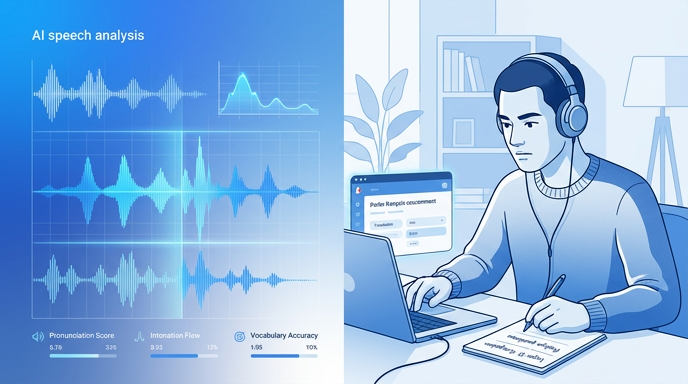
Pronunciation is the area where AI has made perhaps its most dramatic impact. In 2026, you no longer need to rely on a human listener to tell you if you sound like a native speaker. AI pronunciation tools can analyze individual phonemes with remarkable accuracy.
How AI Pronunciation Training Works
Modern pronunciation trainers use deep learning models trained on thousands of hours of native speech. When you speak:
Phoneme-level analysis — The AI breaks your speech into individual sounds and compares each one to native pronunciation.
Visual feedback — Waveforms and spectrograms show you exactly where your pronunciation deviates from the target.
Articulation guidance — The AI uses 3D animations of the mouth and vocal tract to show you how to position your tongue and lips for difficult sounds.
Minimal pair drilling — The system identifies the specific sound contrasts that are hardest for speakers of your native language and generates targeted exercises.
Combining Pronunciation Tools with Conversation
For best results, use pronunciation tools and conversational AI together. Practice specific sounds in isolation with a pronunciation trainer, then immediately use them in natural conversation with TalkMe. The conversational AI will reinforce correct pronunciation in a realistic context, helping you transfer what you learn in drilling exercises to real communication.
6. AI Content Generators for Personalized Learning
One of the most exciting developments in 2026 is the ability to generate personalized learning content on demand. Instead of relying on pre-made materials that may or may not match your interests, you can now create custom content in seconds.
What You Can Generate
Personalized reading passages — Ask for a 500-word article about your favorite hobby, written at your level, with target vocabulary highlighted.
Custom dialogues — Generate conversations between two native speakers on any topic, at any difficulty level.
Grammar exercises — Instead of generic exercises from textbooks, generate exercises that use vocabulary you are currently studying.
Listening comprehension clips — AI can now generate realistic audio clips with different accents and speaking speeds, complete with comprehension questions.
This personalization dramatically increases engagement. When content connects to your actual interests and daily life, you learn faster and retain more.
7. Community and Social Learning Enhanced by AI
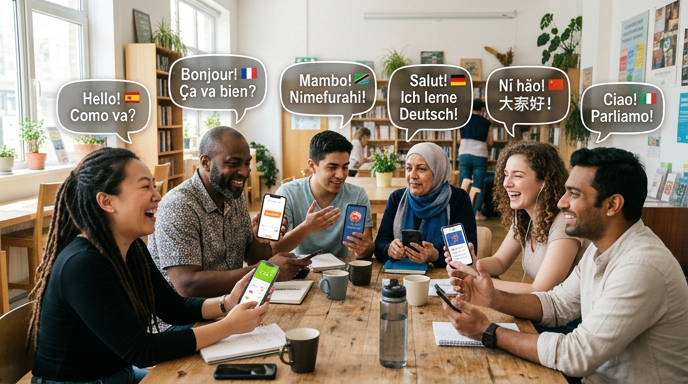
Language learning has always been a social activity, and AI has enhanced — not replaced — the social dimension. In 2026, AI tools facilitate more meaningful human interaction.
AI-Moderated Language Exchanges
Language exchange apps now use AI to improve the experience:
Smart matching — AI analyzes your learning style, interests, and schedule to pair you with compatible language partners.
Real-time translation assistance — When you get stuck during a conversation, AI provides context-appropriate help without breaking the flow.
Session analysis — After each exchange, AI generates a summary of new vocabulary and grammar points that came up during the conversation.
Suggested topics — AI recommends discussion topics based on your shared interests and current learning goals.
Using TalkMe to Prepare for Human Conversations
A highly effective strategy is to use TalkMe as a "rehearsal space" before real human conversations. Practice the vocabulary and sentence structures you want to use, build confidence with the AI, and then bring that confidence to your human interactions. Over time, you will notice less hesitation and more fluency in both settings.
8. Building Your Personal AI Language Learning Stack
With so many resources available, the challenge is not finding tools — it is choosing the right combination and using them consistently. Here is a recommended stack for 2026:
The Minimal Setup (15 minutes per day)
Conversational AI: TalkMe — 10 minutes of speaking practice daily
Flashcards: AI-powered SRS app — 5 minutes of review
Listening: AI podcast player — passive listening during commute
The Complete Setup (45-60 minutes per day)
Conversational AI: TalkMe — 20 minutes
Flashcards: AI SRS with personalized content — 10 minutes
Listening: Adaptive audio library — 10 minutes
Writing: AI writing assistant — 10 minutes
Review: AI analytics dashboard — 5 minutes to review progress and adjust
The Intensive Setup (2+ hours per day)
Conversational AI: TalkMe — 30 minutes
Pronunciation: Dedicated AI pronunciation trainer — 15 minutes
Flashcards: Deep review sessions — 15 minutes
Listening: Extended immersion with smart captions — 30 minutes
Writing: AI-assisted composition and revision — 20 minutes
Language exchange: AI-moderated human conversation — 30 minutes
9. Measuring Progress with AI Analytics
One of the most underrated benefits of AI tools is the data they generate. In 2026, language learners have access to analytics that simply were not possible before.
What Modern Analytics Track
Vocabulary growth — Not just word count, but how many words you can actively use in conversation versus passive recognition.
Pronunciation improvement — Graphs showing your accuracy on specific phonemes over time.
Speaking speed — How your words-per-minute rate is approaching native speaker levels.
Error patterns — Persistent mistakes broken down by category (grammar, vocabulary, pronunciation, cultural appropriateness).
Fluency score — A composite metric that weights your ability to maintain natural conversation without excessive hesitation.
Using Analytics to Guide Learning
The best approach is to review your analytics weekly and adjust your focus accordingly. If your data shows that grammar errors are concentrated in verb tenses, spend more time with TalkMe practicing narratives about past events. If pronunciation lags on specific sounds, increase your drilling time on minimal pairs.
The TalkMe blog publishes regular articles on how to interpret language learning data and adjust your study strategy for maximum efficiency. These insights, combined with your personal analytics, create a powerful feedback loop.
10. The Future of AI Language Learning
As we look beyond 2026, several trends are already emerging:
Multimodal AI tutors that combine voice, video, and text in seamless interactions, with the AI understanding context from your environment through your camera and microphone.
Emotion-aware AI that detects frustration, boredom, or confusion and adjusts the conversation accordingly.
Virtual reality integration where AI tutors exist as 3D avatars in immersive environments for truly contextual learning.
Brain-computer interfaces for accelerated language acquisition — still experimental but progressing rapidly.
These developments promise to make language learning faster, more engaging, and more accessible than ever before.
The Role of Open Source AI in Language Learning
An important trend worth highlighting is the growing availability of open-source language models that anyone can run locally. While commercial tools like TalkMe offer polished, ready-to-use experiences, open-source AI gives advanced learners and developers the ability to customize every aspect of their learning environment. You can fine-tune models on specific vocabulary domains, create custom pronunciation datasets, or build your own spaced repetition algorithms. This democratization of AI means that the most innovative language learning tools of tomorrow might come not from big companies, but from individual learners sharing their creations with the community.
Common Mistakes to Avoid When Using AI Language Tools
Even with the best AI resources, learners can fall into traps that slow their progress. Awareness of these common pitfalls will help you get the most out of your tools.
Mistake 1: Passive Consumption
It is tempting to let AI do the work — have it translate everything, generate perfect sentences, and correct every error before you even finish speaking. But passive consumption creates the illusion of learning without real retention. The most effective approach is to struggle first, then use AI as a coach. Try to express yourself without help. Make mistakes. Then use AI to understand and correct those mistakes. This struggle-based learning leads to deeper and longer-lasting neural connections.
Mistake 2: Tool Hopping
In 2026, new language learning apps appear almost weekly. It is easy to fall into the trap of downloading every new tool, spending more time evaluating than actually learning. The solution is to commit to a core stack — we recommend starting with just TalkMe for conversation and an AI SRS for vocabulary — and stick with it for at least 90 days before considering additions. Consistency beats variety every time.
Mistake 3: Ignoring Output Skills
AI tools make input (reading and listening) incredibly easy and enjoyable. It is possible to spend hours consuming content without ever producing a single word. This creates a dangerous imbalance: excellent comprehension with almost no speaking ability. Deliberately prioritize output by using conversational AI daily, keeping a spoken journal, or writing short texts that AI can review. Your output skills will never improve unless you actively exercise them.
Conclusion: Start Your AI Language Learning Journey Today
The resources described in this guide represent the cutting edge of language learning technology in 2026. The barriers that once made fluency seem unreachable — limited speaking practice, delayed feedback, and generic content — have been largely eliminated by AI.
The key is not to wait for the perfect tool or the perfect moment. Start with one resource, use it consistently, and build from there. If we had to recommend a single starting point, it would be a conversational AI tutor like TalkMe. Speaking practice is the area where AI provides the most dramatic improvement over traditional methods, and it is also the area where most learners need the most help.
Once you have established a daily conversation habit with TalkMe, layer in the other resources gradually. Add flashcards for vocabulary retention, listening tools for comprehension, and writing assistants for precision. Each tool amplifies the effectiveness of the others.
For ongoing guides, tips, and deep dives into specific language learning topics, check out the TalkMe blog. Whether you are just starting your first foreign language or adding a fifth to your repertoire, the AI-powered resources available in 2026 can take you further, faster than you ever thought possible.
Happy learning — and we will talk to you soon on TalkMe. 🎧



Comments
No comments yet.
Leave a Comment