
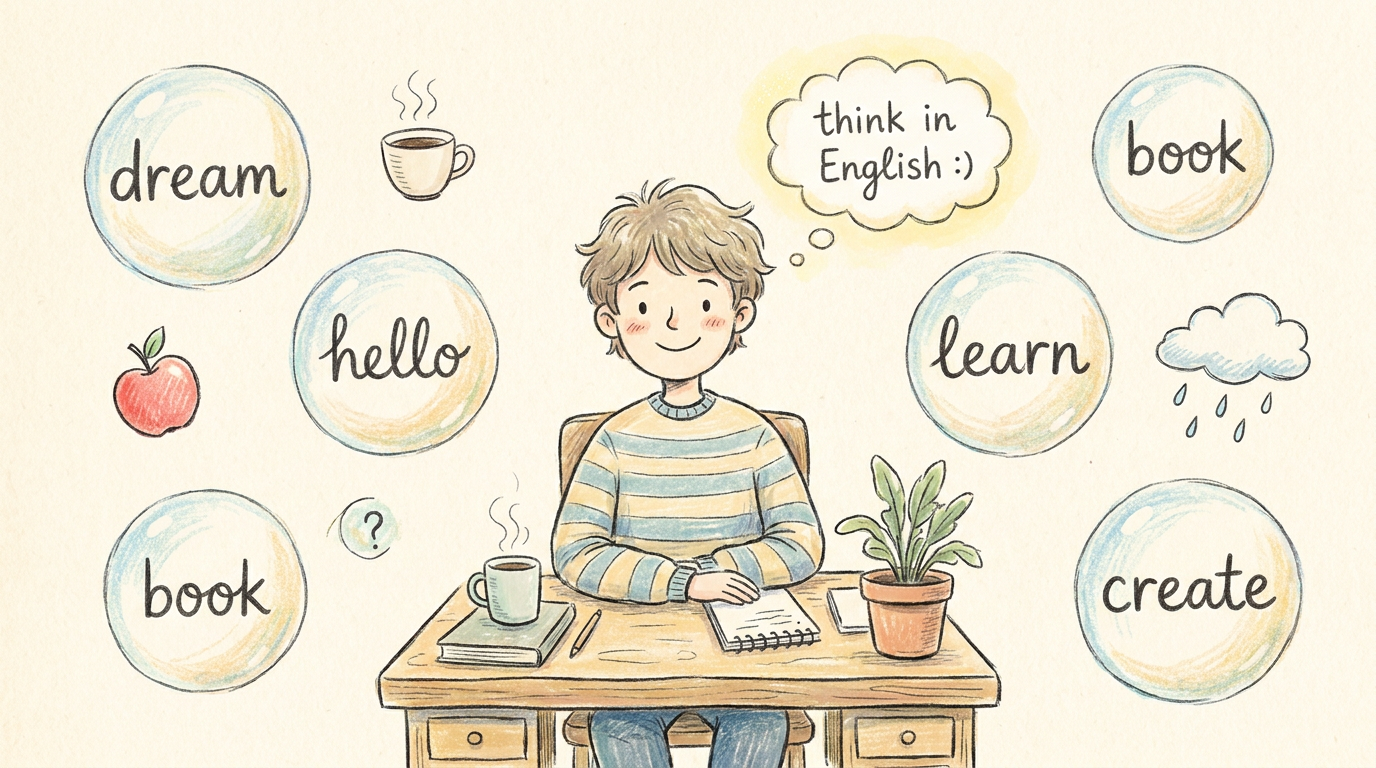
If you've ever struggled to have a spontaneous conversation in English, there's a good chance you know this feeling: you think of what you want to say in your native language, mentally translate it into English, then speak — only to find the moment has already passed. This "mental translation" habit is one of the biggest obstacles for intermediate and advanced learners. The solution isn't to study more grammar. It's to learn how to think in English.
This guide breaks down exactly how to rewire your brain so that English becomes your default thinking language — not a language you translate into.
Why You're Still Translating (And Why It's Slowing You Down)
Your brain is wired for efficiency. When you learned your first language as a child, you didn't translate — you associated sounds and words directly with experiences and emotions. When you learn a second language as an adult, your brain often takes a shortcut: it maps new words onto existing ones in your native language.
The result? Every time you want to say something in English, your brain runs a two-step process:
Form the thought in your native language
Translate it word-by-word into English
This double processing is slow, mentally exhausting, and produces unnatural sentences. The goal is to short-circuit step one entirely.
![blog-EN[EN-026]-How to Think in English 1.png](/upload/blog-EN%5BEN-026%5D-How%20to%20Think%20in%20English%201.png)
Technique 1: Start Thinking in Single Words, Then Phrases
Don't try to think in full English sentences right away — that's too big a jump. Instead, start small.
Step 1 — Label your world in English.
When you see a coffee cup, think: cup. hot. morning. coffee. Don't describe it in your native language first. Just let the English word pop up.
Step 2 — Upgrade to phrases.
Once single words feel natural, add simple phrases: a warm cup of coffee, I need coffee, too tired today.
Step 3 — Build sentences from phrases.
Combine your phrase fragments: It's Monday morning and I really need this coffee.
This progression feels slow at first, but it rewires your brain faster than you'd expect.
Technique 2: Run a "Mental Monologue" in English
One of the most effective habits you can build is a running internal commentary in English throughout your day.
Here's how it works: narrate what you're doing, like a character in a movie.
While cooking: I'm chopping onions. The pan is too hot. I should turn it down.
While commuting: The train is packed today. I hope I get a seat. Only three more stops.
While shopping: Should I get the large size? It's better value but I won't finish it.
You don't need anyone to talk to. Your own internal voice is enough. Start with 5 minutes per day and gradually extend it. Many fluent speakers credit this habit as the single biggest turning point in their fluency journey.
![blog-EN[EN-026]-How to Think in English 2.png](/upload/blog-EN%5BEN-026%5D-How%20to%20Think%20in%20English%202.png)
Technique 3: Think in Concepts, Not Translations
One of the trickiest challenges is translating concepts that don't map neatly between languages. For example, in Japanese there's 木漏れ日 (komorebi) — the light filtering through leaves. In Portuguese there's saudade — a bittersweet longing.
When you encounter these situations in English, the goal isn't to find the "perfect" equivalent. It's to describe the feeling or concept directly in English.
Exercise: Take an abstract emotion or concept from your native language that has no direct English equivalent. Write three English sentences that describe it without translating it.
Example (Portuguese → English):
Instead of translating saudade, you might think: That deep, quiet ache when you miss someone who's far away. Nostalgia with a sadness in it. A longing that feels bittersweet.
This trains your brain to express rather than translate.
Technique 4: Use "English-Only" Windows
Designate specific time blocks as English-only mental zones.
Morning routine: From the moment you wake up until you leave the house, think only in English.
TV and media: Watch English content and actively notice what phrases stick in your mind.
Journaling: Keep a short English diary. Even three sentences per day adds up fast.
The key is consistency, not duration. A 10-minute English-only window every day beats a 2-hour weekend session once a week.
Sample journal prompts:
What am I looking forward to today?
What's one thing that annoyed me recently, and why?
If I could go anywhere this weekend, where would I go?
Technique 5: Practice with Real-Time Conversation
All the internal practice in the world has to eventually meet real conversation. The best tool for this is live speaking practice — and AI conversation partners have become genuinely powerful for this.
TalkMe is designed specifically for this moment. It gives you a real-time AI conversation partner who responds naturally, corrects your errors gently, and lets you talk about anything you want — without the anxiety of being judged by another person.
The advantage over traditional apps: TalkMe keeps you speaking continuously, which is exactly the condition where English thinking is trained. When you're forced to respond immediately, there's no time to translate. Your brain adapts.
Try combining TalkMe sessions with the mental monologue habit: spend 10 minutes narrating your morning in English, then have a 10-minute TalkMe conversation about it.
![blog-EN[EN-026]-How to Think in English 3.png](/upload/blog-EN%5BEN-026%5D-How%20to%20Think%20in%20English%203.png)
A 4-Week Training Plan
Common Mistakes to Avoid
❌ Trying to translate perfectly
Perfection is the enemy of fluency. Aim for good enough thoughts in English, not flawless ones.
❌ Giving up when you can't find a word
When you can't find the English word, describe it around it. "The thing you use to... the person who... the feeling when..." — this circumlocution is actually a core fluency skill.
❌ Only practicing when studying
English thinking has to happen outside study time. That's the whole point. Your daily life is the classroom.
Final Thought
Thinking in English isn't a talent — it's a trained habit. Every time you catch yourself translating and choose to describe instead, you're building new neural pathways. Be patient with the process. Most learners start noticing a real shift in 3–6 weeks of consistent practice.
The goal isn't to forget your native language. It's to give English its own separate space in your mind — a space where it can run freely, without waiting for translation.
Start with one technique today. Pick the mental monologue. Try it for 10 minutes during your next commute. See what happens.
Want to accelerate the process? Try TalkMe — the AI speaking partner designed for real conversation practice. Visit blog.talkme.ai for more learning strategies.



Comments
No comments yet.
Leave a Comment