

When learning a new language, one of the first phrases people want to learn is how to express gratitude. If you’ve been wondering how to say thank you in Chinese, you’ve come to the right place.
In this article, you’ll learn:
How to say thank you in Chinese Mandarin
How to write thank you in Chinese letters
Cultural context and common expressions
How TalkMe AI, the best AI language tutor, can help you master Mandarin through real conversation
Whether you're traveling to China, studying the language, or just want to impress your Chinese-speaking friends, this guide will help you sound natural and polite.
The Basics: How to Say Thank You in Chinese Mandarin
The most common and widely used way to say thank you in Chinese Mandarin is:
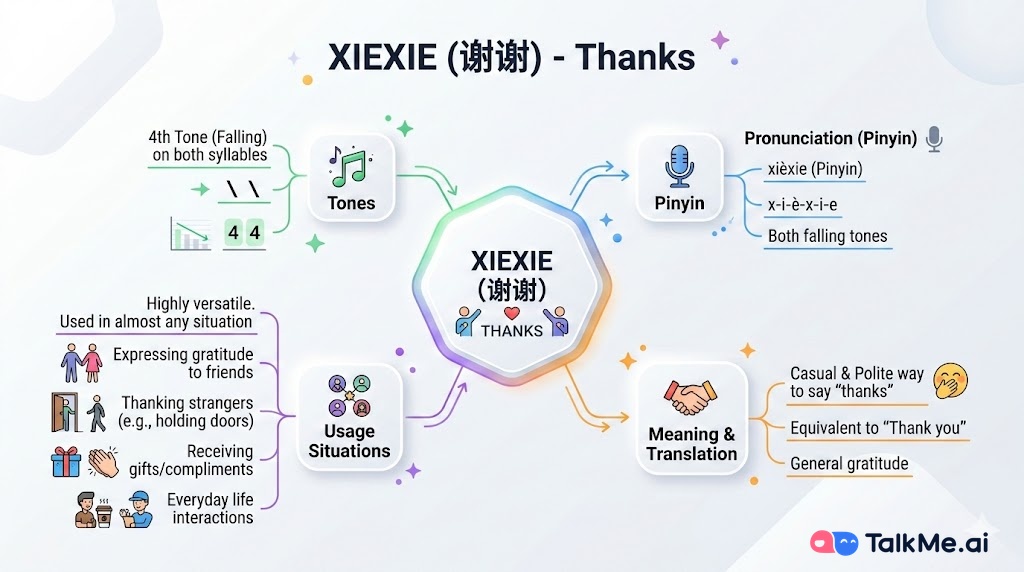
谢谢 (xièxie)
Pinyin (pronunciation): xièxie
Tone: Both syllables are in the fourth tone (falling tone)
Meaning: A casual and polite way to say “thanks”
You can use 谢谢 in almost any situation — whether you’re thanking a stranger for holding the door or expressing gratitude to a close friend.
Example Conversations:
A: 你帮了我很多。 (Nǐ bāng le wǒ hěn duō.) — “You helped me a lot.”
B: 谢谢! — “Thank you!”
A: 给你咖啡。 (Gěi nǐ kāfēi.) — “Here’s your coffee.”
B: 谢谢你! — “Thank you!”
It’s simple, sincere, and universal — exactly what you need to get started.
Thank You in Chinese Letters and Writing Practice
If you’re also interested in reading and writing Chinese, it’s helpful to recognize thank you in Chinese letters.
Here’s a breakdown:
谢 (xiè) = “to thank”
It uses the speech radical “讠” on the left, indicating a word related to speaking.
The word 谢谢 is written by repeating the character “谢”, which adds a polite, softer emphasis.
Writing Tips:
Use stroke order apps or Chinese character writing tools to practice.
Combine character learning with speaking practice using TalkMe AI, which offers voice recognition and stroke guidance in one place.
Learning to read, write, and say thank you in Chinese will reinforce your memory and boost your confidence when communicating with native speakers.
Different Ways to Say Thank You in Chinese
As in English, Mandarin offers several ways to say thanks — from informal to deeply formal expressions.
With TalkMe AI, you can practice each variation in different real-life role-play settings — whether you're thanking a host at dinner or giving a speech at work.
The Role of Politeness and Tone in Chinese Culture
Learning thank you in Chinese Mandarin goes beyond translation — it’s about understanding how and when to say it.
Here are some key cultural tips:
In close relationships, “谢谢” may be replaced with actions or gestures — not every small favor gets a spoken thank you.
Adding 你 (nǐ) or 您 (nín) shows different levels of respect — the latter being more formal.
Phrases like 感谢 (gǎnxiè) are commonly used in emails, speeches, and formal contexts.
TalkMe AI includes cultural explanations and practice dialogues to help you apply each phrase appropriately, boosting both your fluency and cultural awareness.
Practice Thank You in Real Conversations with TalkMe AI
Want to master how to say thank you in Chinese in a natural, real-life setting?
Meet TalkMe AI — a smart, interactive AI language tutor that helps you practice Chinese Mandarin (and other languages) with native-level fluency.
Why TalkMe AI Works So Well:
Natural Conversations with AI Tutors
You’ll practice thank you in Chinese through dynamic, everyday dialogues — not boring drills.Grammar Feedback & Corrections
Get instant help with pronunciation, tone, and vocabulary. No need to guess if you're doing it right.Real-Life Scenarios
Thank someone for a meal, a gift, or their help — just like in real life.Role-play Practice
Practice both sides of the conversation and learn how others respond.
Whether you’re a beginner or advancing your skills, TalkMe AI adapts to your level and helps you sound polite, confident, and fluent.
Why TalkMe AI Is the Best Tool to Learn Chinese
Traditional flashcards might teach you the word 谢谢, but they don’t teach you how to use it correctly in a conversation.
Here’s how TalkMe AI goes beyond:
Voice Feedback with Tone Coaching:
Chinese is tonal, so saying “xièxie” the wrong way can confuse people. TalkMe AI catches and corrects your tones in real time.Realistic Scenarios:
Learn when to say “谢谢”, when to use “感谢”, and when a smile is better than words.Memory Anchoring via Role-play:
By acting out gratitude scenarios, you’ll better remember vocabulary, phrases, and cultural context.
Plus, TalkMe AI isn’t just for Mandarin. You can learn:
English
Spanish
French
Japanese
Korean
—all with the same engaging AI-powered experience.
A Sample TalkMe AI Dialogue: Thanking in Mandarin
Scenario: You receive a birthday gift from a Chinese-speaking friend.
AI Tutor: 这是给你的生日礼物。 (This is your birthday gift.)
You: 哇,谢谢你! (Wow, thank you!)
AI Tutor: 不客气!你喜欢吗? (You’re welcome! Do you like it?)
You: 非常喜欢,真的很感谢你。 (I love it — I truly appreciate it.)
AI Feedback: Excellent use of formal gratitude! For even higher politeness, try saying “我感激不尽”.
This kind of guided, contextual feedback is what makes TalkMe AI a powerful tool for speaking Mandarin naturally.
Other Phrases to Pair with Thank You in Chinese
Want to level up beyond 谢谢? Here are some must-know responses and polite add-ons:
不客气 (bú kè qi) — You’re welcome
没关系 (méi guān xi) — It’s okay / No problem
哪里哪里 (nǎlǐ nǎlǐ) — Humble response to praise (like “not at all!”)
应该的 (yīnggāi de) — It’s my duty / Don’t mention it
With TalkMe AI, you can rehearse both the “thank you” and the culturally appropriate response — an essential skill for sounding natural in Mandarin conversations.
Final Verdict
Learning to say thank you in Chinese is more than memorizing a phrase — it’s about understanding tone, culture, and context.
Whether you’re thanking someone for directions, a gift, or a meal, knowing how to say thank you in Chinese Mandarin the right way makes a big difference.
And with TalkMe AI, your Mandarin learning journey becomes smoother, smarter, and more engaging. You’ll learn:
To pronounce xièxie clearly and confidently
To recognize thank you in Chinese letters like 谢谢
To express gratitude in role-play and real-life conversations
To get corrections and feedback from your AI tutor — anytime
Start your Mandarin journey today with TalkMe AI — and start saying thank you in Chinese like a native speaker.



Comments
No comments yet.
Leave a Comment