

Most English learners can read and write well but freeze when it's time to speak. This guide breaks down a practical, step-by-step system to build real speaking confidence — from thinking in English to practicing daily with the right tools and techniques.
Why Learning to Speak English Feels So Hard
You've been studying English for years. Your grammar is solid. You can read articles, understand movies, maybe even write decent emails. But the moment someone asks you a question in English — your mind goes blank.
You're not alone. This is the single most common frustration among English learners worldwide.
Here's why it happens: reading and writing are passive-receptive skills. You have time to think, process, and revise. Speaking is active-productive — it happens in real time. Your brain needs to recall vocabulary, construct sentences, manage pronunciation, and read social cues all at once. No wonder it feels overwhelming.
The good news? Speaking is a skill, not a talent. And like any skill, it can be trained systematically.
This guide gives you that system.
Step 1: Start Thinking in English
The biggest barrier to fluent speaking isn't vocabulary — it's the translation habit.
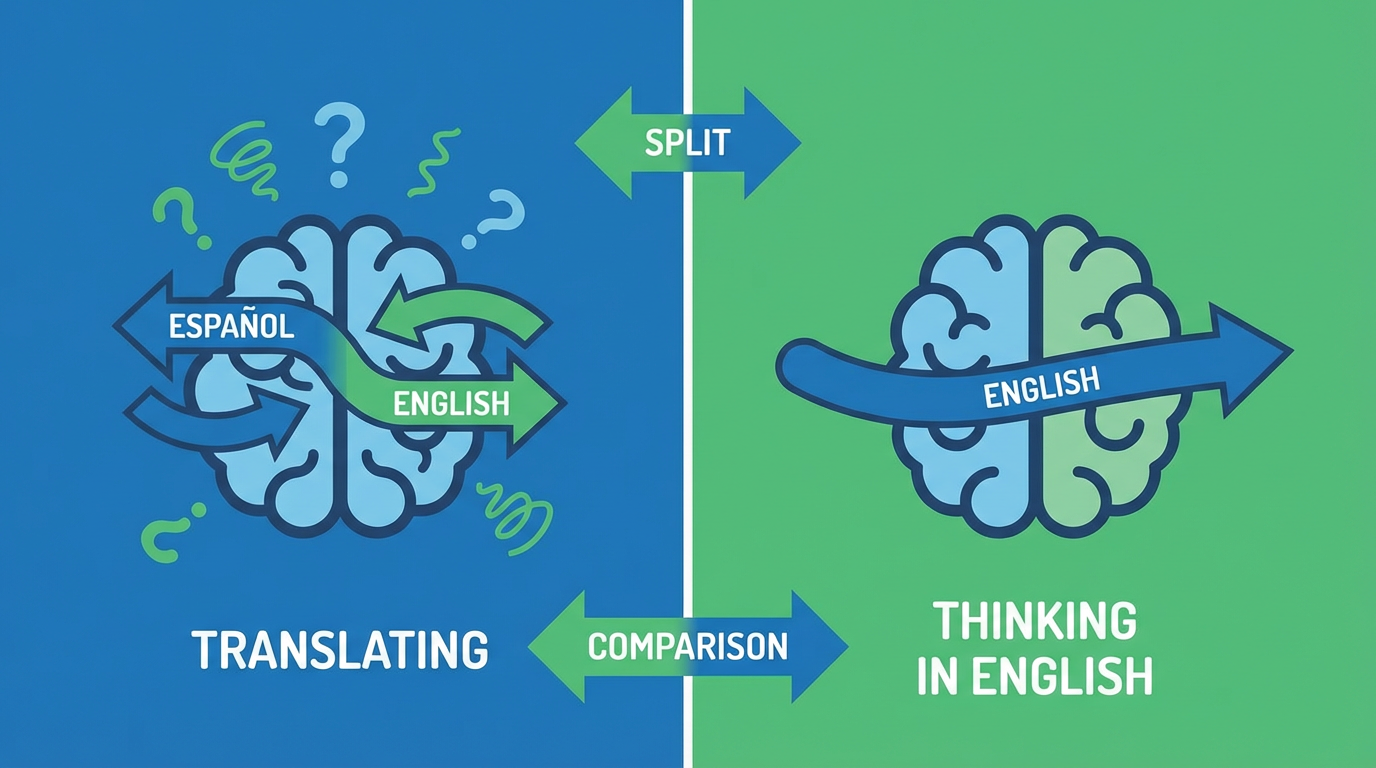
When someone asks you "How was your weekend?", your brain probably does this:
Hear the English question
Translate to your native language
Formulate the answer in your native language
Translate back to English
Speak
That's four extra steps. By the time you're ready to talk, the conversation has already moved on.
How to Break the Translation Loop
Label your surroundings. Walk through your home and label everything in English — door, mirror, keyboard, coffee cup. Seeing English words throughout your day trains your brain to skip the middleman.
Talk to yourself in English. Narrate your day: "I'm making coffee now. I need to check my email. The weather looks nice today." It feels silly at first, but this is how you build the direct connection between thought and English output.
Set your phone language to English. This forces you to process daily information in English — messages, notifications, settings menus. Small but constant exposure rewires your thinking patterns.
Keep a one-sentence journal. Every night, write one sentence about your day in English. Not a paragraph, not an essay. One sentence. This builds the habit of expressing yourself directly in English without translation.
Timeline: Most learners notice a significant reduction in translation time after 2-3 weeks of daily practice.
Step 2: Build a Speaking Practice Routine
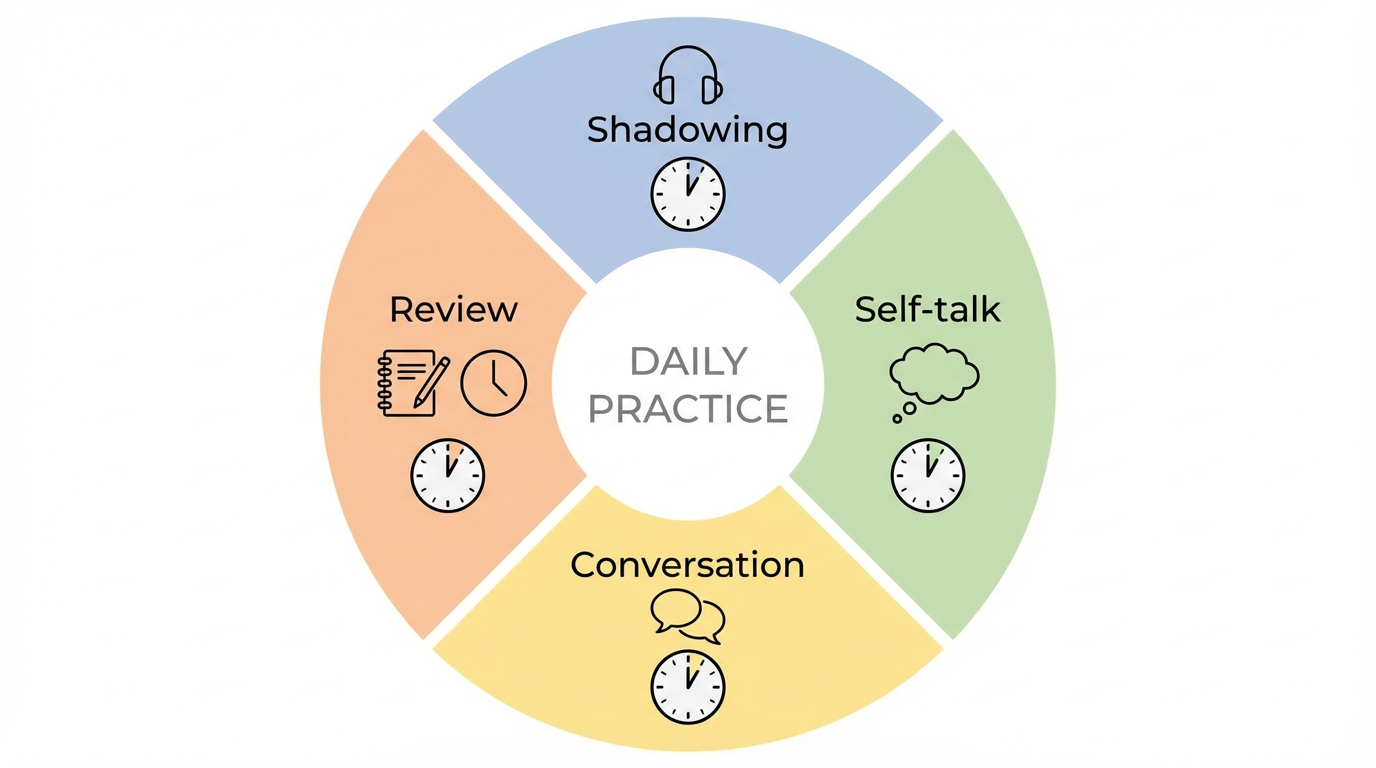
Consistency beats intensity. Practicing 20 minutes a day is far more effective than two hours once a week.
The 20-Minute Daily Speaking Plan
Shadowing: The Technique Polyglots Swear By
Shadowing means listening to native English audio and repeating it at the same time — not after, but simultaneously. Think of it like an echo with a one-second delay.
Find a short audio clip (podcast, YouTube, audiobook) — 2-3 minutes max
Listen once without repeating
Play it again and speak along, matching the pace and intonation
Don't worry about understanding every word — focus on rhythm and flow
Great sources for shadowing material:
TED Talks — clear delivery, diverse topics
BBC 6 Minute English — designed for learners, perfect length
YouTube channels like Rachel's English and English with Lucy
Pro tip: Record yourself shadowing and compare it to the original. You'll hear patterns you never noticed before.
Step 3: Practice with AI Tutors (The Game Changer in 2026)
One of the biggest barriers to speaking practice has always been finding someone to talk to. Language exchange partners flake. Tutors are expensive. Friends get busy.
In 2026, AI conversation tools have become genuinely useful for speaking practice. They're available 24/7, infinitely patient, and — unlike language partners — they won't judge your mistakes.

What to Look For in an AI Speaking Tool
Realistic conversation flow — not multiple choice, actual free-form dialogue
Pronunciation feedback — tells you what sounds off and how to fix it
Topic variety — daily small talk, business meetings, travel scenarios, interviews
Adaptive difficulty — adjusts to your level as you improve
Recommended AI Speaking Tools
TalkMe
Website: talkme.ai
TalkMe focuses entirely on speaking and listening through realistic conversation scenarios. You pick a topic — job interview, café ordering, travel planning — and have an actual voice conversation with an AI tutor. It gives feedback on your pronunciation and suggests better ways to phrase things.
ELSA Speak
Website: elsaspeak.com
ELSA specializes in pronunciation training. It breaks down your speech at the phoneme level and gives targeted exercises for the specific sounds you're getting wrong. Especially useful for learners preparing for IELTS or TOEFL speaking sections.
VivaLingua
Website: vivalingua.ai
Offers structured conversation practice with AI tutors that adapt to your level and interests.
Best practice: Use AI tutors for 10-15 minutes daily. Treat it like a gym session — short, consistent, and focused.
Step 4: Find Real Conversation Partners
AI is powerful, but nothing replaces human conversation. Real people hesitate, change topics, use slang, and react unpredictably. You need that unpredictability to truly build fluency.
Language Exchange Platforms
Tandem
Free app that matches you with native English speakers learning your language. You help them with your language, they help you with English. Built-in voice and video calls make it easy to practice speaking.
HelloTalk
Similar to Tandem but with a larger user base. The timeline feature lets you post short voice messages and get corrections from native speakers.
Meetup
Search for "English conversation" or "language exchange" meetups in your city. In-person practice forces you to think on your feet in a way apps can't replicate.
Online Communities
Reddit: r/language_exchange, r/CasualConversation
Discord servers: Many language learning communities have voice channels dedicated to English practice
Tip: Set a weekly "English-only" hangout with a language partner. Regularity matters more than length.
Step 5: Learn Phrases, Not Just Words
One of the fastest ways to sound more natural is to learn chunks — groups of words that native speakers use together.
Instead of learning the word "decision" and then figuring out how to use it in a sentence, learn the phrase "make a decision." Instead of learning "effort," learn "put in a lot of effort."
High-Value Phrases to Start With
Memorize phrases like these and they'll come out naturally in conversation — no translation needed.
Step 6: Record Yourself and Review
This is the step most learners skip, and it's the one that produces the fastest improvement.
The Self-Recording Method
Pick a topic (e.g., "Describe your last vacation")
Record yourself speaking for 2 minutes — no preparation, no script
Listen back and note:
Long pauses (where you got stuck)
Words you couldn't remember
Pronunciation issues
Repeated filler words (um, uh, like)
Try again, focusing on improving the weak spots
Compare the two recordings
After two weeks of daily self-recording, play your first recording alongside your latest one. The improvement will be audible.
Step 7: Immerse Yourself in Spoken English
Passive listening counts. A lot.
Your brain is constantly absorbing language patterns, even when you're not actively studying. The more spoken English you consume, the more natural your own speech becomes.
What to Listen To (By Level)
Beginner:
BBC 6 Minute English — short, clear, learner-friendly
VOA Learning English — slow-paced news reports
EnglishClass101 podcasts — structured lessons with native audio
Intermediate:
The Joe Rogan Experience (pick episodes with clear speakers) — natural, unscripted conversation
Conan O'Brien Needs a Friend — humorous, fast-paced, great for idioms
Luke's English Podcast — designed for intermediate learners, covers culture and language
Advanced:
Radiolab — complex storytelling with sophisticated vocabulary
The Daily (NYT) — news analysis with professional presenters
Any podcast on a topic you enjoy — at this level, content matters more than the English itself
The "English Only" Rule
Pick one activity you do daily — commuting, cooking, exercising — and make it English-only time. No music in your native language, no podcasts in your native language. Just English audio.
That's 30-60 minutes of extra immersion per day, zero extra study time required.
Common Mistakes That Hold Learners Back
1. Waiting Until You're "Ready"
You will never feel ready. The discomfort of speaking imperfectly is the price of admission. Every fluent speaker went through a phase where they sounded foolish. The ones who succeeded are the ones who kept going anyway.
2. Obsessing Over Grammar While Speaking
Your conversation partner doesn't care if you said "he go" instead of "he goes." They care about understanding you. Prioritize fluency over accuracy during conversation. Fix grammar during study time.
3. Only Studying, Never Speaking
You can't learn to ride a bicycle by reading about bicycles. Speaking is a physical skill that requires physical practice. Reading grammar books won't make you a better speaker. Talking will.
4. Comparing Yourself to Native Speakers
Native speakers have 20+ years of daily practice. You're comparing your chapter 3 to their chapter 300. The only fair comparison is you today vs. you three months ago.
5. Skipping Pronunciation
Poor pronunciation doesn't just make you hard to understand — it makes you less confident, which makes you speak less, which makes you worse. It's a vicious cycle. Even 5 minutes of pronunciation work per day pays compound dividends.
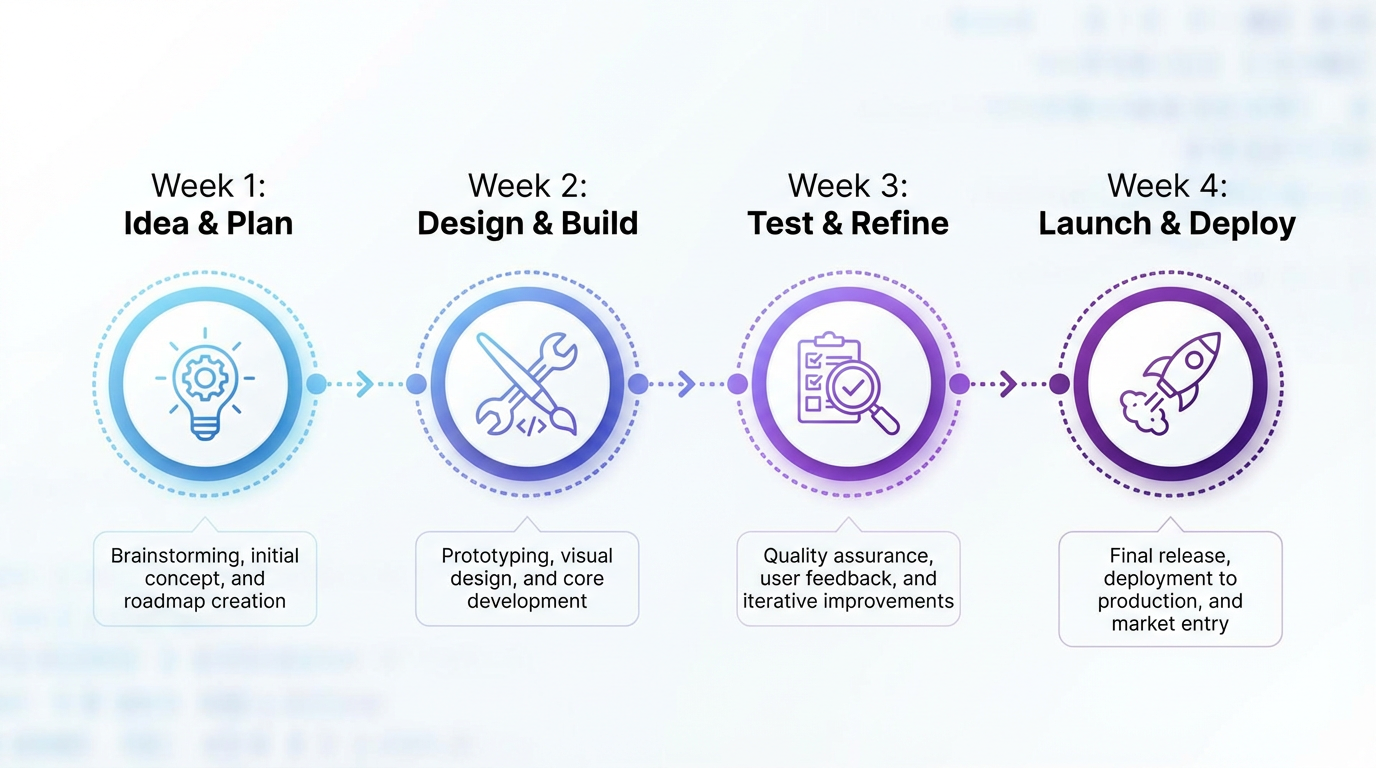
Your 30-Day Action Plan
/
FAQ
How long does it take to become fluent in English speaking?
A: Most learners can hold comfortable everyday conversations in 6-12 months with consistent daily practice (20+ min/day).
British English or American English — which should I focus on?
A: Pick one for pronunciation, but expose yourself to both. Clarity and confidence matter more than accent.
Is it too late to learn speaking as an adult?
A: Not at all. Adults have better discipline and can use deliberate practice strategies that children can't.
What if I make mistakes while speaking?
A: You will — and that's normal. Every mistake is a signal telling you what to improve next. Communication beats perfection.
Can I learn speaking without a teacher?
A: Yes. AI tutors, language exchange apps, podcasts, and self-recording give you everything you need in 2026.
How do I overcome the fear of speaking?
A: Start where it feels safe: talk to yourself, then to AI, then gradually increase to real conversations. Fear fades with exposure.
Final Thought
Learning to speak English isn't about reaching perfection. It's about reaching a point where you can express yourself freely, connect with people, and handle real conversations without panic.
That point is closer than you think. Start today — even if it's just five minutes of talking to yourself in English. The best time to start was last year. The second best time is right now.
Ready to start practicing? Try having a free conversation with an AI tutor at TalkMe — no pressure, no judgment, just practice.



Comments
No comments yet.
Leave a Comment