

You've been studying English for years. You can read articles, understand grammar rules, and even write decent essays. But the moment someone says "Let's have a conversation in English" — your mind goes blank.
Sound familiar?
You're not alone. Speaking is the skill that trips up the most English learners — and it's also the one that matters most in real life. This guide will show you exactly how to learn English speaking from the ground up, covering the best methods, practice strategies, and mindset shifts that actually lead to fluency.
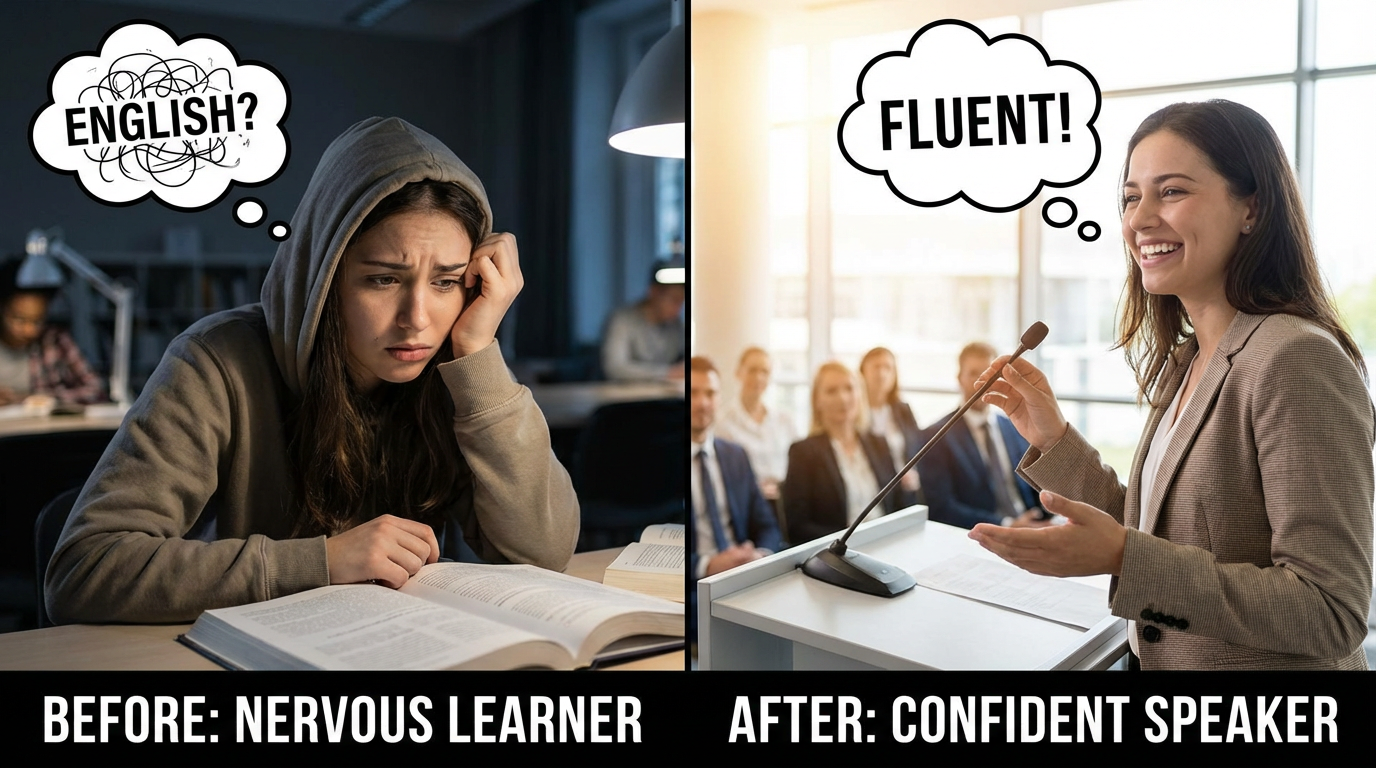
Why English Speaking Feels So Hard
Before diving into solutions, let's understand the problem.
Most traditional English education focuses on reading and writing — grammar exercises, vocabulary tests, translation drills. These methods build passive knowledge, but speaking requires active production. It's a completely different skill.
Here's what happens in your brain when you try to speak:
You think of an idea
You search for the right words
You remember grammar rules
You try to string everything together
You worry about pronunciation
You say it (or freeze up)
Steps 2–5 all happen in less than a second for fluent speakers — but for learners, each step feels like a separate, slow process. The good news? With the right practice, you can train your brain to do all of this automatically.
The 5 Core Principles of Learning English Speaking
1. Speaking Practice ≠ Language Study
This is the biggest mistake learners make. They spend 90% of their time studying and 10% speaking — when it should be the other way around.
Reading grammar books and watching English movies is preparation for speaking, not speaking itself. You need to actually open your mouth and produce English regularly.
Rule of thumb: If you want to speak well, you need to speak every day.
2. Quantity Beats Perfection
Many learners wait until they "know enough English" to start speaking. But fluency comes from high-volume repetition, not from waiting until you're perfect.
Think about how babies learn to speak: they babble, make mistakes, get corrected, and repeat. They don't study grammar charts before trying to talk.
Give yourself permission to make mistakes. Every error is data — it shows you exactly what you need to practice next.
3. Comprehensible Input is Your Foundation
Linguist Stephen Krashen's research showed that we acquire language by understanding messages slightly above our current level (he called this "i+1").
In practice, this means:
Listen to and read English content that's challenging but mostly understandable
Don't drown yourself in content that's 80% incomprehensible
Prioritize contextual learning over isolated vocabulary lists
4. Speaking and Listening Are Inseparable
You can't improve your speaking without improving your listening. When you understand how fluent speakers actually talk — their rhythm, connected speech, contractions, and reductions — your own speaking improves dramatically.
Great listeners become great speakers.
5. Build a Feedback Loop
Studying alone has limits. To improve rapidly, you need feedback — someone or something to tell you when your pronunciation is off, when your sentence sounds unnatural, or when you've made a grammar mistake.
This is where conversation partners and AI-powered tools (more on this later) become invaluable.
Step-by-Step: How to Learn English Speaking Effectively
Step 1: Start with Phonetics — Get Your Sounds Right
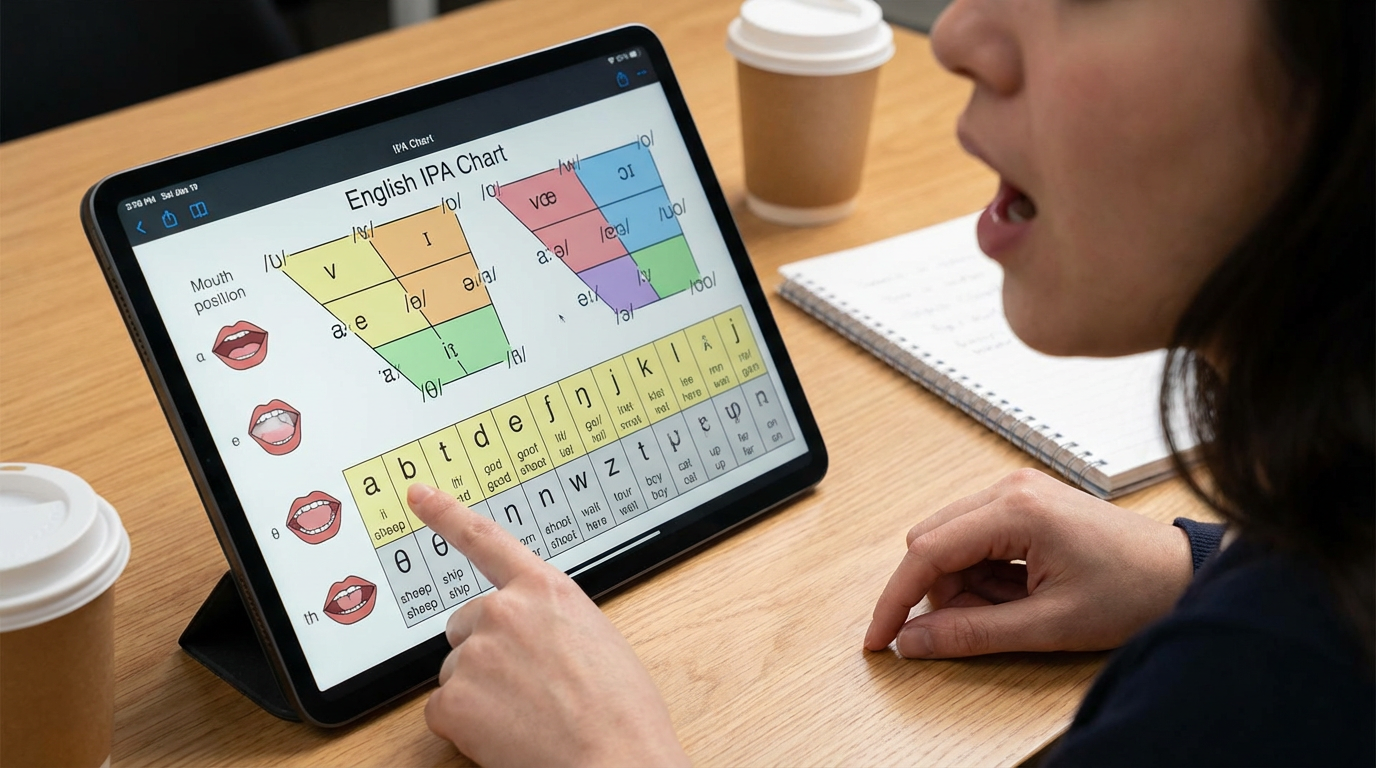
Before you worry about fluency, make sure your foundation sounds are correct.
English has 44 phonemes (distinct sounds) — significantly more than many other languages. Common problem areas include:
Vowel sounds:
Short vs. long vowels: sit vs. seat, full vs. fool
The schwa sound (ə): the most common sound in English, found in about, problem, lesson
Consonant sounds:
The TH sounds: voiced /ð/ (the, this, that) vs. unvoiced /θ/ (think, three, both)
/v/ vs. /b/: very vs. berry
/r/ vs. /l/: a challenge for many Asian language speakers
How to practice:
Use the International Phonetic Alphabet (IPA) as a reference
Watch YouTube videos showing mouth movements for each sound
Record yourself and compare to native speaker models
Practice minimal pairs (words that differ by one sound): ship/sheep, pull/pool, van/ban
Step 2: Build a Strong Vocabulary for Conversation
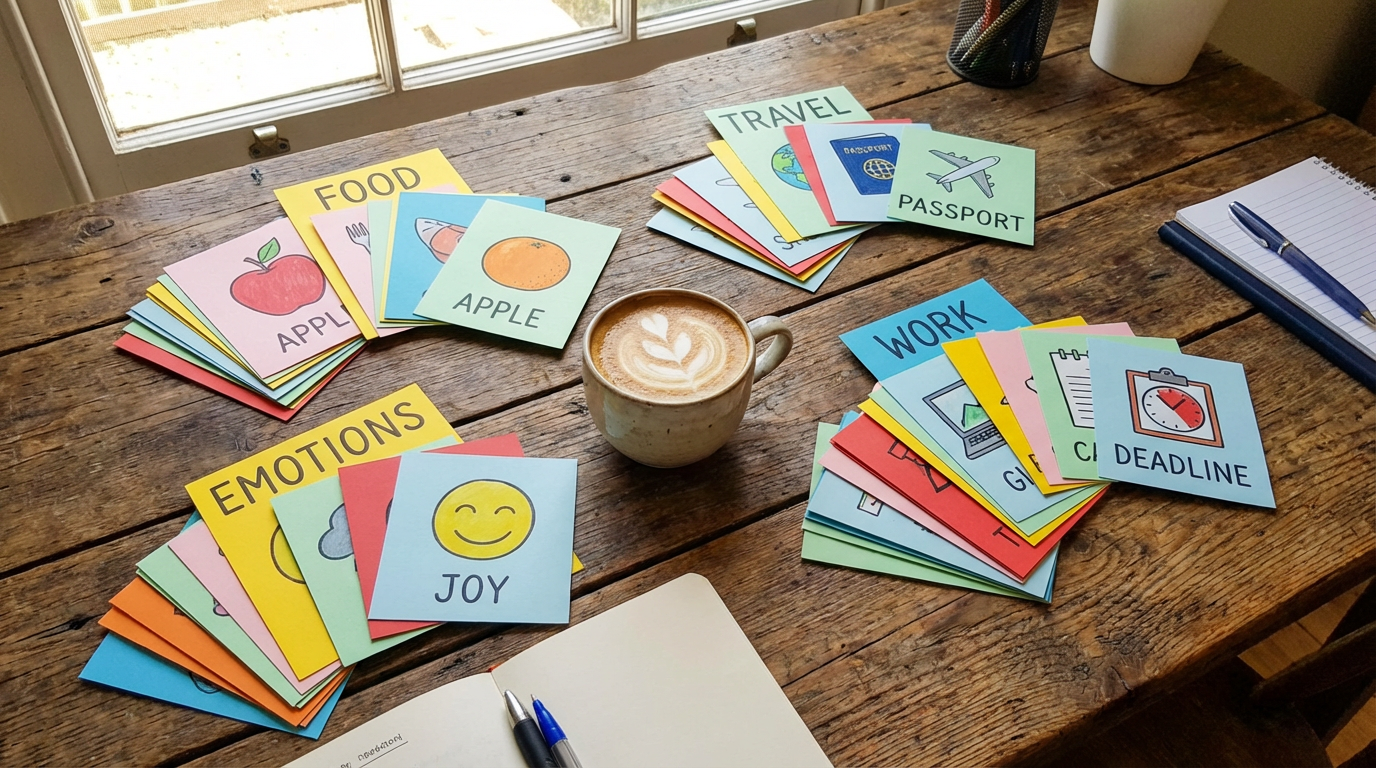
You don't need a huge vocabulary to start speaking. Research suggests that the 3,000 most common English words cover around 95% of everyday conversation.
Focus on:
High-frequency vocabulary first:
Greetings and small talk (How's it going? Not bad, yourself?)
Feelings and opinions (I think..., In my opinion..., I feel like...)
Time expressions (recently, lately, used to, going to)
Filler phrases (You know what I mean? Let me think... That's a good point.)
Vocabulary in context:
Don't memorize isolated words — learn them in example sentences that show how they're actually used.
Instead of:
persist — to continue firmly
Learn it as:
"She persisted in her studies even when things got difficult."
Topic-based clusters:
Group vocabulary by theme: work, travel, family, hobbies, emotions. This makes words easier to recall mid-conversation.
Step 3: Master the Most Important Grammar Patterns for Speaking
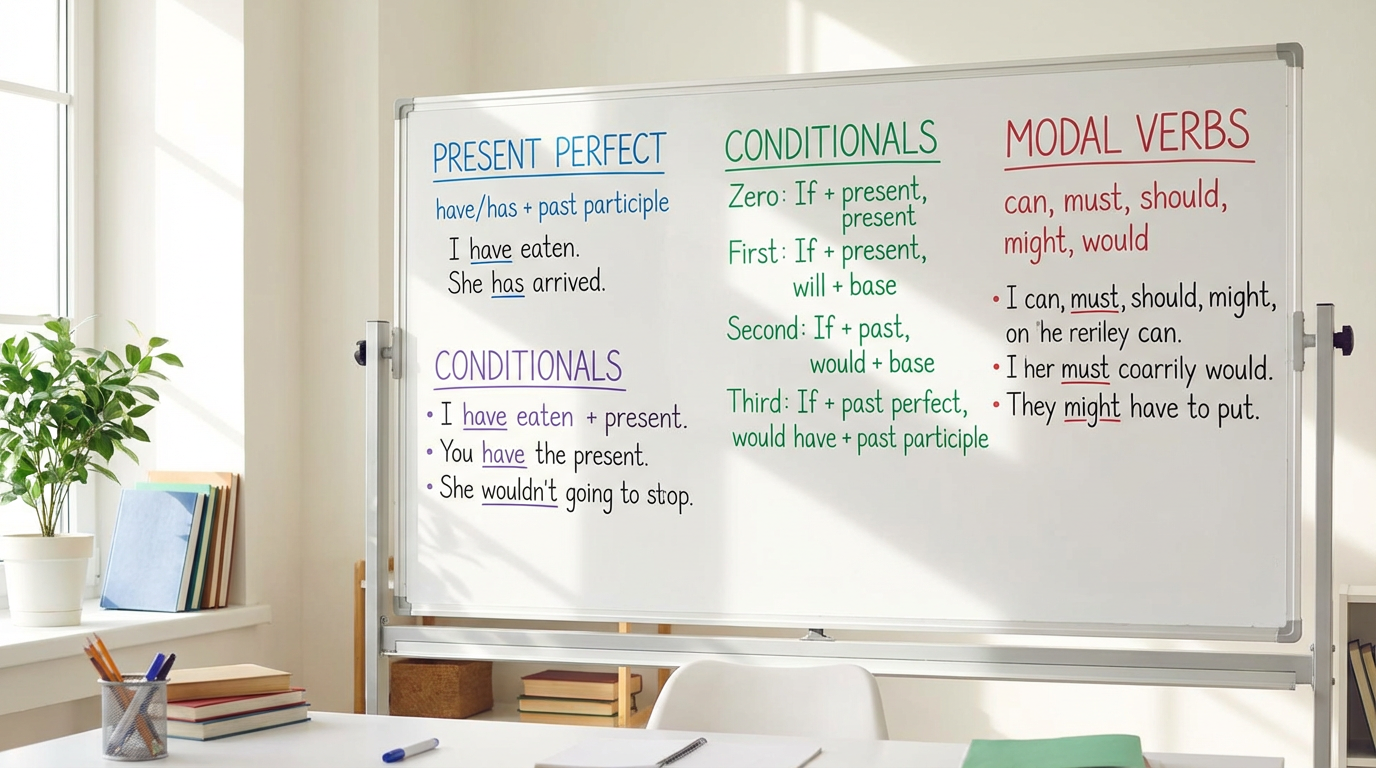
You don't need to master every grammar rule before speaking. Focus on the patterns that come up most in real conversations:
1. Present Perfect (I have/I've + past participle)
Use this to talk about past experiences without specifying when:
I've been to London twice.
Have you ever tried sushi?
I haven't seen that movie yet.
2. Conditional Sentences (If... then...)
Essential for hypothetical conversations:
Real conditions: If it rains, I'll take an umbrella.
Hypotheticals: If I had more time, I'd travel more.
Past regrets: If I had studied harder, I would have passed.
3. Modal Verbs (can, could, would, should, might)
These carry huge amounts of social meaning:
Could you help me with this? (polite request)
You should try this restaurant. (recommendation)
I might be late. (uncertainty)
4. Phrasal Verbs
Native speakers use these constantly. Start with high-frequency ones:
give up, look forward to, run out of, bring up, figure out
Grammar tip: Practice grammar patterns through speaking drills, not just written exercises. Say each pattern out loud at least 10 times until it feels automatic.
Step 4: Develop Your Listening Skills in Parallel

Your speaking can't exceed your listening. Here's how to build world-class listening comprehension:
Active vs. Passive Listening
Passive listening (having English on in the background) helps with exposure but has limits.
Active listening is where real improvement happens:
Listen to a short clip (60–90 seconds)
Try to transcribe what you hear
Check the transcript/subtitles
Note words, phrases, and connected speech patterns you missed
Listen again — notice the patterns you couldn't catch before
Resources for different levels:
Train your ear for natural speech
Native English speakers don't speak like textbooks. They:
Contract everything: I'm gonna, wanna, gotta, kinda, sorta, shoulda
Link words together: "What are you going to do?" sounds like "Whatcha gonna do?"
Reduce unstressed syllables: "I can do it" → "I c'n do it"
Tuning into these patterns transforms your comprehension — and your speaking.
Step 5: Practice Speaking Every Single Day
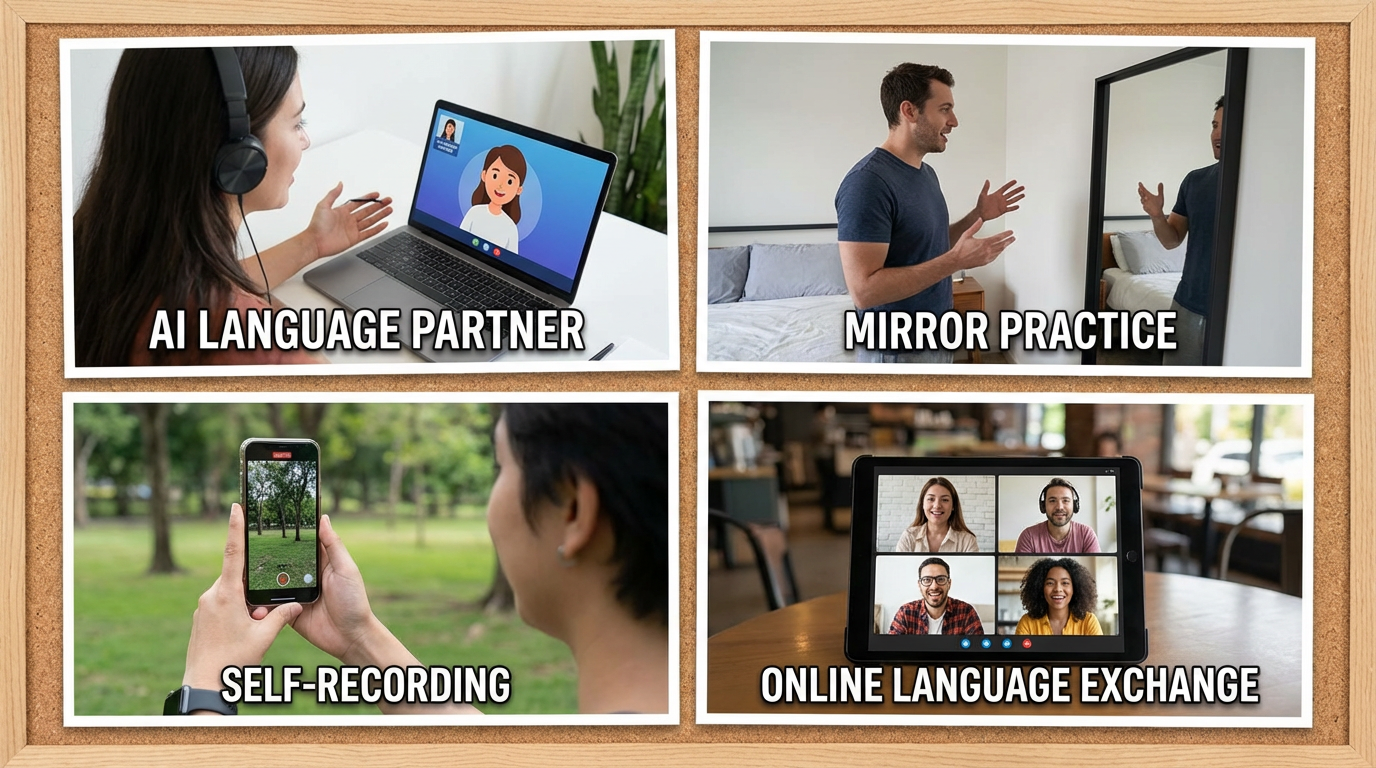
This is the step most people skip because it feels uncomfortable. Push through the discomfort — this is where the magic happens.
Method 1: Self-Talk
Narrate your daily activities in English:
"I'm making coffee. I usually take it black, but today I feel like adding some milk."
"I need to reply to that email, but first I'll finish this report."
This trains your brain to think in English without the pressure of a real conversation.
Method 2: Shadowing
This powerful technique involves listening to a native speaker and repeating immediately — matching their rhythm, intonation, and connected speech.
How to shadow:
Choose an audio clip with a transcript (podcast, movie scene, TED Talk)
Listen once through
Play it again, speaking along in real-time
Focus on sounding like the speaker — not just saying the words
Method 3: Speaking with Real People
Nothing replaces human conversation. Options include:
Language exchange partners (apps like Tandem, HelloTalk)
Online tutors (italki, Preply)
Conversation groups (Meetup, local conversation clubs)
AI conversation practice (more below)
Method 4: Record and Review
Record a 2–3 minute monologue on any topic. Then listen back critically:
Are your sentences clear?
Do you use filler words excessively (um, uh, like, you know)?
Are there patterns in your mistakes?
Reviewing your own speech is uncomfortable but incredibly effective.
How to Structure Your Daily English Speaking Practice
Consistency beats intensity. Here's a practical daily routine that works for busy people:
15-Minute Daily Routine
30-Minute Daily Routine (for serious improvement)
Weekly Speaking Goals
3x per week: 20-minute conversation with a real person or AI partner
Daily: 10–15 minutes of self-talk or shadowing
Weekly: Record one speaking sample and review it
Common Mistakes That Kill Your English Speaking Progress
Mistake 1: Translating in Your Head
If you're mentally translating from your native language before speaking, you'll always be slow and stilted.
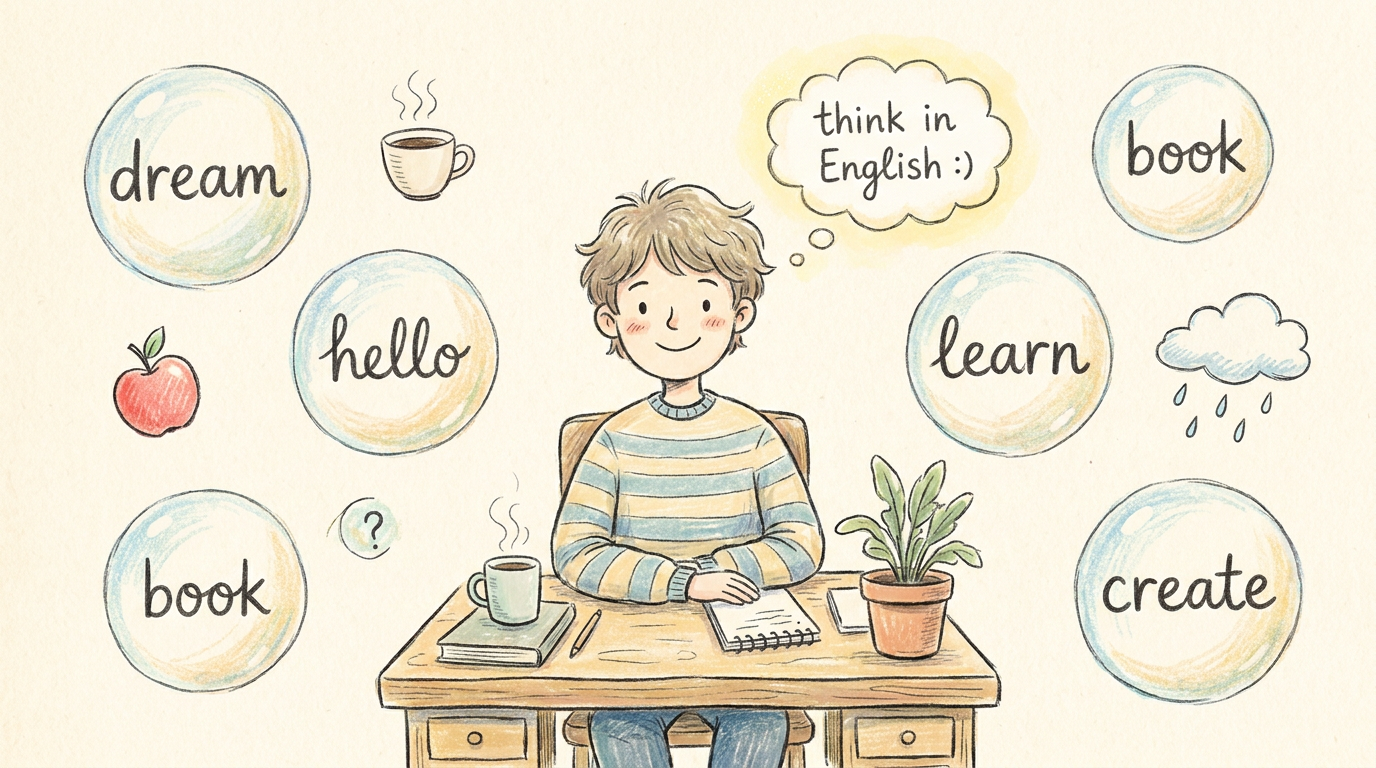
Fix: Practice thinking in English. When you see an object or experience a feeling, immediately label it in English without going through your native language.
Mistake 2: Waiting for the "Right Moment" to Practice
Learners often say: "I'll practice speaking when my vocabulary is bigger / my grammar is better / I feel more confident." This logic traps you in permanent preparation mode.
Fix: Start speaking NOW. Use what you have. Vocabulary and grammar improve through speaking, not before it.
Mistake 3: Only Practicing in Your Comfort Zone
If your conversations always follow the same script ("Hi, how are you? Fine, thanks."), you'll plateau quickly.
Fix: Actively seek out challenging topics — news stories, debates, abstract ideas, technical subjects. Discomfort is growth.
Mistake 4: Ignoring Pronunciation Until "Later"
Many learners assume pronunciation will fix itself. It often doesn't — bad habits get entrenched over time.
Fix: Address pronunciation early. Get feedback on your most persistent errors and practice them specifically.
Mistake 5: Studying Without Speaking
Hours of vocabulary apps and grammar videos feel productive — but they're not the same as speaking practice.
Fix: For every hour you spend studying English, spend at least 30 minutes speaking English.
The Role of Technology in Learning English Speaking
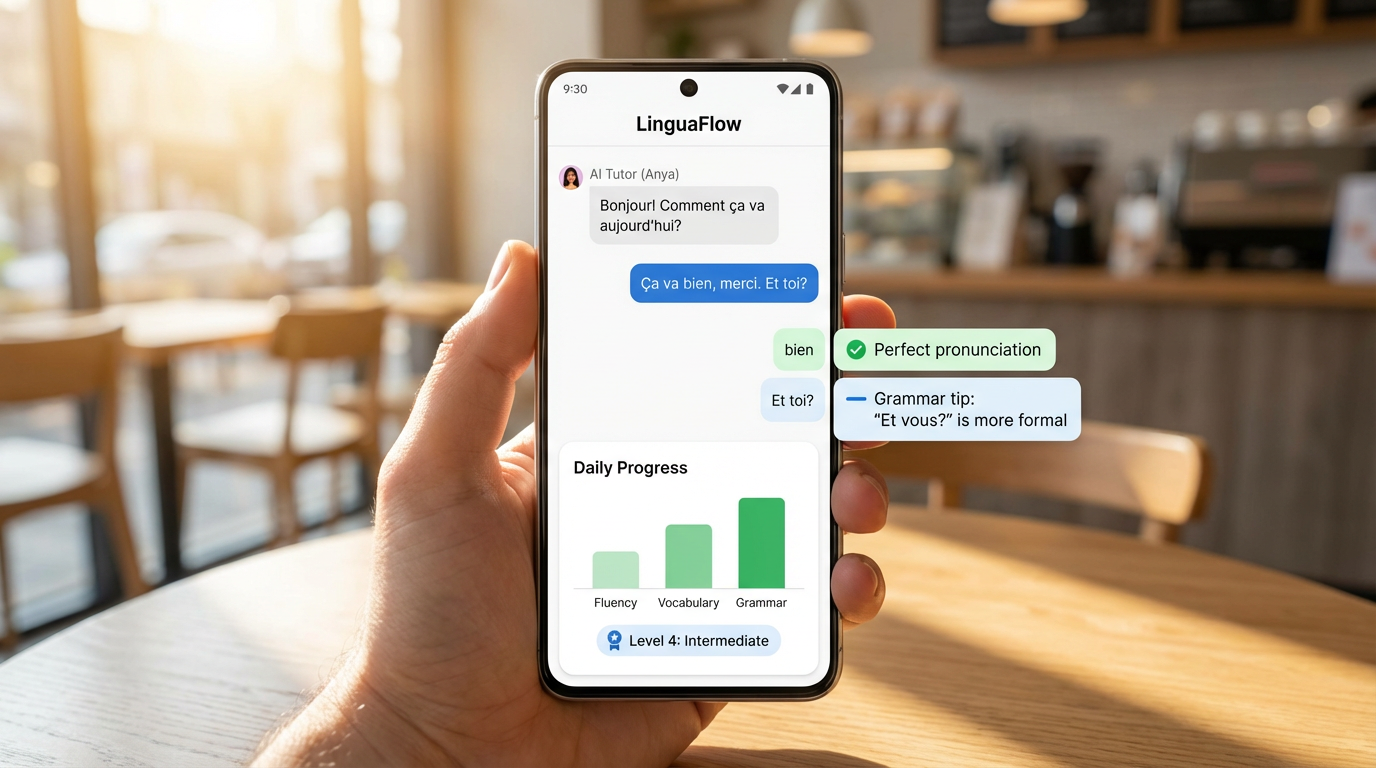
Technology has transformed what's possible for solo English learners. The best tools today give you:
AI Conversation Partners
AI-powered speaking tools like TalkMe let you have unlimited English conversations on any topic, 24/7, with instant feedback on your pronunciation, grammar, and word choice. Unlike human tutors, you can practice at 2 AM, repeat the same scenario 20 times without embarrassment, and get objective feedback every time.
Try TalkMe at talkme.ai — it's designed specifically for learners who want to build real speaking confidence through conversation.
Pronunciation Apps
Tools like ELSA Speak use AI to give you phoneme-level feedback — identifying exactly which sounds you're producing incorrectly and giving targeted drills.
Spaced Repetition for Vocabulary
Apps like Anki use algorithms to help you review vocabulary at the optimal moment before you forget it — keeping useful words active in your long-term memory.
Video Conferencing for Language Exchange
Platforms like italki and Tandem connect you with native speakers for language exchange or paid lessons — giving you access to authentic conversation partners worldwide.
Building Fluency: A Realistic Timeline
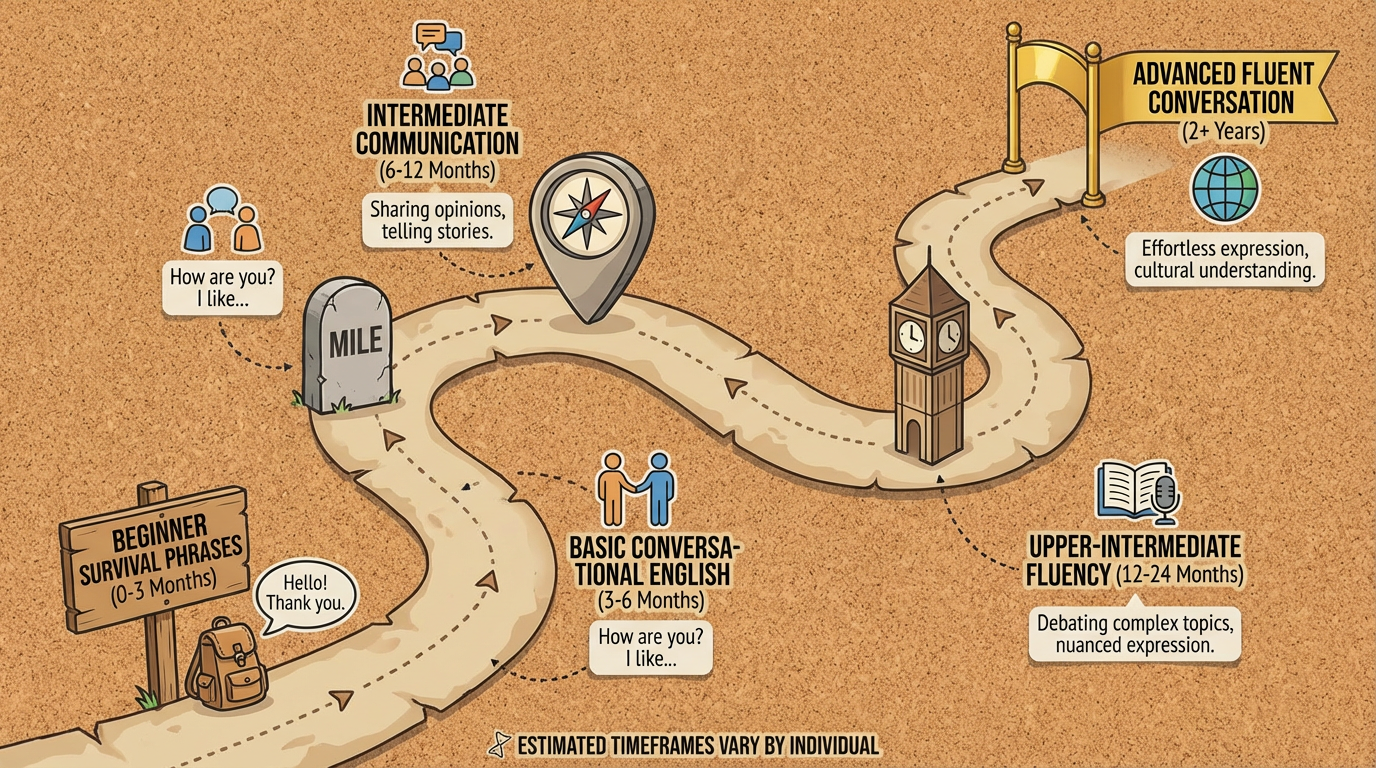
One of the most demotivating things about language learning is not knowing how long it will take. Here's a realistic picture:
Survival English (A1–A2): 3–6 months
Handle basic introductions and small talk
Ask simple questions and understand responses
Navigate common situations (shopping, directions, ordering food)
Daily practice needed: 30 minutes/day
Conversational English (B1–B2): 6–18 months
Discuss most topics in everyday life
Express opinions with nuance
Follow movies and podcasts without struggling
Daily practice needed: 45–60 minutes/day
Fluent English (C1–C2): 18 months–3+ years
Speak naturally without searching for words
Understand accents, slang, humor, and idioms
Think and dream in English
Daily practice needed: 60+ minutes/day
Important caveat: These timelines assume consistent daily practice with substantial speaking time. Passive exposure alone (watching movies without actively engaging) will make progress much slower.
Speaking Practice by Situation: Real Phrases That Work
Job Interviews
"I'd like to highlight my experience in..."
"That's a great question. From my perspective..."
"I'm most proud of [achievement] because..."
"I'm still developing [skill], but here's how I'm approaching it..."
Casual Conversations
"What's your take on [topic]?"
"Funny you mention that — I was just thinking about..."
"I could be wrong, but I think..."
"That reminds me of..."
Presentations and Public Speaking
"Today, I'd like to walk you through..."
"Let me give you an example."
"To summarize the key points..."
"I'd be happy to take any questions."
Handling Communication Breakdowns
"Sorry, could you repeat that more slowly?"
"I'm not sure I caught that — did you say...?"
"Let me make sure I understand — you're saying that...?"
"Could you say that in a different way?"
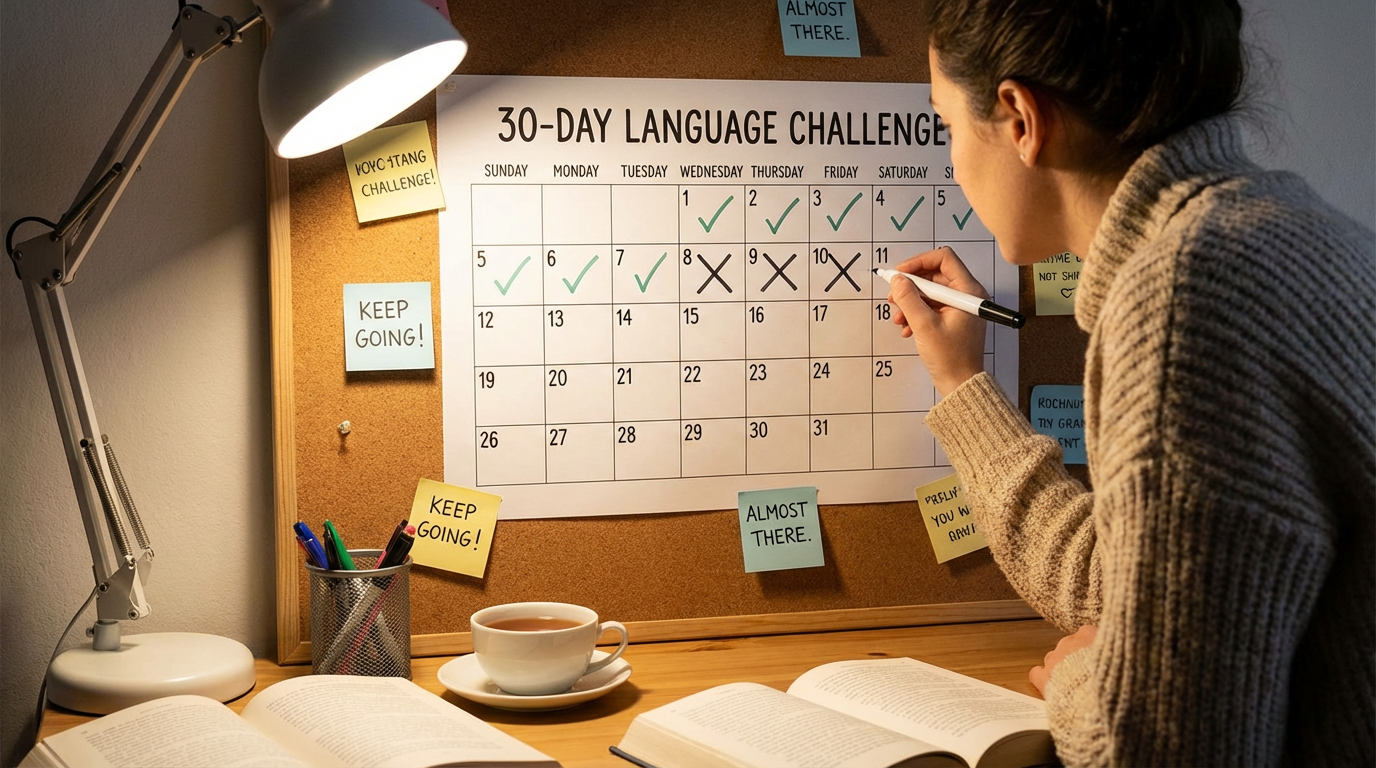
Your 30-Day English Speaking Challenge
Want a concrete plan to kick-start your progress? Here's a 30-day challenge:
Week 1 – Foundation
Day 1–3: Learn the IPA chart and practice the 5 vowel sounds that trip you up most
Day 4–5: Record yourself speaking for 2 minutes. Set it as your benchmark.
Day 6–7: Start self-talk habit. Narrate your morning routine in English.
Week 2 – Input Overload
Day 8–10: Choose one podcast/show. Listen to the same 5-minute clip daily. Shadow it.
Day 11–12: Learn 30 conversational phrases you'll actually use
Day 13–14: Have your first conversation practice (AI, tutor, or partner). Don't worry about being perfect.
Week 3 – Real Conversations
Day 15–17: Have 3 conversation sessions this week. Push for 20 minutes each.
Day 18–19: Focus on one grammar pattern. Use it 20 times in speech this week.
Day 20–21: Record yourself again. Compare to Day 1. Celebrate the progress.
Week 4 – Challenge Up
Day 22–24: Tackle a topic you've never discussed in English (technology, philosophy, politics, etc.)
Day 25–27: Try 1 full hour of English immersion — only think, speak, and consume in English
Day 28–30: Reflect on your progress. Set your next 30-day goal.
Frequently Asked Questions
Q: How long does it take to learn to speak English fluently?
A: Most learners reach conversational fluency (B2 level) in 6–18 months with consistent daily practice. Full fluency (C1/C2) typically takes 2–4 years. The key variable is how much speaking practice you do — not just how long you study.
Q: Can I learn to speak English without a teacher?
A: Absolutely. With today's AI speaking partners, language exchange apps, and self-study resources, it's entirely possible to become fluent without a traditional teacher. That said, occasional feedback from a qualified tutor can accelerate progress, especially for pronunciation.
Q: What's the best way to practice English speaking alone?
A: Self-talk (narrating your day), shadowing native speakers, and using AI conversation tools are the top three methods for solo practice. Among these, AI conversation tools like TalkMe are particularly effective because they give you real-time feedback and unlimited practice scenarios. Check out blog.talkme.ai for more speaking practice tips.
Q: Is it normal to feel nervous speaking English?
A: Completely normal. Language anxiety affects the majority of learners. The most effective way to overcome it is gradual exposure — start with low-stakes situations (talking to yourself, AI tools) and gradually work toward higher-stakes conversations.
Q: Should I focus on British English or American English?
A: Either works — choose the accent from the culture you interact with most. Consistency is more important than the choice itself. That said, it helps to expose yourself to multiple accents so you can understand a wide range of speakers.
Q: My grammar is good but my speaking is slow. What should I do?
A: This is extremely common. Your grammar knowledge is stored as explicit knowledge (you can think about it), but fluent speaking requires implicit knowledge (automatic). The bridge between them is high-volume speaking practice. Use your grammar rules in conversation until they become second nature — that's when speed improves.
The Bottom Line: How to Learn English Speaking
Here's the truth about how to learn English speaking:
There's no shortcut. But there is a right direction.
The right direction is: speak more, study less. Get your sounds right early. Build vocabulary through context. Practice listening and speaking as twin skills. Use technology to maximize your practice time. Find real conversation partners. Be consistent.
The learners who become fluent fastest share one trait: they embrace the discomfort of speaking before they feel ready. Every awkward conversation, every mispronounced word, every moment of searching for the right phrase — these are not failures. They're reps in the gym.
Start speaking today. Your future fluent self will thank you.
Ready to put this into practice? Visit talkme.ai to start real AI-powered English speaking conversations — or explore more practical guides at blog.talkme.ai.



Comments
No comments yet.
Leave a Comment