
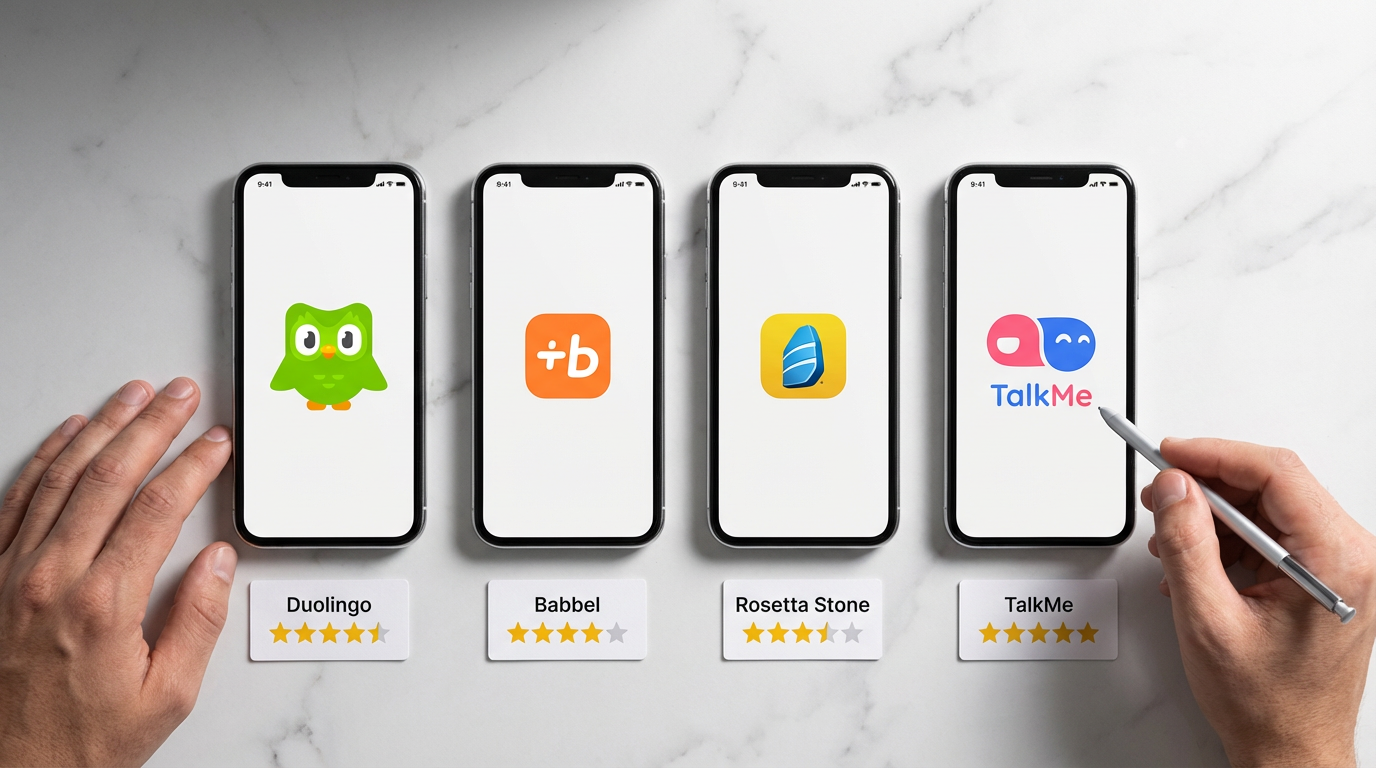
Four apps, four different philosophies — and each one has something genuinely valuable to offer.
Why We Wrote This
Language apps have come a long way. A decade ago, your options were limited. Today, there are dozens of quality tools — and the four apps in this comparison represent some of the best the industry has to offer.
We spent time with each one. We talked to learners who've used them. And we tried to answer a simple question:
Which app is right for your learning style and goals?
There's no single "best" app. But there is a best combination — and that's what this guide is about.
At a Glance
Duolingo — The Habit Builder
Duolingo has earned its place as the world's most popular language app, and for good reason. Over 500 million users have downloaded it, and its approach to keeping people engaged is genuinely impressive.
What makes it shine:
The first thing you'll notice is how easy it is to start. Duolingo's lessons are short — typically 3–5 minutes — and they're designed to feel more like a game than a study session. The streak system, XP points, and leaderboards create a satisfying loop that keeps you coming back.
With 40+ languages available, including popular ones like Korean, Japanese, French, and Spanish, Duolingo offers incredible breadth. Whether you want to learn a widely-spoken language or something more niche, chances are Duolingo has you covered.
The free tier is remarkably generous. You can access core lessons, build vocabulary, and get a solid introduction to a language's grammar patterns without spending anything. That accessibility is part of why so many people start their language journey here.
The learning experience:
Duolingo teaches through a mix of translation exercises, matching games, listening comprehension, and brief speaking prompts. The variety keeps things fresh, and the app does a good job of reinforcing vocabulary through spaced repetition.
For learners who are just beginning or who struggle with consistency, Duolingo provides the structure and motivation to build learning into a daily routine. And that daily consistency — more than any single app feature — is what drives long-term progress.
Babbel — The Structured Guide
If Duolingo is about building a habit, Babbel is about building understanding. Created by a team of over 150 linguists and language educators, Babbel takes a more methodical approach to language learning.
What makes it shine:
Babbel's courses are organized around practical, real-life scenarios. Instead of abstract vocabulary drills, you're learning phrases you'd actually use: ordering at a restaurant, navigating a train station, introducing yourself at a networking event. Everything feels purposeful.
The grammar instruction is where Babbel truly stands out. Each lesson takes time to explain why sentences are constructed the way they are. You're not just memorizing patterns — you're understanding the logic behind the language. For learners who like to know the rules before applying them, this is a breath of fresh air.
Babbel's speech recognition is solid and well-calibrated. The pronunciation exercises encourage you to produce accurate sounds, and the feedback feels constructive rather than punishing. The conversation lessons, where you build real dialogues with native-speaker audio, are particularly well-done.
There's research behind it, too. A study by the City University of New York found that 15 hours of Babbel produced results equivalent to a semester of college language instruction. That's a meaningful claim, and it holds up.
The learning experience:
Babbel's lessons feel more like a well-designed course than a casual game. Each session builds on the previous one, and the progression from beginner to intermediate is clearly mapped out. If you're someone who values structure and wants to know exactly where you're headed, Babbel delivers.
Rosetta Stone — The Immersion Specialist
Rosetta Stone has been around since 1992, and it's earned its reputation as a unique approach to language learning. Its philosophy is simple: learn a language the way you learned your first one — through immersion, without translation.
What makes it shine:
The TruAccent speech recognition technology is widely regarded as some of the best in any consumer language app. It provides detailed, real-time feedback on your pronunciation, helping you develop an authentic accent from the very beginning. For learners who care about how they sound — and many do — this is a significant advantage.
Rosetta Stone's immersive approach means you're always thinking in the target language. There are no translations to fall back on, no English crutches. You learn to associate words directly with images, actions, and concepts. Over time, this can help you develop a more intuitive feel for the language.
The milestone-based progression gives you a clear sense of advancement. You can see exactly where you are and what's coming next, which provides a satisfying sense of forward motion.
Some Rosetta Stone plans include live coaching sessions with native speakers — a feature that adds genuine conversational practice to the mix and bridges the gap between exercises and real-world application.
The learning experience:
Rosetta Stone's approach isn't for everyone, but for the right learner, it's transformative. If you've ever felt frustrated by constantly translating in your head, Rosetta Stone offers an alternative path. The immersive method takes patience, but many learners find that it leads to a deeper, more instinctive understanding of the language.
TalkMe — The Conversation Partner
TalkMe takes a fundamentally different approach from the other three apps. Instead of completing structured lessons, you have open-ended conversations with AI tutors — as naturally as you would with a real person.
What makes it shine:
The conversation experience is remarkably natural. TalkMe's AI tutors have distinct voices and conversational styles, and the dialogues flow in a way that feels genuinely spontaneous. You might be practicing a job interview in English one minute, then chatting about your weekend plans in Korean the next.
The scenarios are practical and diverse: business meetings, travel situations, casual socializing, exam preparation. Whatever your reason for learning a language, there's likely a conversation setting that matches it.
Because the AI responds in real time, you get the experience of thinking on your feet — producing language under conversational pressure, just like you would in a real interaction. That's something structured exercises, no matter how well-designed, can't fully replicate.
TalkMe provides feedback on grammar, vocabulary, and pronunciation during and after each conversation. And because it's available 24/7, you can practice whenever the mood strikes — early morning, lunch break, late at night. There's no scheduling, no waiting for a partner, and no pressure.
The learning experience:
TalkMe is designed for the moment when you've learned enough to start using the language but aren't quite confident enough to do it with real people. It fills that gap beautifully — giving you a space to practice, make mistakes, and build fluency without any embarrassment or judgment.
How They Complement Each Other
Here's the thing that most comparison articles miss: these apps aren't competitors. They're teammates.
Each one covers a different part of the language learning journey:
Many successful language learners use a combination of these tools. Duolingo gets them started. Babbel deepens their understanding. Rosetta Stone refines their pronunciation. And TalkMe gives them the practice space to actually speak.
Features at a Glance:
Finding Your Right Mix
The best approach depends on where you are in your learning journey and what matters most to you.
If you're just getting started with a new language, Duolingo is a fantastic first step. It's free, it's fun, and it'll help you build the daily habit that makes long-term learning possible.
If you want a structured path from beginner to intermediate, Babbel's courses are among the most well-designed in the industry. The grammar explanations and practical conversation scenarios give you a strong, usable foundation.
If pronunciation and accent are your priority, Rosetta Stone's TruAccent technology and immersive method are hard to beat. It's an investment, but for the right learner, it pays off.
If you're ready to have real conversations, TalkMe creates a space where you can practice speaking naturally — whenever you want, about whatever you want, without any pressure. For many learners, this is the step that transforms "I've been studying" into "I can actually speak."
Keep Going
Language learning isn't about finding the one perfect app. It's about showing up, practicing regularly, and gradually building the skills that let you connect with people in a new language.
Whichever app — or combination of apps — you choose, the most important thing is to start. And then to keep going.
Explore all four apps and find the combination that works for you. There's no wrong answer — only the one that fits your goals, your schedule, and your learning style.
Visit talkme.ai to try AI conversation practice for free. For more guides, comparisons, and language learning tips, head to blog.talkme.ai.
Frequently Asked Questions
Which language app is best for beginners?
Duolingo is the most popular starting point — it's free, fun, and excellent at building a daily learning habit. If you prefer a more structured, course-like experience, Babbel is a great choice with clear progression and solid grammar explanations. Both are excellent for laying the groundwork before moving on to more advanced practice.
Which app is best for actually speaking a language?
If speaking is your primary goal, you'll want to combine a structured learning app with a conversation practice tool. TalkMe is designed specifically for this — you have open-ended conversations with AI tutors across real-world scenarios, which trains the spontaneous language production that exercises alone can't replicate. italki (human tutors) is another strong option for live speaking practice.
Can I use multiple language apps at the same time?
Absolutely — and many successful learners do. A common approach is using Duolingo or Babbel for structured learning (vocabulary, grammar, patterns) and adding TalkMe for conversation practice. The apps complement each other well because they cover different parts of the learning process. The key is to not overload yourself — 2 apps at a time is a good rule of thumb.
Is there a free language app that actually works?
Yes. Duolingo has a generous free tier that covers core lessons and vocabulary for 40+ languages. TalkMe is free to start and provides conversation practice. HelloTalk and Tandem are free for language exchange with native speakers. You can build a solid language foundation without spending money — paid apps generally offer more structure or convenience rather than fundamentally different results.
What's the difference between Babbel and Duolingo?
Duolingo focuses on gamified, bite-sized lessons that build vocabulary and basic patterns through repetition. It's excellent for consistency and motivation. Babbel takes a more structured, course-based approach with thorough grammar explanations and practical conversation scenarios. Both are effective — Duolingo tends to work better for casual learners and habit-building, while Babbel suits learners who want a clear, guided curriculum.
Should I learn with an app or take real classes?
Apps and classes serve different purposes. Apps offer flexibility, low cost, and the ability to practice daily in short sessions. Classes provide accountability, personalized feedback, and social interaction. Many learners start with apps to build a foundation, then add classes or conversation practice (like TalkMe's AI tutors or italki's human tutors) when they're ready to start actually speaking.
This comparison was last updated in 2026 and reflects current features and experiences. App offerings may change — visit each app's official website for the latest information.



Comments
No comments yet.
Leave a Comment