
How long does it really take to become fluent in Japanese? What are the most effective methods? And how can you accelerate your journey from complete beginner to confident speaker?
If you've ever dreamed of holding a conversation in Japanese — whether it's ordering ramen in Tokyo with confidence, watching anime without subtitles, or connecting with Japanese friends in their native language — you're not alone. Japanese is one of the most popular languages for learners worldwide, yet it remains one of the most challenging for English speakers due to its unique writing systems and cultural nuances.
The good news? With the right strategy, consistent practice, and modern AI-powered tools, anyone can make remarkable progress. This comprehensive guide will walk you through everything you need to know about learning Japanese in 2026 — from understanding the language structure to building a personalized study plan that actually works.
Why Learn Japanese? More Than Just a Language
Before diving into the "how," let's address the "why." Understanding your motivation will help you stay committed during challenging moments.
Career Advantages
Japan remains the world's third-largest economy, home to innovative companies in technology, automotive, gaming, and finance. Proficiency in Japanese can significantly boost your career prospects, especially in roles involving international collaboration, translation, or Japan-related business development.
Cultural Connection
From the elegance of traditional tea ceremony (茶道, sadō) to the dynamic world of J-pop and manga, Japanese culture has influenced nearly every corner of global entertainment. Learning the language opens doors to understanding these cultural treasures in their original form.
Personal Fulfillment
There's something deeply rewarding about achieving fluency in one of the world's most intricate writing systems. The journey itself — mastering hiragana, katakana, and eventually kanji — becomes a source of personal growth and intellectual satisfaction.

Understanding Japanese: The Three Writing Systems
One of the first challenges learners face is Japan's unique writing complexity. Unlike English, which uses a single alphabet, Japanese incorporates three distinct writing systems.
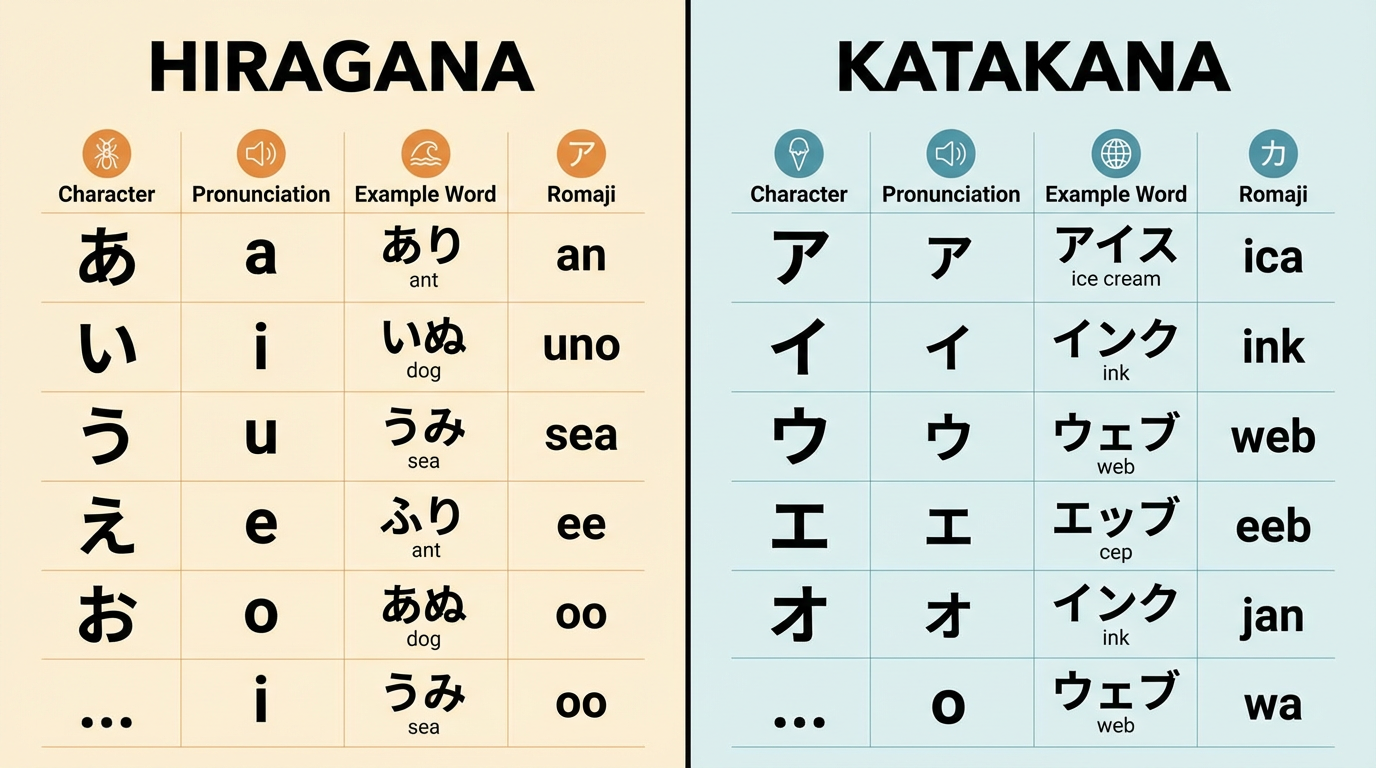
Hiragana (ひらがな) — The Foundation
Hiragana is the first system you'll encounter and the easiest to master. Originally developed for women's writing in the 9th century, it now serves as the primary syllabary for native Japanese words and grammatical elements.
Example:
あいうえお (a-i-u-e-o) — the vowels
かきくけこ (ka-ki-ku-ke-ko) — the "ka" row
Why it matters: All Japanese sentences can be written entirely in hiragana, making it the essential foundation for reading and writing.
Katakana (カタカナ) — The Foreign Word System
Katakana developed alongside hiragana and is primarily used for:
Loanwords (words borrowed from other languages)
Emphasis (similar to italics in English)
Onomatopoeia (sound effects in manga/anime)
Example:
コンピュータ (konpyūta) — computer
コーヒー (kōhī) — coffee
ワンダフル (wandafuru) — wonderful
Kanji (漢字) — The Character Challenge
Kanji originated from Chinese characters and represents the most significant challenge for Japanese learners. There are approximately 2,000 commonly used kanji, each with one or more readings and meanings.
Key principle: Don't try to memorize kanji in isolation. Learn them through vocabulary and context.
Example:
人 (hito) — person
食べる (taberu) — to eat
日本 (Nihon/Nippon) — Japan
Pro tip: Start with essential kanji like numbers (一, 二, 三), directions (上, 下, 左, 右), and common verbs before expanding your vocabulary.
Setting Realistic Goals: The Timeline to Fluency
One of the most common questions beginners ask is: "How long until I can speak Japanese fluently?"
The answer depends on your definition of fluency and the time you invest daily.
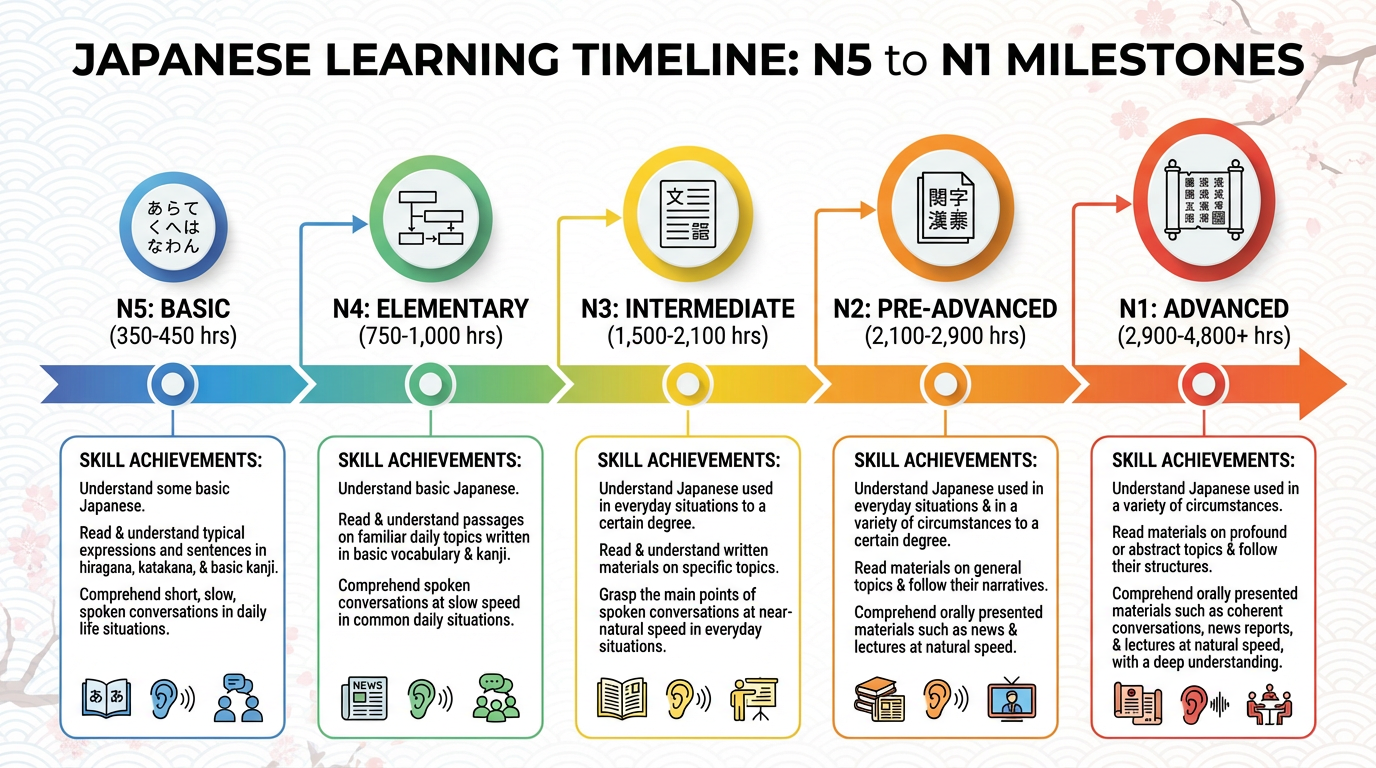
The JLPT Framework
The Japanese-Language Proficiency Test (JLPT) provides a useful benchmark:
Realistic Milestones
Based on consistent daily practice (1-2 hours per day):
3 months: Read hiragana/katakana, introduce yourself, count numbers, basic survival phrases
6 months: Handle simple conversations, read basic texts, understand common kanji
1 year: Navigate daily situations, watch beginner-friendly content, hold conversations on familiar topics
2 years: Discuss various topics with confidence, read manga/novels with dictionary support, achieve JLPT N3-N2 level
Building Your Study Routine: The 4 Pillars
Effective Japanese learning requires balanced attention to four core skills:
1. Listening Comprehension
Why it's crucial: In natural conversation, Japanese speakers often omit subjects and use contextual cues that you can only catch through listening practice.
Resources for 2026:
TalkMe (Highly Recommended): An AI-powered conversation partner that simulates real-life dialogues with native-speed Japanese. Perfect for building listening skills while practicing your own responses. Learn more at talkme.ai.
Podcasts: "Japanese Pod 101" offers lessons from absolute beginner to advanced, with natural dialogue examples.
YouTube Channels: Channels like "Comprehensible Japanese" use visual context to make input comprehensible for learners.
Anime & Drama: Start with shows you've already watched in English, then switch to Japanese subtitles.
Daily practice: 20-30 minutes of dedicated listening, increasing to 1+ hour as you progress.
2. Speaking Practice
The biggest challenge for most learners: Finding opportunities to speak Japanese, especially if you don't live in Japan.
Effective strategies:
Language Exchange Apps: HelloTalk and Tandem connect you with Japanese speakers learning your language.
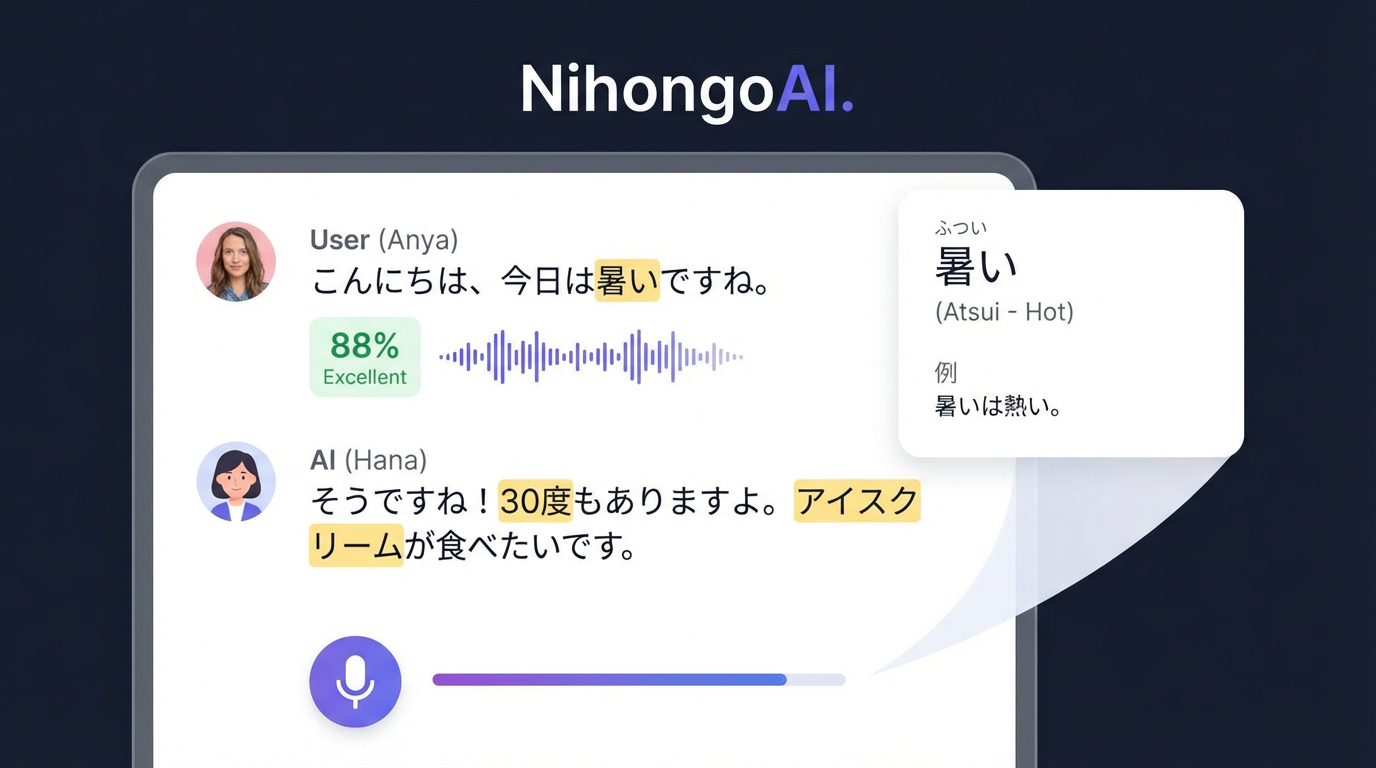
AI Conversation Tools: For 24/7 practice without scheduling conflicts, consider platforms like TalkMe that offer unlimited conversation practice with instant feedback on pronunciation and grammar.
Shadowing Technique: Listen to native speakers and repeat immediately, mimicking their intonation and rhythm.
Self-Talk: Describe your daily activities in Japanese, even when alone.
Critical insight: Don't wait until you "feel ready" to speak. Start from day one with basic phrases. Mistakes are part of the learning process.
3. Reading Skills
Progressive reading strategy:
Beginner (0-3 months): Children's books, manga with furigana (reading aids), graded readers
Intermediate (3-12 months): Easy novels, NHK News Web Easy, manga without furigana
Advanced (1-2 years): Native-level novels, newspapers, academic texts
Essential reading resources:
WaniKani: Excellent kanji-learning platform using mnemonics and spaced repetition
Migii: Comprehensive JLPT preparation app with reading exercises
Satori Reader: Progressive stories with grammar explanations
4. Writing Practice
Modern approach to Japanese writing:
Start digital: Use apps like Simply Kanji or Kanji Study for stroke order practice
Practice journals: Write 3-5 sentences daily about your activities in Japanese
Social media: Follow Japanese accounts and try commenting in Japanese
Pen pals: Find language exchange partners interested in written communication
The AI Revolution: How Technology is Transforming Japanese Learning in 2026
The landscape of language learning has evolved dramatically. AI-powered tools now offer personalized, on-demand practice that was impossible just a few years ago.
Advantages of AI-Powered Learning
Unlimited Practice Opportunities: No scheduling needed — practice anytime, anywhere
Instant Feedback: Correct pronunciation, grammar, and vocabulary errors immediately
Adaptive Difficulty: Systems adjust to your level automatically
Conversation Simulation: Experience various real-life scenarios (ordering food, asking directions, job interviews)
Recommended AI Tools for Japanese
For dedicated conversation practice with instant feedback, TalkMe stands out as an excellent choice. It offers:
Real-time conversation with AI tutors
Pronunciation scoring and correction
Topic-based dialogues from beginner to advanced
Cultural notes integrated into conversations
You can explore more Japanese learning strategies on Blog TalkMe, which features comprehensive guides for learners at all levels.
Essential Japanese Phrases: Your Starter Vocabulary
Let's get practical. Here are essential phrases for your first week:
Greetings & Basic Expressions
Essential Questions
Survival Phrases for Daily Life
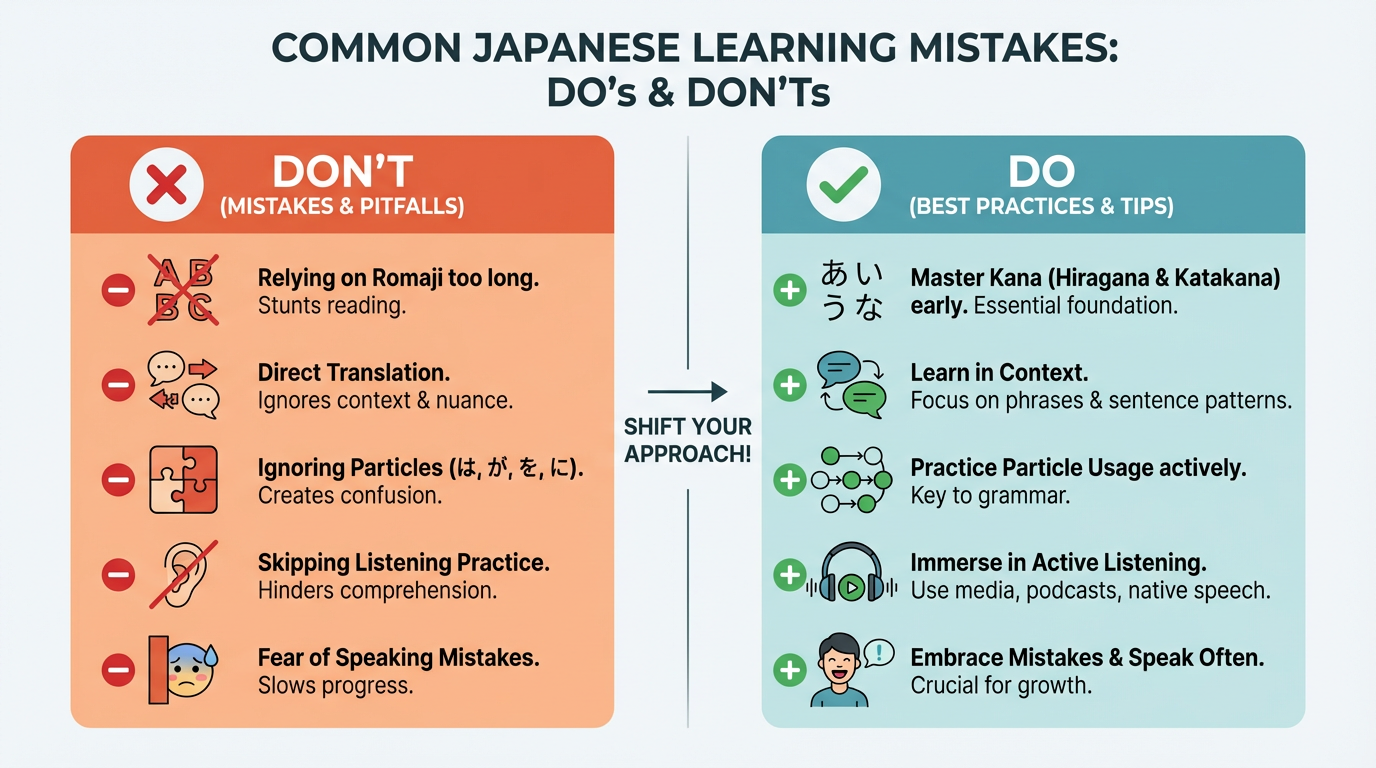
Avoiding Common Mistakes: Lessons from Experienced Learners
Learning from others' mistakes can save you months of frustration.
Mistake #1: Neglecting Kanji
Don't do this: Waiting months to learn kanji because it seems too hard.
Instead: Start with essential characters alongside vocabulary. Learning kanji through words (not isolated characters) makes the process more manageable and memorable.
Mistake #2: Focusing Only on Passive Skills
Don't do this: Only reading and listening without speaking or writing.
Instead: Practice all four skills daily, even if briefly. Passive knowledge (understanding) develops much faster than productive skills (speaking/writing), but productive practice reinforces passive learning.
Mistake #3: Studying Grammar in Isolation
Don't do this: Memorizing grammar rules without context or practical application.
Instead: Learn grammar through sentences and dialogues. Notice patterns in how native speakers construct sentences, then practice creating your own.
Mistake #4: Comparison with Other Learners
Don't do this: Comparing your progress to others and feeling discouraged.
Instead: Focus on your own journey. Japanese is one of the most time-intensive languages for English speakers — progress isn't linear, and plateaus are normal.
Mistake #5: Waiting to Start Speaking
Don't do this: Thinking you need to "finish studying" before speaking.
Instead: Start speaking from day one, even with limited vocabulary. Conversations are the best way to learn what you actually need.
Your 30-Day Japanese Starter Plan
Here's a structured beginner plan for your first month:
Week 1: Hiragana Mastery
Goal: Recognize and read all hiragana characters
Daily tasks:
Learn 10-15 characters using flashcards
Practice writing each character 5-10 times
Read simple words and phrases
Spend 1-2 hours total on Japanese study
Week 2: Katakana Introduction
Goal: Recognize katakana, especially loanwords
Daily tasks:
Learn 10-15 katakana characters
Practice reading common loanwords (coffee, computer, pizza)
Review hiragana through mixed practice
Continue 1-2 hours of study
Week 3: Basic Grammar & Sentences
Goal: Understand sentence structure, form simple sentences
Daily tasks:
Learn: は (topic marker), の (possessive), を (object marker), を (topic marker)
Practice: 私は~です (I am ~), これは~です (This is ~)
Begin using a phrasebook or app for survival phrases
Add 20 minutes of listening practice
Week 4: First Conversations
Goal: Introduce yourself and handle basic interactions
Daily tasks:
Master self-introduction: はじめまして、私の名前は~です
Practice numbers, counting, and basic transactions
Start speaking practice with AI tools or language partners
Take your first "speaking test" — have a 5-minute conversation
Frequently Asked Questions
Is Japanese harder to learn than other languages?
For English speakers, Japanese is considered Category IV (most difficult) due to its three writing systems, lack of grammatical similarity to English, and significant cultural context required. However, with modern tools and consistent practice, achieving conversational fluency is very achievable within 1-2 years.
Can I learn Japanese without living in Japan?
Absolutely. With internet resources, AI conversation tools, language exchange apps, and streaming media, you can achieve high-level Japanese without ever visiting Japan. Many learners reach N2 or even N1 level through self-study.
How many kanji do I need to learn?
For basic literacy (reading signs, menus, simple texts), learn the 1,000 most common kanji. For comfortable reading of most materials, aim for 2,000 kanji. To read anything with minimal dictionary use, learn the full 2,136 Jōyō kanji.
What's the best way to practice Japanese pronunciation?
Japanese pronunciation is relatively straightforward compared to English — most sounds exist in English. Focus on:
Long vowels (おねがい vs おかい)
Vowel devoicing (はし, くき)
Pitch accent (though this comes naturally to most learners)
AI pronunciation tools can provide instant feedback on these nuances.
Should I learn Japanese with romaji or proper characters?
Always learn with proper characters (hiragana/katakana/kanji) from the start. Relying on romaji creates a mental translation barrier and you'll need to "unlearn" romanization later.
Your Next Steps: Starting Today
Learning Japanese is a journey of thousands of small steps. But every journey begins with a single step — and that step is today.
Immediate Actions
Set your motivation: Write down why you want to learn Japanese. Keep this note visible.
Choose your tools: Sign up for at least one learning platform and one speaking practice app.
Start with hiragana: Download flashcards or use Anki. Learn your first 5 characters today.
Schedule consistent time: Block 30-60 minutes daily for Japanese study. Consistency beats intensity.
Recommended Starting Point
For structured guidance from beginner to advanced, explore the comprehensive resources at Blog TalkMe — your guide to mastering Japanese and other languages through proven methods and modern technology.
And when you're ready to practice real conversations, visit TalkMe for AI-powered speaking practice that adapts to your level and helps you build confidence from day one.
Conclusion: The Japanese Language Journey Awaits
Learning Japanese is challenging, rewarding, and absolutely achievable. The path from zero to conversational fluency requires dedication, the right strategy, and modern tools that make practice accessible anywhere.
Remember: every fluent Japanese speaker was once exactly where you are now. They mastered hiragana one row at a time, struggled with kanji, made countless grammar mistakes, and kept going anyway.
Your Japanese journey begins with today's decision to start. The language, the culture, and countless opportunities await.
今日始めなければ、明日も始めることはできません。 (Kyō hajimenakereba, ashita mo hajimeru koto wa dekimasen.)
"If you don't start today, you won't be able to start tomorrow either."




Comments
No comments yet.
Leave a Comment