
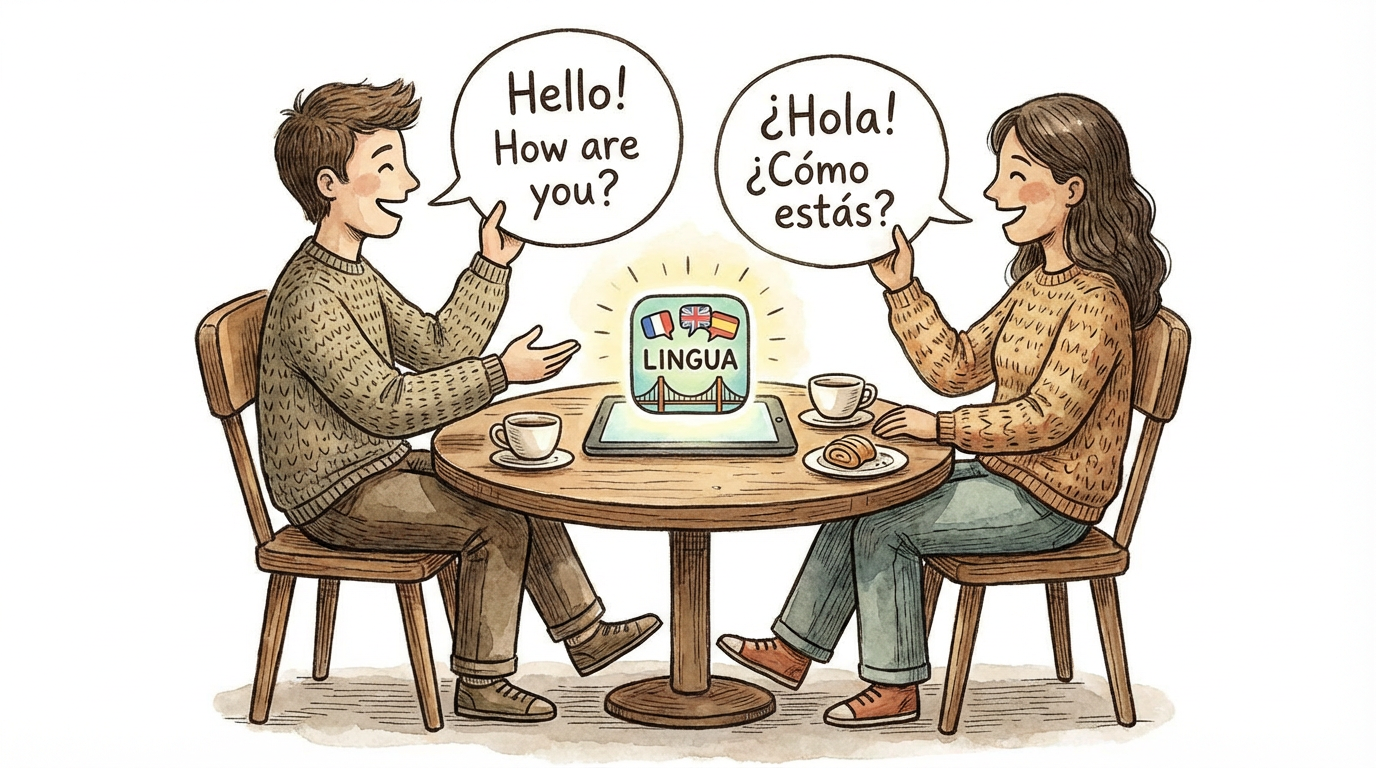
If you've ever wished you could practice your target language with a real person — not just an app — then language exchange is exactly what you need. In 2026, there are more options than ever to connect with native speakers around the world. This guide breaks down the best language exchange websites and apps, how they work, and how to get the most out of every session.
What Is a Language Exchange?
A language exchange (also called a "tandem" exchange) is a mutual learning arrangement between two people who speak different native languages. You help your partner practice your language, and they help you practice theirs. It's free, authentic, and one of the fastest ways to build real conversational fluency.
The key benefits:
Real conversations with native speakers (not textbook scripts)
Cultural insights you can't get from an app
Immediate feedback on pronunciation and natural phrasing
Mutual motivation — you're helping someone too
Zero cost in most cases
Top Language Exchange Websites in 2026
1. Tandem
Best for: Serious learners who want structured sessions
Tandem has grown into one of the most popular language exchange platforms with over 10 million users. It uses a matching algorithm to connect you with compatible partners based on your native language, target language, learning goals, and interests.
Key features:
Audio and video call integration (no need to switch apps)
Built-in translation tool and correction feature — partners can highlight and correct your text in real time
"Community" section with tutors and topic-based conversations
Available as a mobile app (iOS/Android) and desktop
Best for: Learners at intermediate level and above who want consistent, goal-oriented exchange partners.
![blog-EN[EN-022]-Best Language Exchange Websites and Apps in 2026 1.png](/upload/blog-EN%5BEN-022%5D-Best%20Language%20Exchange%20Websites%20and%20Apps%20in%202026%201.png)
2. HelloTalk
Best for: Casual learners who want social-style language practice
HelloTalk blends language exchange with a social media feed. You can post "Moments" (like Instagram stories) in your target language and get corrections from native speakers — similar to crowdsourcing feedback.
Key features:
Moments feed for daily language practice (voice, text, photo)
Translation, transliteration, and romanization tools built into chat
Voice message and call features
150+ languages supported
Best for: Beginners who want low-pressure, social-style practice and aren't ready for full video calls yet.
Tip: Use Moments every day even for just one sentence. Native speakers will correct you naturally, and it builds a writing habit fast.
3. Speaky
Best for: Quick matching and multilingual learners
Speaky is a lightweight language exchange platform focused purely on connecting partners. With over 1 million users speaking 110+ languages, it's a good option if you want variety and flexibility.
Key features:
Fast partner matching (within minutes)
Simple interface — less feature bloat than Tandem or HelloTalk
Chat, audio, and video options
Available on web and mobile
Best for: Learners who want a simple tool to find a partner quickly without too many distractions.
4. Italki
Best for: Combining exchange with professional tutoring
Italki is unique because it bridges the gap between language exchange (free community conversations) and paid professional tutoring. You can book sessions with certified teachers starting from as low as $5/hour, or participate in free community discussions.
Key features:
Marketplace with 10,000+ tutors and community tutors
Language exchange section: post a "Language Partner Request"
Notebook feature: write entries in your target language and get corrections from the community
Large community for less common languages (e.g., Swahili, Catalan)
Best for: Learners who want the flexibility to combine free exchange with occasional paid lessons for structured feedback.
5. Conversation Exchange
Best for: Simple, no-frills partner matching
One of the oldest language exchange websites still running, Conversation Exchange (conversationexchange.com) is a simple directory-style platform where you can search for partners by language, country, or learning format (face-to-face, chat, email pen pal).
Best for: Learners who want to arrange in-person exchanges or email-based penpals for a slower-paced learning style.
6. Discord Language Servers
Best for: Community immersion and group conversation practice
Discord has become a massive hub for language learners. Dedicated servers like the "Language Learning" server (400,000+ members) and individual language-specific servers (e.g., "Learn Korean," "Español World") host:
Daily writing challenges
Voice chat rooms for speaking practice
Native speaker volunteers who answer questions
Best for: Learners who thrive in community settings and want exposure to informal, authentic language use.
![blog-EN[EN-022]-Best Language Exchange Websites and Apps in 2026 2.png](/upload/blog-EN%5BEN-022%5D-Best%20Language%20Exchange%20Websites%20and%20Apps%20in%202026%202.png)
How to Make Language Exchange Actually Work
Finding a partner is the easy part. The real challenge is staying consistent and making sessions productive. Here's what actually works:
Structure your sessions
Don't just "chat." Divide your 30–60 minute session:
15 minutes: your partner speaks their target language (you correct them)
15 minutes: you speak your target language (they correct you)
10 minutes: free conversation on a shared topic
Pick a focus topic in advance
Before each session, agree on a theme: travel, food, movies, work, a news article. This prevents the dreaded "so… what do you want to talk about?" dead zone.
Ask for specific corrections
Tell your partner: "Please correct me every time I make a grammar mistake" or "Focus only on unnatural word choices today." Partners often go easy on you — be explicit.
Use AI conversation tools between sessions
Language exchange works best when supplemented with daily practice. Tools like TalkMe (talkme.ai) let you have AI-powered conversations in your target language 24/7 — perfect for practicing between partner sessions without the scheduling pressure.
How TalkMe + language exchange work together:
Use TalkMe daily for low-stakes fluency building, then bring your improved skills into your weekly exchange session for authentic feedback from a real person. The two approaches are highly complementary.
Common Language Exchange Mistakes to Avoid
Mistake 1: Switching entirely to English when things get hard
This defeats the purpose. When you hit a wall, use simpler sentences — don't bail out.
Mistake 2: Spending too much time helping your partner
It's a mutual exchange. If you're spending 45 minutes helping them and 10 minutes on yourself, renegotiate.
Mistake 3: Skipping correction feedback
Some partners will be polite and not correct you. Tell them explicitly: "I want real corrections — don't worry about hurting my feelings."
Mistake 4: Giving up after a bad match
Not every partner will be a good fit. If a match doesn't click after 2–3 sessions, move on. Most platforms let you connect with multiple partners.
Mistake 5: Only using one platform
Different platforms serve different needs. Use HelloTalk for casual daily writing, Tandem for structured calls, and Discord for community immersion.
Choosing the Right Platform for Your Level
Languages Best Suited for Exchange
Language exchange works especially well for:
Spanish — Huge global community, easy to find partners
English — Almost every non-native speaker wants to practice
Korean — K-pop and K-drama have driven massive demand
Japanese — Strong Tandem/HelloTalk communities
French, German, Portuguese — Good availability, especially on Speaky and Italki
Less common languages (e.g., Vietnamese, Swahili, Icelandic) have smaller but dedicated communities on Italki and Discord.
30-Day Language Exchange Challenge
Want to jumpstart your progress? Try this:
Week 1: Sign up for Tandem or HelloTalk. Post one "Moment" or message per day in your target language. Don't worry about mistakes.
Week 2: Schedule your first video call session. Use the 15/15/10 structure above. Debrief after: what new words did you learn?
Week 3: Join one Discord language server. Participate in a daily writing challenge or voice channel at least 3 times this week.
Week 4: Combine: 3 exchange sessions + daily TalkMe AI practice. Track your progress by recording a 1-minute voice memo at the start and end of the week.
FAQ
Q: Is language exchange effective for complete beginners?
A: It can be, but it's more effective if you know some basics first. Even 2–4 weeks of beginner app study (Duolingo, TalkMe, or a phrasebook) will make your first exchange session much more productive.
Q: How often should I do language exchange?
A: Aim for 2–3 sessions per week for steady progress. Once a week is better than nothing, but daily AI conversation practice (like TalkMe) fills the gaps effectively.
Q: What if my language partner cancels or disappears?
A: This is common. Always have 2–3 active partners so one cancellation doesn't kill your momentum. Platforms like Tandem let you chat with multiple partners simultaneously.
Q: Should I use video or just text chat?
A: Video is more powerful for speaking practice, but text is fine for beginners. Graduate to voice/video as soon as you feel ready — it's uncomfortable at first but highly effective.
Q: Are there language exchanges for specific goals (business, travel, exams)?
A: Yes. Italki's tutor marketplace has specialists in business language and exam prep. On Tandem, you can filter partners by interest tags including "business," "travel," and "academic."
Q: How does AI conversation practice compare to human exchange?
A: AI tools like TalkMe are available 24/7, judgment-free, and great for building basic fluency. Human exchange adds cultural nuance, emotional connection, and authentic feedback that AI can't fully replicate. They're best used together.
Final Thoughts
Language exchange is one of the most underutilized tools in language learning — probably because it takes more effort to set up than clicking "Start Lesson" on an app. But the payoff is enormous. A real human connection in your target language is irreplaceable.
Start with one platform, schedule your first session this week, and supplement with daily AI practice at TalkMe (talkme.ai) to build confidence before and between sessions. Your target language is waiting — and so is your future language partner.
Explore more language learning resources and guides at blog.talkme.ai.


Comments
No comments yet.
Leave a Comment