
A question I get a lot: "Can an app actually remove my accent?"
Honest answer: probably not entirely—and that's okay. Your accent is part of who you are. What you can do is train your speech to the point where your accent stops being a barrier and starts being just another detail about you. The goal isn't to sound like a native speaker from Ohio. The goal is to be understood the first time, every time, without repeating yourself.
That's what accent reduction training really is—not erasure, but clarity.
And in 2026, you've got some great apps to help you get there. In this article, I'll walk you through the two main approaches these apps take, compare three of the best options on the market, and give you a practical plan to actually see results.
Part 1: The Two Schools of Accent Training Apps
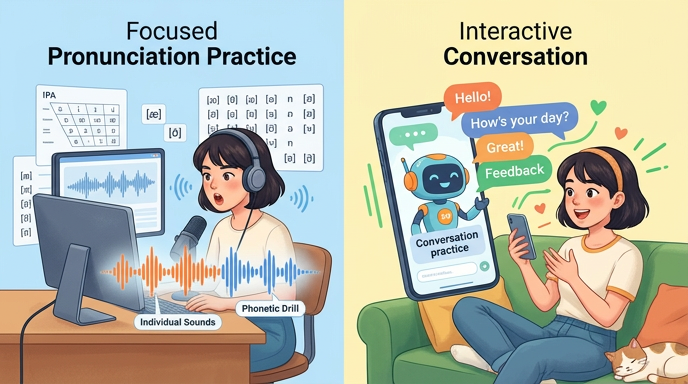
Broadly speaking, accent reduction apps fall into two camps.
Phoneme Correction Apps focus on the building blocks of speech—individual sounds, stress patterns, and intonation. They use AI to analyze your pronunciation, score it against native models, and drill you on the specific sounds you're getting wrong. Think of them as a personal phonetics lab in your pocket.
Conversation Immersion Apps take a different approach. Instead of drilling isolated sounds, they throw you into real dialogue. You talk, the AI talks back, and you learn by doing—absorbing rhythm, flow, and natural speech patterns through repeated exposure and practice.
Here's the thing: neither approach is wrong. In fact, they work best together. But most people pick one and wonder why they plateau.
Part 2: Head-to-Head Comparison
Let's look at how BoldVoice, ELSA Speak, and TalkMe stack up across the features that actually matter for accent improvement.
Part 3: App-by-App Deep Dive
BoldVoice — The Phoneme Specialist
BoldVoice is the heavyweight when it comes to structured American accent training. Its core strength is the combination of Hollywood accent coach video lessons with real-time AI speech analysis. You watch a professional coach demonstrate exactly how to position your tongue and shape your mouth, then you record yourself and get instant feedback.
What makes it effective:
Precision feedback: It doesn't just tell you "that sounded off"—it pinpoints which phoneme, what your stress pattern did wrong, and how your intonation curve compares to a native speaker's.
IPA integration: Interactive mouth diagrams and IPA transcriptions help you see sounds, not just hear them.
Custom learning paths: The app adapts to your native language background and prioritizes the sounds you personally struggle with.
BoldVoice is ideal if you want serious, structured American accent training and you're willing to put in consistent daily practice. Just know that its conversation practice, while present, isn't the app's main strength—it's more of a drill than a natural dialogue.
ELSA Speak — The AI Pronunciation Coach
ELSA (English Language Speech Assistant) takes a more bite-sized, gamified approach. You work through short lessons, record yourself, and get an AI-powered pronunciation score that breaks down your performance in granular detail.
What makes it effective:
Speed and convenience: Lessons are quick (often 5-10 minutes), making daily practice sustainable.
Detailed scoring: ELSA's AI breaks down your pronunciation to the phoneme level, color-coding problem areas so you can see exactly what needs work.
IELTS speaking prep: ELSA has dedicated modules for exam preparation, which is a plus if you're studying for English proficiency tests.
The tradeoff: ELSA is pronunciation-first. Its conversation and dialogue features are secondary and can feel mechanical. If you want to improve fluency—not just pronunciation accuracy—you'll want something to pair it with.
TalkMe — The Conversation Practice Partner
TalkMe takes the immersion approach. Instead of drilling individual sounds, it puts you in front of an AI conversation partner and lets you talk. You practice speaking about real topics—work presentations, travel, daily small talk—and the AI responds naturally, keeping the conversation flowing.
What makes it effective:
Confidence through repetition: The biggest barrier for most non-native speakers isn't knowing the right sound—it's freezing up in real conversations. TalkMe removes that fear by giving you a low-pressure space to talk as much as you want.
Natural rhythm and flow: You absorb stress patterns, intonation, and connected speech organically through dialogue, not through drills.
Topic variety: From casual chats to professional scenarios, you practice the kind of speaking you'll actually do in real life.
Important to note: TalkMe isn't a pronunciation correction app. It won't flag your /θ/ or score your vowel placement. What it does is arguably more important for real-world communication—it gets you talking, building the muscle memory and confidence that drills alone can't provide.
Part 4: The Combo Strategy That Actually Works
Here's the problem with picking just one app: phoneme drills without real conversation practice leave you sounding robotic. And conversation practice without phoneme correction can cement bad habits.
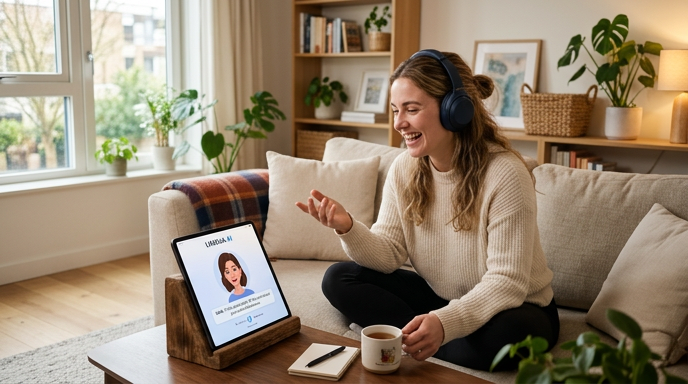
The strategy that gets real results is combining both.
Step 1 — Fix your sounds (BoldVoice or ELSA): Spend 10-15 minutes a day on targeted phoneme practice. Use BoldVoice if you want structured coaching and video demonstrations. Use ELSA if you prefer quick, gamified scoring and bite-sized lessons. Focus on 2-3 problem sounds per week until they feel natural.
Step 2 — Reinforce in conversation (TalkMe): Spend 15-20 minutes a day actually using those sounds in real dialogue. TalkMe gives you a space to apply what you drilled without the pressure of a real person judging you. The key is that you're not just repeating isolated words—you're weaving your improved sounds into natural speech.
Why this works: Your brain needs both. Phoneme drills build the neural pathways for correct sound production. Conversation practice wires those pathways into the context of actual communication. One without the other is half the equation.
Part 5: Your 30-Day Accent Clarity Plan
Here's a realistic, sustainable plan that builds momentum without burning you out.
Week 1 — Assessment & Foundation
BoldVoice/ELSA: Take the placement test. Identify your top 3-5 problem sounds.
TalkMe: Do 3-4 free-form conversations. Record yourself. Listen back. Note where people would ask you to repeat yourself.
Goal: Know exactly what to work on.
Week 2-3 — Targeted Drills + Light Conversation
Morning (10-15 min): BoldVoice/ELSA drills on your target sounds. Master 2 sounds this week.
Evening (15 min): TalkMe conversation on a familiar topic. Consciously use your new sounds.
Goal: See your pronunciation scores improve and feel less mental effort in conversation.
Week 3-4 — Conversation Takes the Lead
Morning (10 min): Maintain phoneme drills, but shift to maintenance mode.
Evening (20 min): TalkMe conversations on progressively harder topics—work scenarios, opinion discussions, storytelling.
Goal: Speak naturally without overthinking your pronunciation.
Week 4+ — Sustain & Expand
Keep daily conversation practice with TalkMe as your primary habit.
Use BoldVoice/ELSA 2-3 times a week for targeted tune-ups.
Record yourself monthly and compare. The progress will surprise you.
Summary: Clarity Over Perfection
No app will make you sound like you grew up in Chicago. And honestly, you don't need to. What you need is to be understood clearly, confidently, and the first time you speak.
For that, BoldVoice and ELSA are excellent tools for fixing your sound production at the phoneme level. Pick whichever matches your learning style—structured coaching or gamified self-study.
Then bring those polished sounds into TalkMe, where real conversation locks them in. It's the difference between practicing scales on a piano and actually playing music with other people. You need both.
Start with 25-30 minutes a day. Mix your tools. Give it 30 days. The clarity you gain is worth far more than a "perfect" accent ever would be.



Comments
No comments yet.
Leave a Comment