

If you've ever tried practicing English speaking on your own, you know the routine. You open an app, say a few sentences into the microphone, and it tells you: "Great job!" or "Keep it up!" And for a split second, you feel good. But then you sit back and wonder — was it really great? Did I pronounce "thorough" correctly? Was my verb tense right? Did I sound natural or like a textbook?
Here's the uncomfortable truth most speaking apps don't want you to think about: you said something, and nobody actually told you whether it was right or wrong. That's not practice. That's talking into the void.
The Feedback Trap Most Learners Fall Into
There are two common ways people practice speaking English. One is self-practice — recording yourself, talking to a mirror, narrating your day. It builds fluency, sure. But there's zero feedback. You reinforce the same mistakes over and over without ever knowing it. That grammar pattern you've been getting wrong for three months? Nobody told you. That vowel sound you're mispronouncing? You can't hear the difference yourself.
The other way is practicing with real people — language exchange partners, tutors, conversation groups. This is better, obviously. A good tutor will catch your mistakes and correct you. But here's the thing: it's uncomfortable. When you're mid-conversation, trying to express a real thought, the last thing you want is someone interrupting to say "actually, you should say 'I have been studying' not 'I am studying.'" You nod politely, but your flow is broken. And honestly? Most conversation partners are too polite to correct you at all. They just want the conversation to keep going.
So you end up in a frustrating loop: you practice speaking, but you never get actionable correction. You're putting in the hours, but you don't know if you're actually improving.
What "Real Feedback" Actually Means
The keyword here is real — and it's more specific than you might think. Real feedback is not:
"Good job!" (vague, tells you nothing)
"You sound great!" (nice, but useless)
A score out of 100 (what does 73 even mean?)
Real feedback is specific, timely, and actionable. It tells you exactly what you got wrong, why it's wrong, and how to fix it. Like this:
You say: "Yesterday I go to the supermarket."
Real feedback: "Almost! You're talking about the past, so you need the past tense: 'Yesterday I went to the supermarket.' Try saying it again."
You say: "I sink this is a good idea."
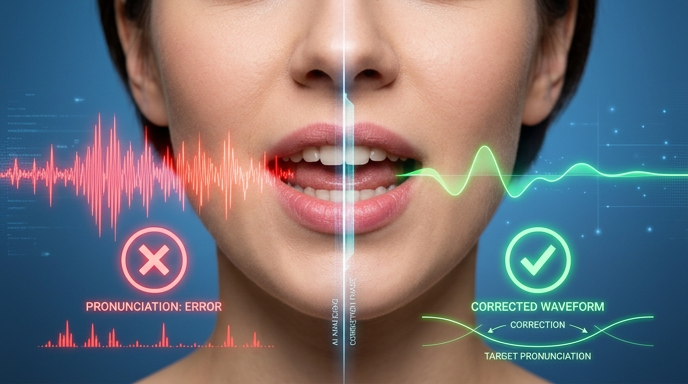
Real feedback: "I noticed your 'th' sound came out as an 's.' Put your tongue between your teeth and try: 'th-ink.' There you go."
That's real feedback. It's not about making you feel good or bad — it's about giving you something concrete to work on. Every correction is a tiny upgrade to your English.
How Different Tools Handle Feedback
Not all AI speaking tools are created equal on this front. Some tools like Katie AI focus on casual conversation practice — you chat with an AI character, and it keeps the dialogue flowing. The feedback tends to be light, more about keeping you engaged than drilling your grammar. SpeakOut leans heavily on pronunciation scoring, giving you color-coded breakdowns of each sound. It's useful if your main goal is accent reduction, but it doesn't catch your grammar or vocabulary mistakes. IELTS Rewind is exam-specific — great if you're prepping for IELTS Speaking, but the corrections are framed around band scores rather than natural communication.
Then there's the general-purpose approach. ChatGPT can hold an English conversation beautifully — but by default, it's designed to be agreeable. It rarely corrects you unless you explicitly ask it to play the role of a tutor. Even then, without a dedicated correction engine, it tends to let small errors slide for the sake of conversational flow.
What sets a dedicated AI speaking tutor apart is combining real-time conversation with systematic correction. Think about it: you're practicing speaking, and the AI responds naturally to what you said — but it also catches and gently corrects your errors within the flow. Not as an interruption, but as part of the reply. "That's an interesting point about your weekend! By the way, you said 'I have went' — the correct form is 'I have gone.' Now, tell me more about that hiking trip."
This is exactly the approach TalkMe AI takes. Instead of treating correction as an awkward side note, it weaves feedback directly into the natural conversation rhythm. The AI digital tutor doesn't just flag a mistake once and move on — it remembers your error patterns. If you keep mixing up present perfect and simple past, it notices the pattern. Over multiple sessions, it adapts and gives you more practice with the structures you struggle with most. That's the difference between feedback that helps for five seconds and feedback that actually changes how you speak.
How to Make the Most of AI Speaking Feedback
Even the best feedback tool won't help if you use it passively. Here are three ways to turn correction into real improvement:
First, actively invite correction. Don't wait for the AI to catch everything — tell it what you want to work on. "I know my past tense is weak, please correct every mistake." The more specific your request, the more targeted the feedback.
Second, keep an error journal. Every time you get corrected, jot it down. Not during the conversation — that breaks the flow. But right after, take 30 seconds to note: what was the mistake, what's the correct form, and why. When you see the same mistake written down three times in a week, it suddenly becomes impossible to ignore.
Third, practice the correction immediately. The AI says "try 'I have been studying.'" Don't just nod — say it out loud. Then say it again in a different sentence. "I have been studying English for two years. She has been studying since morning." Your mouth needs to learn the pattern, not just your brain.
The Bottom Line
The difference between spinning your wheels and actually improving your spoken English isn't how many hours you practice — it's what happens in those hours. If every session ends with "Good job!" and nothing else, you're collecting minutes, not skills.
Real feedback — the kind that catches your grammar slip-ups, nudges your pronunciation, and tracks your patterns over time — transforms speaking practice from a vague hope into a measurable process. Tools like TalkMe are built around this philosophy: conversation should flow naturally, but correction should never be an afterthought. Because the goal isn't just to speak more. It's to speak better, one corrected mistake at a time.


Comments
No comments yet.
Leave a Comment