

What Even Is a "Native Accent"?
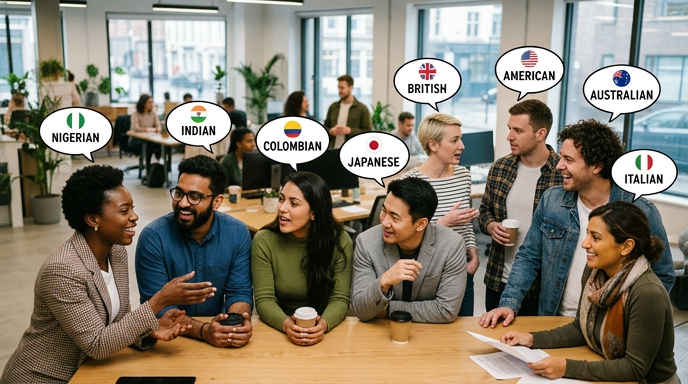
Let's start with an uncomfortable truth: there is no such thing as a single "native accent." Walk into any London office and you'll hear Received Pronunciation, Cockney, Estuary English, and a dozen regional variants—all spoken by native English speakers. Fly to New York and the same sentence sounds completely different. Go to Sydney, and it changes again.
The idea of a unified "native accent" is a myth. What learners are really chasing is usually one specific accent—often General American or Standard Southern British—that they've internalized as "correct" from movies, textbooks, or YouTube.
But here's what seasoned language learners know: accent diversity is the norm, not the exception. In global workplaces, you're more likely to work with colleagues who speak English with Spanish, Mandarin, Hindi, or German accents than with someone from Oxford. The goal shouldn't be to erase your linguistic identity—it should be to be clearly understood.
Intelligibility > Accent Perfection
Research in applied linguistics has been pointing in the same direction for decades: intelligibility—being understood—is a far more practical and achievable goal than accent reduction or elimination. Jennifer Jenkins' Lingua Franca Core identified specific pronunciation features that actually affect understanding (like consonant clusters and vowel length), while many features learners obsess over (like the "th" sound or perfect intonation) rarely cause communication breakdowns.
This is liberating. It means you don't need to sound like a BBC newsreader to speak English effectively. You need to be clear, not perfect.
How AI Speaking Practice Actually Helps
So where does AI fit in? Modern AI speaking tools don't judge your accent against a single "native standard." Instead, they focus on:
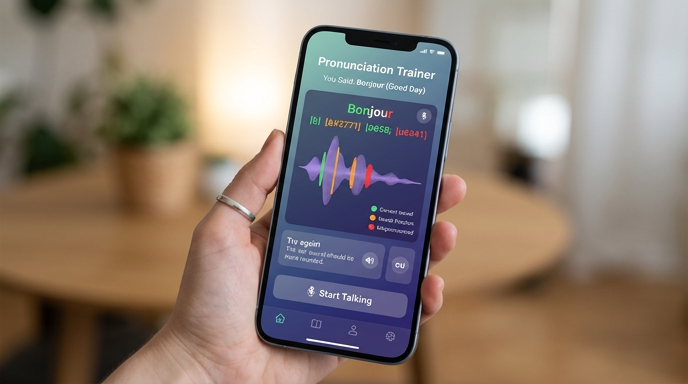
Real-time pronunciation feedback: AI analyzes your speech and flags specific sounds or words that might cause confusion. Not "you don't sound American enough"—but "that vowel might make 'ship' sound like 'sheep.'"
Contextual conversation practice: You practice speaking naturally in scenarios—ordering coffee, giving a presentation, negotiating—and the AI responds in real time, keeping the conversation flowing rather than stopping to correct every syllable.
Multi-accent exposure: Many AI tools now let you choose which English accent you want to practice with. Want to prepare for studying in Australia? Switch to an Australian English voice. Doing business with UK clients? Practice with British English.
Popular AI Tools for Accent Training
Several AI-powered platforms have emerged that specifically target pronunciation and accent training:
ELSA Speak uses speech recognition trained on non-native English data to detect specific pronunciation errors and provide corrective exercises
SpeakShark focuses on conversational fluency with real-time accent analysis during free-flowing dialogue
NativeSpeech combines pronunciation scoring with video content to help learners match mouth movements and sound production
TalkMe takes a conversational approach, letting learners practice free-flowing dialogue with AI partners in American, British, or Australian English accents—users can switch between them depending on whether they're preparing for a US campus, a UK business meeting, or general global communication
Each takes a slightly different approach, but they share a common philosophy: help learners speak clearly, not identically to any one group of speakers. The key differentiator is whether the tool focuses on isolated pronunciation drills or embeds accent practice inside real conversation—and research increasingly favors the latter for long-term retention.
Choosing the Right Accent for Your Goals
Your target accent should match your real-life needs, not some abstract ideal:
Studying in the US: General American pronunciation will help you navigate campus life and social situations more naturally
Working with UK-based teams: British English (RP or contemporary Southern) aligns with business communication conventions
Global business: A clear, neutral international English accent is often more valuable than any regional variant
Exam preparation (IELTS/TOEFL): Focus on the scoring criteria—both exams accept any standard English accent as long as pronunciation is clear
What AI Can't Do (Yet)
AI speaking tools are impressive, but they have limits. They can flag pronunciation issues, but they can't replicate the social pressure of speaking to a real person. They can model ideal speech, but they can't teach you the cultural nuances embedded in accent—when to soften your tone, how to read a room, why you might code-switch in different settings. Imagine sitting in a Chicago break room realizing your colleague's Indian English is as "native" as another's Texas drawl. AI can explain this intellectually, but it can't give you the lived experience of navigating it.
The best approach combines AI practice for daily reps and real human conversation for genuine interaction. Think of AI as your 24/7 pronunciation gym—a place to build muscle memory and confidence before stepping into the real world. If you're using a tool like TalkMe, you can practice the same presentation three times: once in American English for your US team, once in British English for your London stakeholders, and once just focusing on your own clear, natural delivery.

The Bottom Line
The question "can AI make me sound like a native speaker?" misses the point. A better question: "can AI help me speak English clearly enough to connect with people from anywhere in the world?" The answer to that is a confident yes—and the tools to do it are already in your pocket.
Your accent is part of who you are. It carries your history, your first language, your identity. The goal isn't to erase it—it's to make sure it never gets in the way of being understood. Whether you're practicing with an AI conversation partner that lets you toggle between American and British voices, or drilling specific vowel sounds with a pronunciation checker, the destination is the same: clear, confident communication that sounds like you.
That's where AI speaking practice shines: not by forcing you into a single accent mold, but by helping you sharpen the clarity of your own voice—on your own terms, at your own pace, with whatever accent flavor best serves your goals.


Comments
No comments yet.
Leave a Comment