
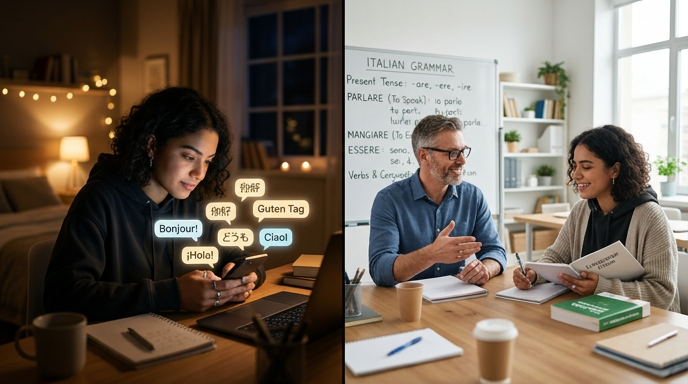
You've probably asked yourself this question: should I pay for a real human tutor, or just use an AI app?
The answer floating around the internet is usually some version of "AI is cheaper so it's better." That's lazy. It misses the point entirely.
The real question isn't which one wins. It's what each one is actually for — and how to use both so your money and time go further.
Let's break it down honestly: what a human tutor actually costs, what AI can and can't do, and the combo approach that gives you the best of both worlds for less than you'd spend on weekly classes alone.
![blog-EN[EN-004]-AILanguageTutorVsHumanTutorCostsBenefitsBestCombo 1.png](/upload/blog-EN%5BEN-004%5D-AILanguageTutorVsHumanTutorCostsBenefitsBestCombo%201.png)
Part 1: The Real Cost of a Human Tutor
Let's talk numbers. On platforms like italki and Preply, a professional language tutor costs anywhere from $15 to $80 per hour depending on the language and the tutor's experience. A native English tutor? Often $40-60. A Japanese or Korean tutor with certification? Similar range.
If you do one session a week, that's $60-320 a month. Two sessions a week doubles it.
Real talk: one hour a week with a tutor gives you roughly 4 hours of speaking practice per month. That's not because the tutor is bad — it's because one hour is one hour, and you're not speaking the language the rest of the week.
An AI language tutor? Think less than the cost of your daily coffee. TalkMe, for example, gives you unlimited conversation practice 24/7 for a flat monthly subscription. You could talk for an hour every single day and it costs the same as one or two human tutor sessions.
But cost isn't the whole story. Let's look at what you actually get from each.
Part 2: What AI Tutors Can Do — And What They Can't
Where AI Tutors Excel
Structured, repetitive practice. If you need to drill verb conjugations 50 times, no human tutor will sit there smiling through repetition #47. An AI will — every single time, without judgment.
Instant feedback loops. You say a sentence, the AI catches the grammar mistake, you correct it, you try again. This feedback cycle takes seconds. With a human tutor, it's slowed down by social niceties and their attention being split across explaining, listening, and managing the session.
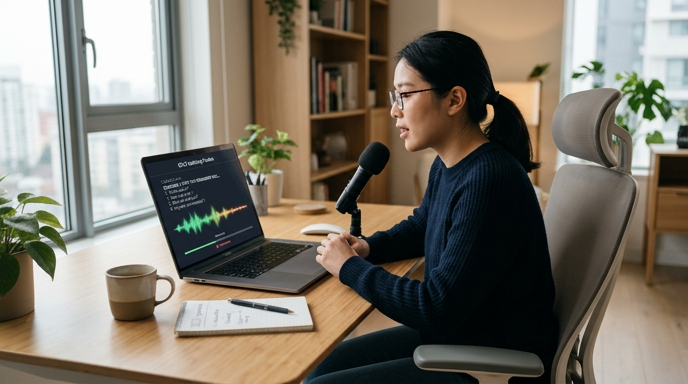
Availability. It's 11 PM, you can't sleep, and you suddenly feel motivated to practice Japanese. No human tutor is answering your message. An AI tutor is ready.
![blog-EN[EN-004]-AILanguageTutorVsHumanTutorCostsBenefitsBestCombo 2.png](/upload/blog-EN%5BEN-004%5D-AILanguageTutorVsHumanTutorCostsBenefitsBestCombo%202.png)
Where Human Tutors Are Irreplaceable
Deep personalization. A great human tutor doesn't just correct your mistakes — they notice your patterns. They remember that you always mess up the subjunctive when talking about future plans, and they design a custom exercise around your actual life, your actual job, your actual goals. AI can personalize, but it doesn't know you the way a human who's worked with you for months does.
Emotional connection and motivation. Learning a language is emotionally draining. You hit plateaus, you feel stupid, you want to quit. A human tutor can read your frustration, adjust their tone, crack a joke, tell you about their own struggle learning a language — things no AI can authentically replicate.
Cultural nuance you can't find in textbooks. Want to know why saying "thank you" too formally to your Korean friend's mom is actually weirder than being casual? Or why Japanese business emails have a completely different register that isn't taught in apps? Human tutors bring lived cultural experience that AI can only approximate from training data.
Part 3: Head-to-Head Comparison
The pattern should be obvious: AI is your daily driver. The human tutor is your specialist. They're not competitors — they're complementary tools.
![blog-EN[EN-004]-AILanguageTutorVsHumanTutorCostsBenefitsBestCombo 3.png](/upload/blog-EN%5BEN-004%5D-AILanguageTutorVsHumanTutorCostsBenefitsBestCombo%203.png)
Part 4: The Combo Plan That Actually Works
Here's the approach that gets you speaking faster than either option alone:
Monday through Friday: AI Daily Practice (15-30 min/day)
Use an AI tutor like TalkMe for high-frequency structured practice. Do scenario-based conversations — ordering food, introducing yourself at work, making small talk about the weather. Let the AI correct your grammar and pronunciation instantly. The key is consistency: 15 minutes every day beats 2 hours once a week.
TalkMe's multi-scenario practice is especially useful here — you're not just repeating the same "hello, how are you" script. You're practicing real conversations in different contexts, which builds the mental flexibility to actually speak in the wild.
Saturday: Human Tutor Deep Dive (1 hour)
Now you come to your session prepared. You've already done 75-150 minutes of practice that week. Your human tutor doesn't need to waste time on drills — they can jump straight into the nuanced stuff: refining your accent in context, explaining why a particular phrase felt "off" to native ears, helping you prepare for a specific real-life situation.
The math: 5 days of AI practice + 1 human session = roughly 6-8 hours of active speaking per week. Cost? Less than two human-only sessions per week, with triple the practice volume.
This is exactly the scenario I mentioned up front: "One tutor session a week plus 10 minutes of AI conversation daily — the cost stays the same, but your practice frequency multiplies. Three months ago you only spoke with your tutor for 12 hours total. Now with daily AI practice, your speaking progress accelerates noticeably."
Part 5: How to Choose Based on Your Stage
Absolute beginner (A0-A1): Start with AI. You need high-volume, low-stakes practice to build basic sentence patterns and vocabulary. A human tutor at this stage is expensive flashcard duty. Add a human tutor once you can hold a 5-minute basic conversation.
Intermediate (A2-B1): This is the combo sweet spot. AI for daily speaking volume and grammar reinforcement. Human tutor once a week for accent refinement, listening comprehension with real native speech, and breaking through plateaus.
Advanced (B2-C1): Lean heavier on human tutors. At this level, your mistakes are subtle — register, nuance, cultural appropriateness. A human tutor's judgment is worth far more than AI pattern-matching. Use AI to maintain daily fluency, but let the human guide your finesse.
The Bottom Line
Stop asking "AI or human?" Start asking "how do I use both?"
AI handles the volume. Human handles the depth. Together, they give you more speaking hours, faster feedback, and deeper learning than either could alone — for less money than you'd spend on human-only weekly sessions.
That's not a compromise. That's just math.


Comments
No comments yet.
Leave a Comment