

When you hear the phrase "AI language tutor," what comes to mind? Probably something that talks to you. An app you speak to, and it speaks back. That basic definition covers roughly 90% of the AI language apps on the market today.
But here's the problem—most of what people call an "AI tutor" is actually just an "AI conversation partner." And there is a massive gulf between the two.
A conversation partner keeps you talking. A tutor makes sure you're talking better every time.
If you've ever used a language app that felt fun but left you wondering "am I actually improving?", you've experienced that gap firsthand. Let's break down what separates a real AI language tutor from an AI chat buddy—and why it matters for your learning outcomes.
Part 1: What a Language Tutor Actually Does (That a Partner Doesn't)
Think about what you pay a human language tutor for. You're not paying for their English. You can find an English speaker to chat with for free. What you're paying for is their teaching system—they know what you should practice right now, how to teach it, and where you should go next.
A real tutor operates on four pillars:
Curriculum design—A sequenced plan. You don't jump from greetings to debating climate policy. There's a path.
Skill assessment—Knowing what you can and can't do. Which sounds trip you up? Which grammar structures do you avoid?
Progress tracking—Remembering what you've practiced and whether it stuck. Not repeating the same lesson five times because nobody wrote it down.
Adaptive practice—Adjusting the difficulty, topic, and format based on your real performance. Not just throwing random questions at you.
A conversation partner does exactly one thing: talks to you. That's valuable—conversation fluency is a muscle you build through repetition. But it's not the same as being taught. If you only ever do free conversation, you plateau at "can express myself, but always with the same five sentence structures and a heavy accent."
An AI language tutor needs to deliver on all four pillars. If it doesn't, it's a partner wearing a tutor's hat.

Part 2: AI Tutor Meets Human Tutor—Not Rivals, Just Different Jobs
Let's get one thing straight: AI tutors are not replacing human tutors. They're handling a different slice of the learning process entirely.
Human tutors excel at things AI can't touch—reading emotional frustration on your face, improvising a culturally nuanced explanation, knowing when to push and when to back off because you're having a rough day. That human intuition is irreplaceable.
AI tutors excel at things humans struggle with: being available at 11 PM on a Tuesday, providing unlimited repetitions without fatigue or judgment, remembering every mistake you've made across six months of practice, and analyzing your pronunciation with millisecond precision.
The smartest approach is complementary: use an AI tutor for daily structured practice—the grind work that builds fluency through repetition and correction. Then bring specific, targeted problems to your human tutor for deeper coaching. You get volume and consistency from AI; you get insight and nuance from humans. Neither one covers the whole picture on its own.

Part 3: Comparing the AI Tutor Landscape—What the Tools Actually Offer
If you look at what's available today, the AI language space splits into roughly three camps:
The Curriculum-First Model (Duolingo, Busuu, Babbel)
These apps are built around structured lesson trees. Each lesson has a defined learning objective—present perfect tense, restaurant vocabulary, past continuous. The AI sits on top of a pre-built curriculum. Progress is clear and measurable, but the experience can feel rigid. You learn what the curriculum says you should learn, when it says you should learn it. Conversation practice is often an afterthought—scripted dialogues rather than genuine back-and-forth.
The Conversation-First Model (Replika-style chat, basic conversation apps)
These put you straight into dialogue. Ask anything, talk about anything, the AI responds. It feels natural and engaging—for about two weeks. Then the cracks show: the AI has no memory of your mistakes, no concept of your current level, and no plan for where you're headed. You're practicing, sure, but you're wandering. Fun ≠ improving.
The Structured Conversation Model (TalkMe, Langua, ELSA)
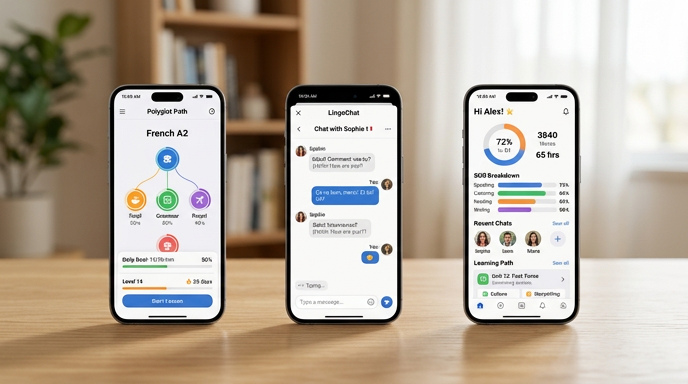
This is the middle path that's getting the most attention right now. These tools combine structured learning paths with genuine conversational AI. TalkMe, for instance, doesn't just throw you into a chat—it routes conversations through a progression system tied to skill levels and learning objectives. You get free-flowing conversation, but within a framework that tracks what you're practicing, identifies recurring errors, and adapts future sessions around your weak spots.
The key difference: in the structured conversation model, the AI remembers. It remembers that you struggled with conditionals last Tuesday. It remembers that your /θ/ sound needs work. It builds your next session around that data. That's what separates "talking to an AI" from "being taught by one."
Part 4: Curriculum-Driven vs. Conversation-Driven—Which Gets You Further?
Here's a question worth asking: what's more valuable for someone at an intermediate plateau—another grammar lesson, or 30 minutes of guided conversation with instant correction?
Duolingo's philosophy is that language is learned through structured exposure and repetition. Complete the tree, collect the crowns, and the knowledge accumulates. The approach works. Millions of people have built vocabulary and basic grammar through it.
TalkMe's philosophy—and the broader Structured Conversation approach—is that language is learned through doing, with guidance. You need to speak, make mistakes, get corrected, and try again. The structure isn't in the lesson tree; it's in the feedback loop.
Neither approach is wrong. But they target different problems. If your goal is building fundamental knowledge from scratch, curriculum-driven tools give you a clear path. If your goal is breaking through a speaking plateau—where you know the words but freeze in real conversations—the conversation-driven model with structured feedback addresses the actual bottleneck.
The most effective approach, honestly, is probably both: use a curriculum tool for systematic knowledge building and a structured conversation tool like TalkMe for turning that knowledge into fluent, confident speech. They feed each other.
Part 5: How to Choose Your AI Language Tutor
Not every tool that calls itself an "AI tutor" actually tutors. Before committing to one, run through this quick checklist:
Does it have a clear progression system, or does it just open a chat window?
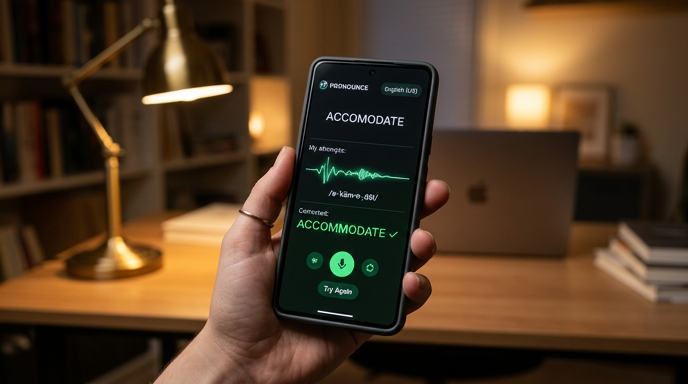
Can it identify your specific pronunciation, grammar, or fluency weaknesses?
Does it remember your performance across sessions, or does every conversation start from zero?
Does practice adapt based on what you got wrong last time?
Can you see measurable improvement—not just "I feel more confident" but "I reduced my /r/ sound errors by 40%"?
If the answer to most of these is "no," you're looking at a conversation partner, not a tutor. Nothing wrong with that—it's just a different category of tool. Use it for what it is, and supplement with something that fills the tutor-shaped gap.
An AI language tutor that earns the title should feel less like talking to a chatbot and more like working with a coach who's been paying attention the whole time. When you sit down for a session, the tool should already know what you need to work on—because it's been tracking, analyzing, and planning. That's the difference between practicing and improving.
And that's the difference worth looking for.


Comments
No comments yet.
Leave a Comment