
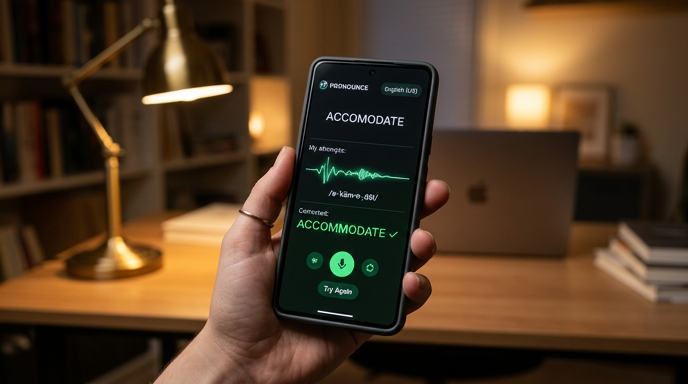
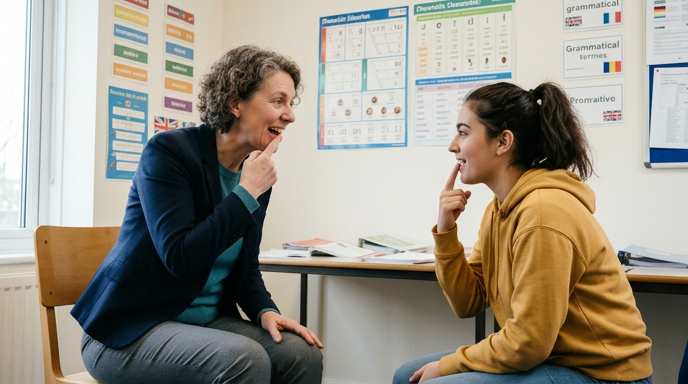
A human pronunciation coach charging $80 an hour. An AI pronunciation tutor that costs $15 a month and is available at 2 AM when you're cramming for tomorrow's presentation.
The math looks obvious. But when it comes to something as nuanced as pronunciation correction, is cheaper always smarter? And more importantly — can an AI tutor actually correct you, or just detect that something sounds off?
Let's break down what AI pronunciation tutors with correction can actually do, where they still fall short, and which tools are worth your time.
Part 1: The Real-Teacher Problem — Three Reasons a Human Coach Is Hard to Keep
Before we talk about AI, let's be honest about why people look for AI alternatives in the first place.
Timezone mismatch. You live in Tokyo and the best pronunciation coaches are in New York or London. Your evenings are their early mornings — and neither of you wants to do a pronunciation drill at 6 AM. The result? You settle for a coach in your timezone who might not be the best fit, or you give up on live coaching entirely.
Scheduling friction. Pronunciation improvement needs consistency — ideally 15 to 20 minutes of focused practice several times a week. Booking a human coach for that frequency is a logistical headache. You're coordinating calendars, dealing with last-minute cancellations, and paying for full sessions when you only needed a quick 10-minute check on one tricky sound.
The cost wall. A qualified accent reduction coach in the US charges anywhere from $60 to $150 per hour. If you need two sessions a week, that's $480 to $1,200 a month — before you've paid for any other learning resources. For most English learners, this simply isn't sustainable long enough to see real results.
This is exactly the gap AI pronunciation tutors are trying to fill. But filling a gap and doing it well are two very different things.
Part 2: What AI Pronunciation Correction Can Actually Do
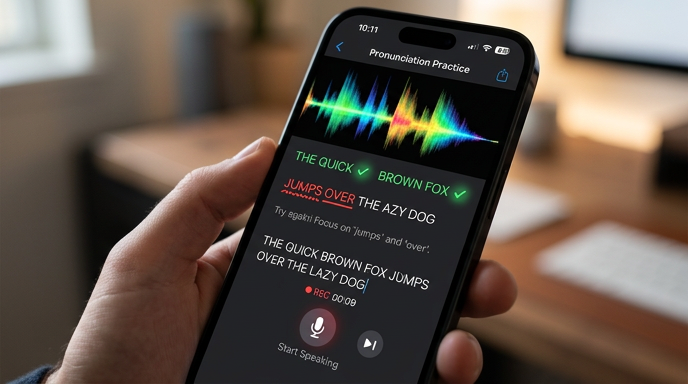
Modern AI pronunciation tools don't just record your voice and play it back. They use automatic speech recognition tuned specifically for non-native speech patterns to analyze your pronunciation against native speaker benchmarks.
Here's what the current generation of tools can do reliably:
Phoneme-level error detection. The AI can identify exactly which sound you mispronounced — not just "your TH is wrong" but "you produced an /s/ instead of /θ/ in the word 'think'." This level of specificity is something even experienced human coaches sometimes struggle to articulate in the moment.
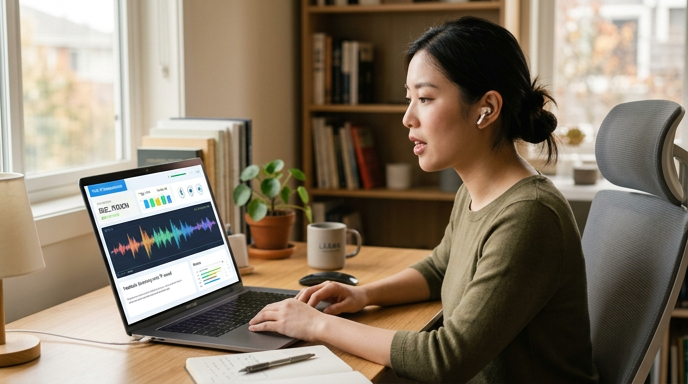
Real-time visual feedback. Tools like Speakerly and Pronounce AI overlay your speech waveform against a native model, showing you pitch contours, stress patterns, and intonation curves in real time. You literally see where your voice rises when it should fall, or where you're inserting extra pauses that break the natural rhythm of English.
Consistent, judgment-free repetition. An AI won't get tired of you repeating the same sentence twenty times. It won't glance at the clock or lose patience. That matters — pronunciation change is muscle memory, and muscle memory needs volume. The AI gives you unlimited reps without ego.
Part 3: How Different AI Pronunciation Tools Actually Correct You
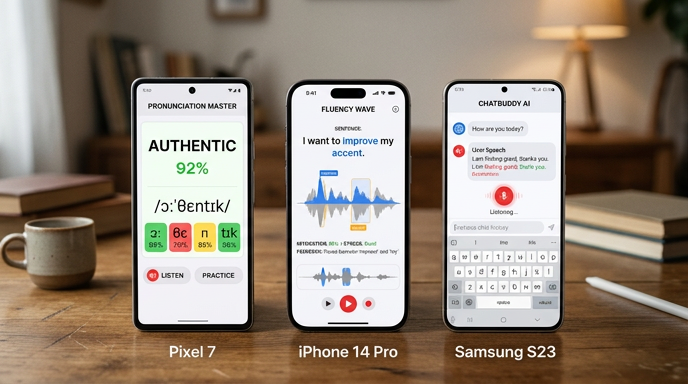
Here's the thing most people miss: not all "pronunciation correction" works the same way. The correction mechanism — when and how a tool tells you you're wrong — is what separates one tool from another.
Single-word correction tools like ELSA Speak isolate individual words or short phrases. You speak, the AI scores each phoneme, and you drill the ones you got wrong. This is excellent for fixing specific sounds — the difference between "ship" and "sheep," or nailing the dark L in "world." But it doesn't prepare you for the chaos of real conversation.
Sentence-level correction tools like Pronounce AI and Speakerly evaluate entire sentences for rhythm, stress, and connected speech. The correction here isn't about individual sounds but about prosody — does your sentence flow naturally, or does every word land with the same weight like a robot reading a script?
Conversational correction tools like TalkMe correct you while you're having a conversation. Instead of stopping to drill a word in isolation, TalkMe flags pronunciation issues in the flow of dialogue — you're practicing in the same context you'll actually use the language. This matters enormously because most people can pronounce words perfectly in a drill and then fall apart the moment they're stringing sentences together under real conversational pressure.
These aren't competitors fighting for the same lane. They solve different problems. A single-word tool won't help you sound natural in conversation. A conversation tool won't give you the phoneme-by-phoneme breakdown you need to fix a specific sound.
Part 4: What AI Still Can't Do — The Real Limitations

For all its precision, AI pronunciation correction has blind spots that genuinely matter:
It can't see your mouth. Tongue position, lip rounding, jaw tension — a massive part of pronunciation is physical. A human coach watches you speak and says "your tongue is too far forward on that R." An AI only hears the acoustic output. It can tell you the sound is wrong but not why your body is producing it wrong. That's a real gap for learners struggling with sounds that don't exist in their native language.
It struggles with accent goals. Do you want to sound American, British, or just "clearly international"? Most AI tools benchmark against a single accent model — typically General American — and can't coach you toward a specific regional accent the way a human coach can tailor their feedback.
It misses the psychological layer. Pronunciation anxiety is a real thing. Many learners know exactly how to produce a sound correctly but freeze up in actual conversations. An AI won't notice that your pronunciation gets significantly worse when you're nervous, or that you're systematically avoiding certain words because you're self-conscious about how they sound.
None of this means AI pronunciation tools are useless. It means you should use them for what they're good at and supplement with human interaction — or conversational AI practice — for what they're not.
Part 5: How to Choose the Right AI Pronunciation Tutor for You
Your choice depends entirely on what "correction" means for your current level:
If you need to fix specific sounds — the TH, the dark L, the difference between short and long vowels — start with a phoneme-focused tool like ELSA Speak. The granular, sound-by-sound feedback is exactly what you need for targeted practice on your weakest points.
If you need to improve overall flow and naturalness — sentence-level tools like Pronounce AI or Speakerly will show you where your rhythm breaks and where your stress patterns sound unnatural. This is the bridge between "pronouncing words correctly" and "sounding like a fluent speaker."
If you need to practice pronunciation in actual conversations — this is where TalkMe's conversational approach makes a difference. The real-time correction during dialogue means you're not just drilling sounds in a vacuum. You're learning to pronounce correctly while thinking about what to say next — which is exactly what real communication demands. That contextual pressure is what makes the correction actually stick.
The bottom line: an AI pronunciation tutor won't fully replace a great human coach — at least not yet. But for the price of one human coaching session, you can get an entire month of unlimited AI-powered pronunciation practice with instant, specific correction. For most learners, that's not a trade-off. It's a smart complement that makes every dollar — and every minute of practice — count.
Comments
No comments yet.
Leave a Comment