
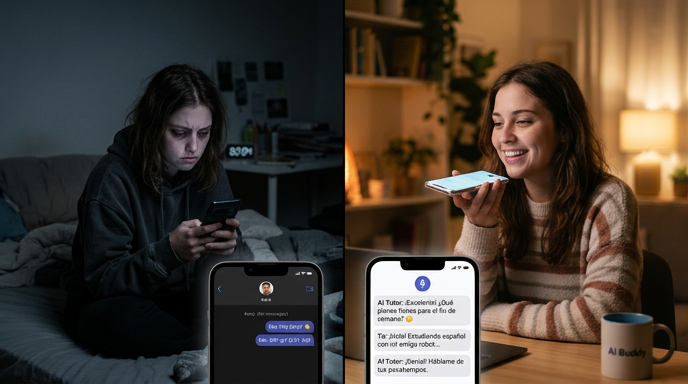
Six months on HelloTalk, and I had sent thirty messages. I got five replies. Three of them were "Do you want to learn Chinese?"
Sound familiar? If you've ever tried a language exchange app, you know the drill. You post an introduction, someone replies, you exchange a few pleasantries... and then the conversation evaporates. No follow-up. No consistency. Just a graveyard of half-finished chats and the sinking feeling that your speaking skills aren't going anywhere.
It's not that language exchange apps are bad. They're not. But they suffer from three structural problems that make them unpredictable for serious speaking practice.
The Three Headaches of Real Language Exchange
First, there's the time zone problem. Your ideal Japanese conversation partner lives in Tokyo. You live in New York. When you're free at 8 PM after work, it's 9 AM their next morning—they're commuting. When they're winding down at 10 PM, you're in a meeting. Asynchronous messaging fills the gap, but messaging isn't speaking. You need real-time conversation to build fluency, and real-time requires overlap that rarely happens.
Second, there's the topic problem. Language exchange conversations default to the same five topics: where are you from, what do you do, why are you learning this language, how's the weather, and—if you're lucky—what did you eat today. These are fine for your first three exchanges. By your tenth, you've mastered introducing yourself and can describe rainfall in excruciating detail, but you still freeze when someone asks about your opinion on remote work policy or your favorite childhood memory.
Third, and most insidious: the embarrassment problem. Real conversation partners are, well, real people. You worry about wasting their time. You hesitate before every sentence, mentally conjugating verbs and double-checking articles. You default to the simplest possible phrasing because you don't want to sound stupid. The very thing that makes language exchange valuable—real human interaction—is also what makes it terrifying for intermediate learners. You need to make mistakes to improve, but making mistakes in front of a stranger feels terrible.
Where AI Conversation Partners Actually Shine
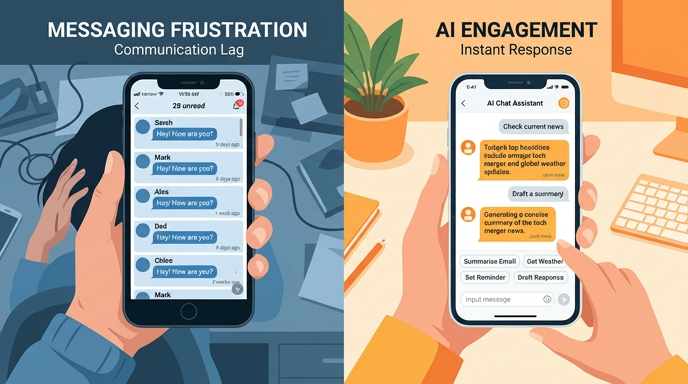
This is where AI conversation partners fill a gap that language exchange can't. Not as a replacement—as a complement.
An AI partner is available whenever you are. 2 AM and you suddenly want to practice describing your weekend plans in Spanish? Go ahead. No time zone math, no waiting for a reply, no guilt about messaging someone at an unreasonable hour. This alone solves the consistency problem that kills most speaking routines.
More importantly, an AI partner gives you a judgment-free zone to be bad at the language. You can stumble through the same sentence five times. You can use the wrong tense and immediately try again. You can ask it to repeat something slowly, then slower, then one more time—without feeling like you're inconveniencing anyone. This psychological safety is enormous for intermediate learners. It's the difference between practicing because you have to and practicing because you want to.
And then there's topic control. With an AI partner, you can say "Let's talk about job interviews" and the conversation goes there. You can practice exactly the scenarios that matter to you—ordering food, negotiating a contract, explaining your research to a colleague—rather than hoping your exchange partner shares your interests. This focused practice is far more efficient than the serendipity of language exchange.

Best of Both Worlds: The Combination Strategy
Here's what the smartest learners I know actually do: they use AI for daily reps and real partners for meaningful milestones.
AI handles your volume practice. Every day, 15-20 minutes of unstructured conversation with an AI tutor—describing your day, debating a random topic, practicing a specific grammar structure you're weak on. This builds the muscle memory of speaking. It's the equivalent of shooting free throws alone in the gym: repetitive, unglamorous, absolutely essential.
Real language exchange handles your reality checks. Once or twice a week, sit down with a native speaker and put everything you've been drilling to the test. Can you follow their natural speed? Do your memorized phrases actually land? Can you handle an unexpected tangent? This is where you discover what's working and what isn't.
Neither approach works as well alone. AI-only learners sometimes develop unnatural phrasing because they're missing the organic chaos of real conversation. Exchange-only learners plateau because they don't get enough sheer volume of speaking practice. Together, they reinforce each other.
Picking the Right Tool for Each Job
Not all AI conversation partners are created equal, and the distinction matters. General-purpose AI chatbots like ChatGPT or companion apps like Replika can hold a conversation, but they weren't built for language learning. They don't correct your grammar. They don't adapt difficulty to your level. They're not designed to push you incrementally beyond your comfort zone.
Language-learning-specific AI partners, like TalkMe, are built for exactly this purpose. TalkMe focuses on structured speaking practice with real-time feedback and an immersive tutor experience. Unlike generic chatbots that will happily chat with you at whatever level you're already at, language-specialized AI tools use adaptive difficulty—giving you slightly harder material as you improve, keeping you in the growth zone where real progress happens. TalkMe supports multiple languages and provides a dedicated AI tutor that feels more like a real teacher than a text bot, because it combines visual, vocal, and emotional cues that make conversation practice feel genuinely immersive.
On the exchange side, HelloTalk and Tandem remain excellent for what they do best: connecting you with real humans for authentic cultural exchange. Use them for the conversations that require genuine human context—slang, humor, cultural references, emotional nuance. An AI can teach you the words for "I miss you." A real person can teach you when it's actually appropriate to say it.
Building a Routine That Actually Sticks
The biggest enemy of speaking progress isn't a bad app or a wrong method—it's inconsistency. You don't need the perfect tool. You need a tool you'll actually use every day.
For most learners, the winning formula looks like this: ten minutes with an AI conversation partner during your morning coffee, covering one specific scenario or grammar point. Then, once a week, a 30-minute live exchange session to pressure-test what you've practiced. The AI sessions build the habit and the volume. The exchange sessions give you the real-world feedback loop.
I've seen learners go from "I've been studying for two years but I can't speak" to having fluid ten-minute conversations in three months using this approach. Not because AI is magic—because consistency is magic, and AI finally makes consistency achievable.
The question isn't "AI conversation partner or real language exchange?" The question is "When do I use which?" Answer that, and you've answered the hardest part of learning to speak a new language.



Comments
No comments yet.
Leave a Comment