

We've all heard it: "The only way to really learn a language is to move there." It's the golden rule of language learning — total immersion, 24/7 exposure, sink-or-swim. But for most of us, packing up and relocating to Tokyo, Madrid, or Paris isn't exactly a Tuesday afternoon decision. So the question becomes: can technology bridge the gap?
With AI conversation tools evolving at breakneck speed, the answer is shifting from "not really" to "closer than you think." Let's break down what language immersion actually is, and see where AI conversation fits into the picture.

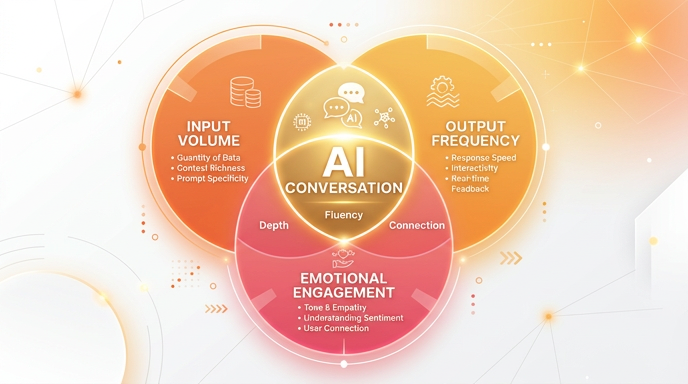
The Three Pillars of Language Immersion
True immersion isn't just about hearing a language — it's a combination of three forces working together:
1. Input Volume (Exposure) — How much target language you consume. Living abroad means street signs, overheard conversations, TV in the background, menus, announcements. Your brain is constantly processing.
2. Output Frequency (Production) — How often you speak or write. Ordering coffee, asking for directions, chatting with coworkers — every interaction forces active recall and real-time construction of sentences.
3. Emotional Engagement (Connection) — This is the one people overlook. When you're genuinely invested — laughing at a joke, negotiating a price, telling a story — your brain encodes language differently. Emotion is the glue that makes vocabulary stick.
The magic of living abroad is that all three happen simultaneously, naturally, every single day. The challenge of learning at home is that you have to deliberately engineer each one.
The At-Home Immersion Stack: What Actually Works
No single tool replaces living abroad. But a strategic combination can get you surprisingly close. Here's how different methods stack up against the three pillars:
The pattern is clear: no single method covers everything. The winning formula is stacking complementary methods. AI conversation fills the "output frequency" gap better than anything else because it's available 24/7, never gets tired, and doesn't judge your mistakes.
Talking to an AI Like It's a Real Person
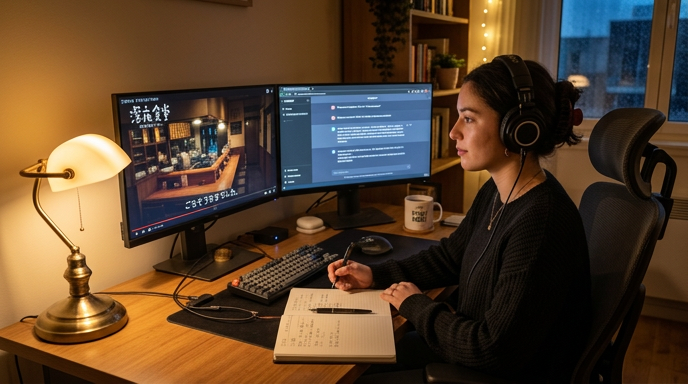
Here's what a practical immersion session looks like with TalkMe's role-play scenarios. Instead of drilling flashcards, you step into a real-world situation:
Scenario: Ordering at a ramen shop in Tokyo
You open the app, select "Japanese Restaurant" role-play, and the AI becomes a ramen shop owner. The conversation flows naturally:
AI (in Japanese): "Welcome! What kind of ramen would you like today?"
You: "I'd like miso ramen, please. And can you make it less salty?"
AI: "Of course. Less salt, got it. Would you like extra chashu pork with that?"
You: "Yes, please. Also, what do you recommend as a side dish?"
This isn't a script — it's an adaptive dialogue. If you fumble a word, the AI adjusts. If you want to practice a specific grammar point, you can steer the conversation there. You're producing language, making real decisions, and the emotional engagement comes from the "what if I mess up this order" tension — even though there's zero real-world consequence.
What AI Conversation Can't Replace (Yet)
Let's be honest about the gaps. AI won't give you:
Passive input — you still need podcasts, YouTube videos, and Netflix for that ambient exposure
Cultural nuance — an AI knows what "tatemae" means but hasn't lived the social pressure of using it
Physical context — body language, gestures, and the awkward dance of real human interaction
That's why the smart approach isn't "AI or abroad" — it's combining AI conversation with input-rich activities. Watch a K-drama episode, then jump into TalkMe and discuss the plot in Korean. Listen to a French news podcast, then practice debating the topic with the AI in French. That's where the magic happens.
Your Immersion Plan by Stage
Beginner (A1-A2): Start with 70% input (graded readers, learner podcasts), 30% output (simple AI conversations about daily routines, weather, hobbies). The AI gives you a judgment-free zone to make mistakes.
Intermediate (B1-B2): Shift to 50/50. Use TalkMe role-plays for specific situations you'll actually encounter — job interviews, travel scenarios, meeting new people. Combine with native content (YouTube, Netflix with target-language subtitles).
Advanced (C1-C2): Go 40% input, 60% output. Debate complex topics with the AI, practice professional presentations, work on accent reduction through repeated speaking drills. The AI becomes your tireless conversation partner for niche vocabulary and specialized contexts.
The Bottom Line
Language immersion isn't a location — it's a behavior. Living in Tokyo and only hanging out with English-speaking expats isn't immersion. Meanwhile, someone in Nebraska doing daily AI conversations in Japanese, watching Japanese YouTube, and reading Japanese news is getting closer to real immersion than most people realize.
AI conversation won't replace the full experience of living abroad — and it shouldn't try to. But as a core pillar of your at-home immersion stack, it solves the hardest problem for most learners: getting enough speaking reps without burning out language partners or emptying your wallet on tutoring.
The "three pillars" framework — input, output, emotion — gives you a clear lens to audit your own routine. If your output pillar is weak, AI conversation is the most practical way to strengthen it, starting today.


Comments
No comments yet.
Leave a Comment